

Quick Answer: What Are Chinese Oil-Paper Umbrellas?
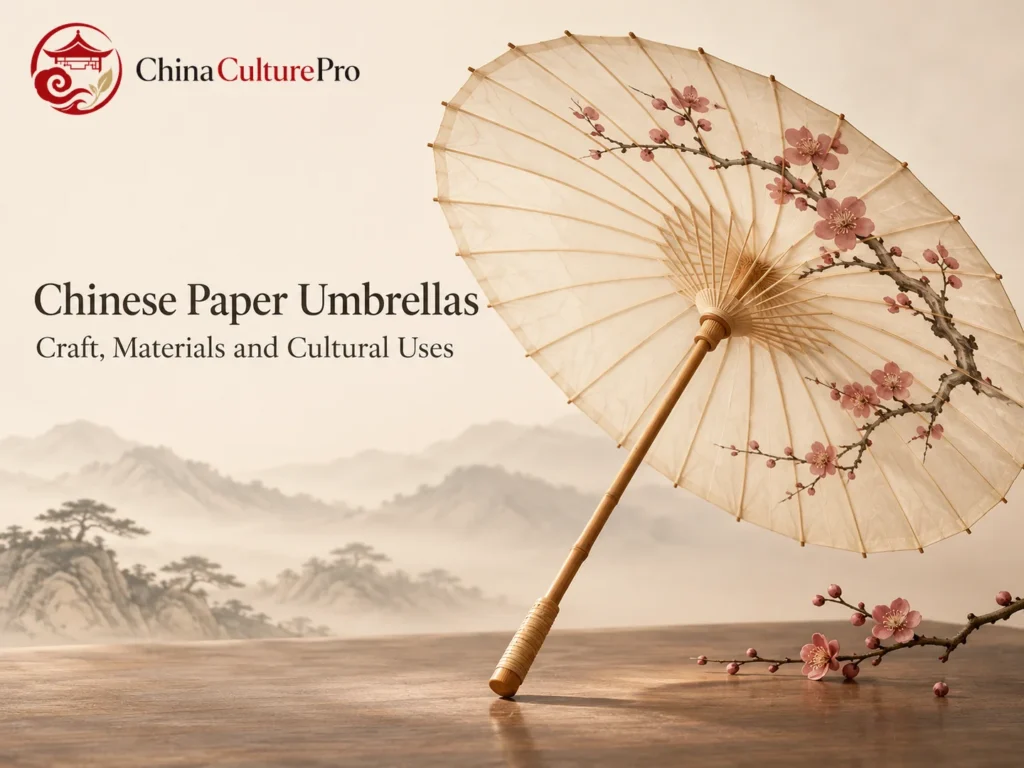
A Chinese oil-paper umbrella (油纸伞, yóuzhǐsǎn) is a folding umbrella with a treated paper canopy, typically on a bamboo frame. Ribs support the opened paper, while an oil treatment helps the canopy shed water. Some examples are painted or made for ceremonial display.[1][2][4][5]
- Frame: Ribs open around a central shaft.
- Canopy: The attached paper forms a continuous cover.
- Finish: Oil treatment and decorative painting do different jobs.
The materials, finish and intended use can vary across workshops.

When an oil-paper umbrella opens, its folds give way to a broad surface supported by slender ribs. That movement shows how the frame and the paper work together. The coating and painted design tell two more parts of the story.
Bamboo Ribs, Paper Canopy and Tung Oil
| Part or material | What it does |
|---|---|
| Bamboo ribs | Support the spread of the canopy and fold inward when the umbrella closes. |
| Paper canopy | Makes the covering surface and can carry a painted image. |
| Tung oil (桐油, tóngyóu) | Treats the paper surface to help it resist water. |
In bamboo weaving, strips can make the entire surface. In an umbrella, the bamboo generally provides a skeleton under a separate canopy. The upper surface shows the paper and finish. The underside reveals the distribution of the ribs and where the paper rests on them.[2][4]
Paper and oil affect different parts of the result. The paper has to cover the spaces between ribs without leaving gaps. A treatment changes how its surface responds to water. A painted image can follow the shape of the canopy, but its color alone tells you little about the coating underneath or over it.[4][5]
How the Frame and Canopy Are Assembled
A frame starts with the shaft and moving ribs. Moving parts connect the ribs to the central shaft so they spread together when the umbrella opens. Workshop records then describe attaching and trimming the paper, treating the canopy and letting the finish dry. That sequence describes separate jobs. Workshops can vary in how they organize and finish them.[3][4][5]
An umbrella has to fold as well as open. The paper needs to move with the ribs, and its edge has to keep the shape when the frame opens. The result brings several types of work together, as in other Chinese traditional crafts. The frame controls the motion, while the paper needs enough flexibility to follow the ribs as they close.[3][4]
A field study of Yuhang (余杭, Yúháng), Zhejiang, describes overlapping paper layers and a thicker area near the top, where the canopy folds closely. The study describes a thinner edge that makes the canopy easier to gather as it closes. If you look through the open canopy, changes in thickness can affect how much light reaches the underside.[4]
Fenshui and Yuhang Umbrella Traditions
The Fenshui (分水, Fēnshuǐ) tradition in Luzhou, Sichuan, was entered in China’s national intangible cultural heritage inventory in 2008. The local records list bamboo, paper and tung oil among the materials. They also mention edging and binding as distinct parts of the work.[1][2][3]
The Yuhang study describes dividing umbrella work between the frame and the paper covering. It also records the formation of a local cooperative in 2006 and inclusion on Zhejiang’s provincial list in 2007. Experienced makers gathered to restore production and teach learners, an example of protecting living heritage.[4]
The same study describes umbrella shops buying prepared frames from specialist workshops and covering them with paper. A finished umbrella could therefore bring together work from more than one shop. This also helps explain why restoring the craft involved bringing together people who knew different parts of it.[4]
Everyday Shelter, Wedding Use and Display
Oil treatment helped make the paper canopy useful for shelter. A painted umbrella can also be presented as a display object. Read the materials and the intended use together, since a similar silhouette can appear on a lightweight decorative piece or a working umbrella.[1][4]
In Meinong (美浓, Měinóng), Kaohsiung, the local Hakka (客家, Kèjiā) cultural authority records a custom of including paper umbrellas in wedding gifts. It also describes a red umbrella held over a bride in one form of the ceremony. The account describes local wedding practices and associated wishes for the couple.[5]
The Meinong account also links paper umbrellas to everyday shade and rain shelter. The same kind of object can move between daily use and ceremony. For a displayed umbrella, look for details that identify the occasion, such as a wedding account or information supplied by the maker.[5]
FAQs About Chinese Paper Umbrellas
Can an oil-paper umbrella be used in the rain?
Working oil-paper umbrellas were used for shelter from rain. An individual umbrella’s condition, construction and intended use determine how it can be used.
Is every paper umbrella coated in oil?
Paper describes the canopy material. An oil-paper umbrella has a treated paper canopy. A paper shade made for decoration may use a different finish.
Are Chinese paper umbrellas always red?
Red appears in some ceremonial settings. Other designs can use lighter paper, different colors and painted motifs.
Is an oil-paper umbrella the same as a silk parasol?
An oil-paper umbrella uses treated paper for the cover. A silk parasol has a fabric cover. Both may have a folding frame, while the materials and intended uses can differ.
Sumber
[1] Museum Digital Warisan Budaya Takbenda Tiongkok. Umbrella Making: Oil-Paper Umbrella Making Techniques
[2] China Intangible Cultural Heritage Digital Museum. Keeping the Oil-Paper Umbrella in the Rain Lane
[3] Sichuan Intangible Cultural Heritage Protection Center. Umbrella Makers of the Old Street
[4] Xue Yannian. Transmission and Culture of Yuhang Paper Umbrella Making
[5] Kaohsiung City Government Hakka Affairs Commission. Hakka Arts: Oil-Paper Umbrellas