


Quick Answer: Did Chinese Mariners Sail Overseas Before Zheng He?
Yes. Chinese sailors, merchants and envoys crossed Asian seas before Zheng He (郑和, Zhèng Hé) led the Ming voyages in the early fifteenth century. Song and Yuan ships traded with Southeast Asia, and by the Yuan period written records also place Chinese vessels in southern Indian waters. [2][5][8]
- Tang: Foreign vessels already carried Chinese ceramics through Southeast Asian waters.
- Song: Ports and shipyards supported regular seaborne trade, attested by wrecks and cargoes.
- Yuan: Envoys and merchants sailed into the Indian Ocean well before the Ming fleets. [1][2][3][5][8]
The origin of a cargo is one clue. The ship that carried it and the people who sailed it require separate evidence. [1][5]
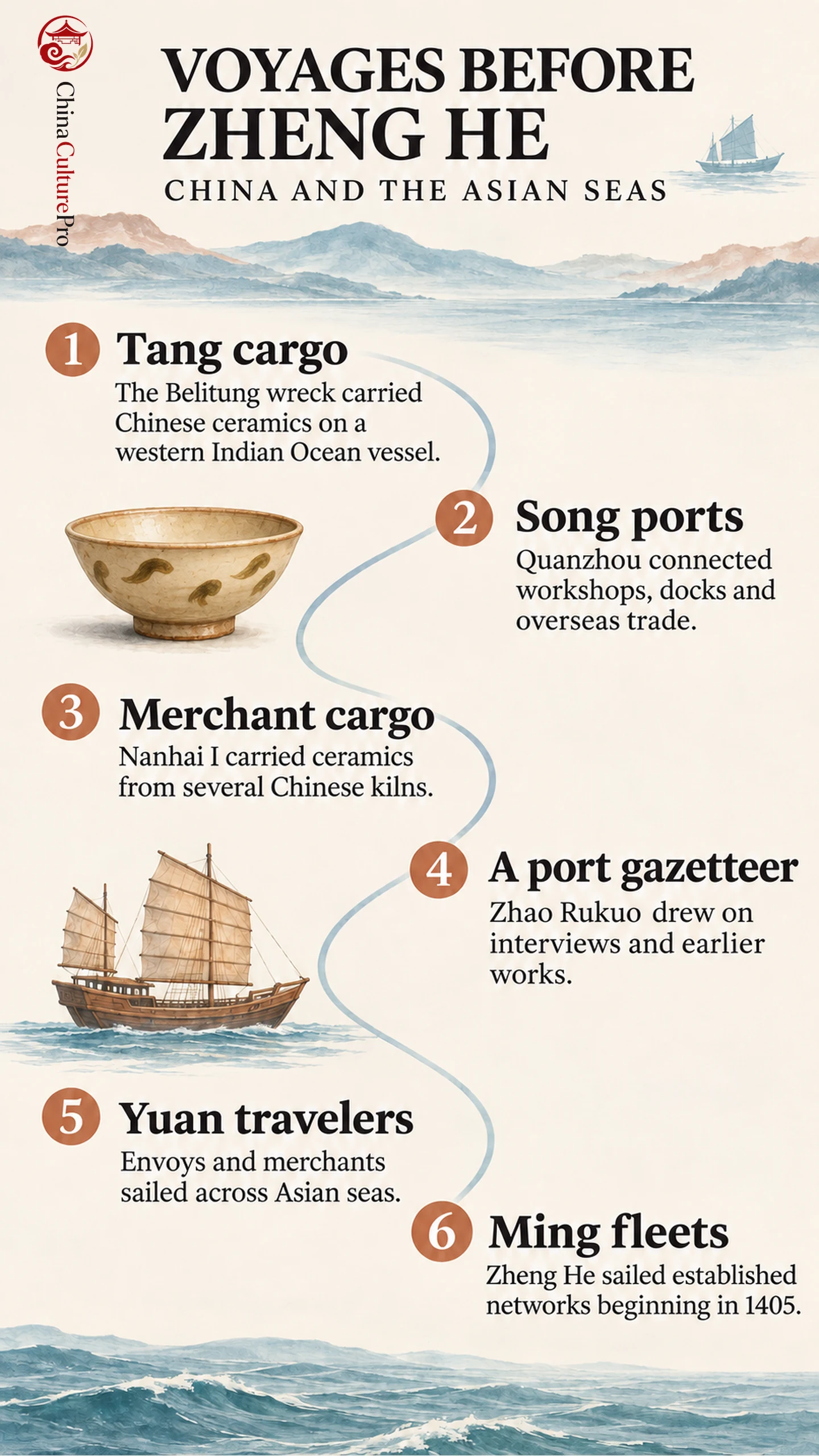
A hull, a customs official’s book and a traveler’s account preserve different parts of the story. Put together, they explain how Chinese goods moved long before the Ming voyages and how Chinese-operated ships became more visible in the same waters.
What Tang Cargoes Reveal About Early Routes
A ninth-century shipwreck found off Belitung, Indonesia, carried tens of thousands of Tang ceramics. The wooden planks of the hull had been sewn together. The Asian Civilisations Museum identifies that construction with the Persian Gulf or western Indian Ocean. The ceramics and the ship thus point to different places of manufacture. [1][5]
The wreck helps explain why the maritime Silk Road is best understood as overlapping routes. A ship might load in one port, carry goods from many workshops and stop in waters controlled by a third society. In this case, Chinese workshops supplied the export goods and a vessel built in a western Indian Ocean tradition transported them. [1][5]
How Song Ports and Ships Supported Ocean Trade
By the Song period, Quanzhou (泉州, Quánzhōu) linked kilns, iron production sites, inland transport and coastal docks. Its maritime trade office handled overseas commerce. The port also supported shipbuilding, repairs and the recruitment of crews. Those services allowed merchants to use the harbor as a base for repeated voyages. [2][3]
The Southern Song merchant wreck Nanhai I (南海一号, Nánhǎi yī hào), found off Guangdong, carried ceramics from several producing regions, as well as metal goods and objects used aboard. Its cargo brought together products from kilns including Longquan, Jingdezhen and Dehua. The Guangdong Museum describes a departure from Quanzhou and passage through Southeast Asia as a preliminary reconstruction. [4]
A separate, late thirteenth-century vessel excavated in Quanzhou Bay had compartments holding pepper, aromatic woods and other imports. Some goods could have passed through several markets. Their presence reveals what reached a Chinese port, while the hull preserves physical evidence of how a vessel was divided for ocean trade. [2][5]
Written evidence has its own limits. Quanzhou trade official Zhao Rukuo (赵汝适, Zhào Rǔkuò), also known as Zhao Rugua, compiled the Zhufan zhi (诸蕃志, Zhūfān zhì) around 1225. Its descriptions of overseas markets combine interviews and earlier Chinese works. An entry tells readers what could be learned in a port city without establishing that its author sailed there. [5][6]
Where Yuan-Era Travelers and Envoys Went
One Yuan mission had to change course after encountering difficult winds. The dynastic history records that envoy Yang Tingbi (杨庭璧, Yáng Tíngbì) sailed from Quanzhou in 1281. According to Tansen Sen’s analysis, difficult winds near Sri Lanka led sailors to recommend an emergency landing in Ma’bar, on the southeastern coast of India. Such a detour shows why a named destination and an actual course are different pieces of evidence. [2][8]
In the 1330s, Wang Dayuan (汪大渊, Wāng Dàyuān) sailed with merchants. His account appeared in a local gazetteer in 1349 and was published separately the following year as Daoyi zhilüe (岛夷志略, Dǎoyí zhìlüè). His entries on Longyamen and Banzu, places associated with present-day Singapore, describe different settlements in the same maritime area. Elsewhere he reports an attack on Temasek. The entries combine observations about local life with reports of events. [2][7]
The Moroccan traveler Ibn Battuta reported seeing Chinese ships at Calicut on India’s Malabar coast in the fourteenth century. Read alongside the Yuan record, his account shows that contacts with India included ordinary shipping as well as voyages commissioned by a court. [2]
What Zheng He Inherited and Changed
When Zheng He set out in 1405, ports and sea routes already linked Southeast Asia to South Asia. Earlier travelers had used those connections for trade, diplomacy and religious study. The Ming court concentrated maritime resources in repeated official expeditions, with large fleets able to negotiate or use force far from home. Their scale and political reach are part of what made them distinctive. [2][5][8]
The Yuan court also sent armed fleets overseas, including the expedition against Java in 1292–1293. That history makes the Ming voyages part of a longer use of fleets in foreign affairs. The Ming court made repeated long-distance voyages part of its diplomatic policy. [2][8]
FAQs About Chinese Maritime Voyages Before Zheng He
Did Chinese ships reach India before Zheng He?
Yes. A Yuan-era account records the mission of Yang Tingbi reaching southern India, and Ibn Battuta reports seeing Chinese vessels at Calicut in the fourteenth century. [2][8]
Does Chinese pottery found abroad prove that a Chinese ship carried it?
No. The Belitung wreck carried Tang ceramics on a vessel built in a western Indian Ocean tradition. Hull construction and written evidence can help identify vessels independently of the goods they carried. [1][5]
Were the earlier voyages all official expeditions?
No. Merchant shipping, travelers moving aboard commercial vessels and court missions were distinct kinds of activity. Wang Dayuan traveled with merchants, while Yang Tingbi sailed as an envoy. [2][7][8]
Sumber
[1] Asian Civilisations Museum. The Tang Shipwreck: Art and Exchange in the 9th Century
[2] Tansen Sen. Maritime Interactions between China and India: Coastal India and the Ascendancy of Chinese Maritime Power in the Indian Ocean
[3] UNESCO World Heritage Centre. Quanzhou: Emporium of the World in Song–Yuan China
[4] Guangdong Museum. The Route of the Sea: Nanhai I Shipwreck and Maritime Trade in the Southern Song Dynasty
[5] Derek Heng. Southeast Asia–China Economic Interactions in the Late First to Mid-Second Millennium C.E.: Narrative, Sources, and Pedagogical Objectives
[6] Zhao Rukuo, translated by Shao-yun Yang. A Chinese Gazetteer of Foreign Lands: A New Translation of Part 1 of the Zhufan zhi
[7] Lee Meiyu, National Library Board, Singapore. Tales of the Dragon’s Tooth Strait
[8] Qu Jinliang. The Chinese Fleets in the Indian Ocean (13th–15th Centuries)