


Quick Answer: Who Was Zheng He?
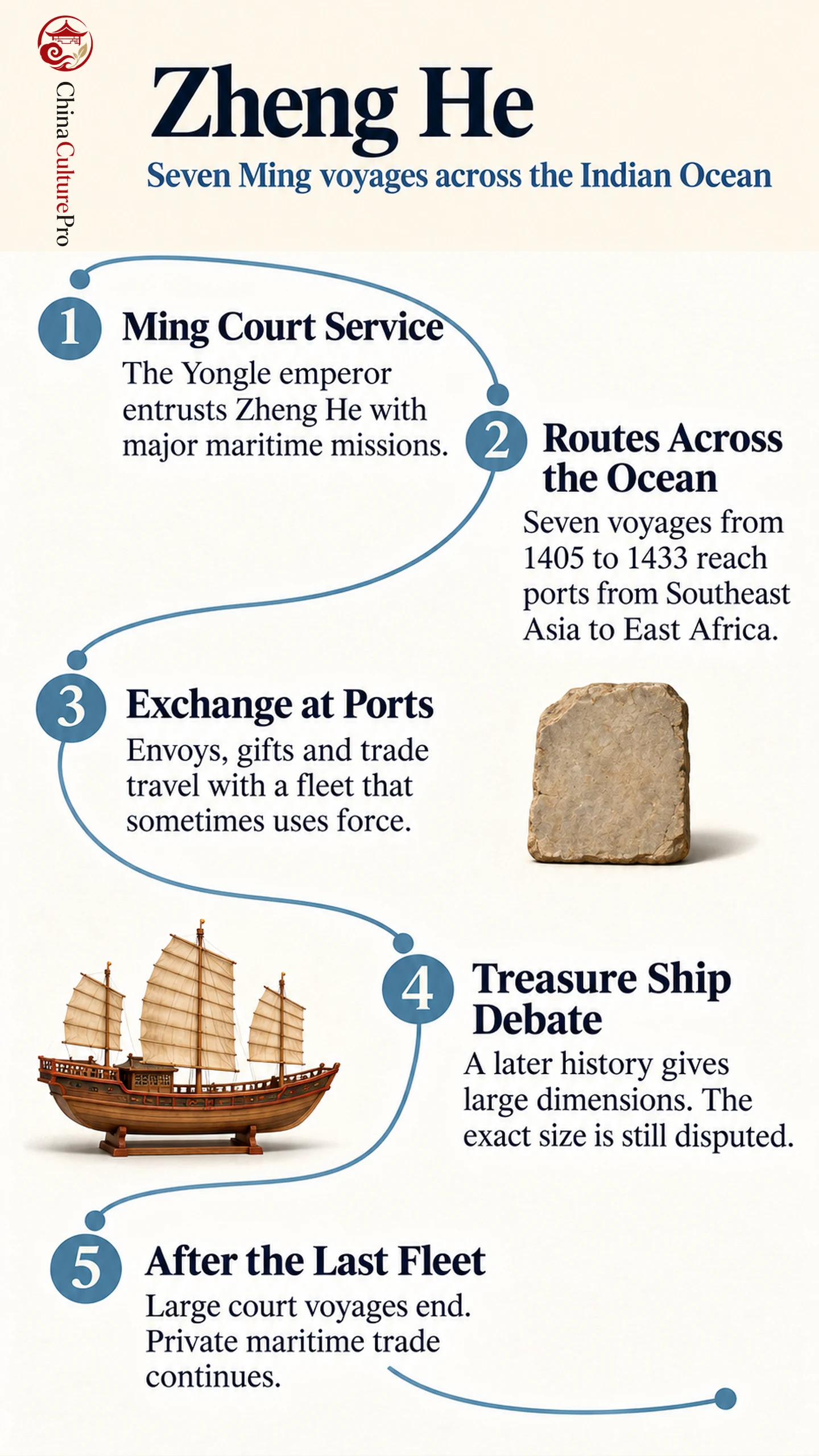
Zheng He (郑和, Zhèng Hé) was a Ming court eunuch and commander who led seven maritime expeditions between 1405 and 1433. His fleets sailed from China to ports across Southeast Asia and the Indian Ocean, reaching the Persian Gulf and the East African coast.[1][2][3]
- Dates: The first voyage sailed in 1405. The last expedition returned in 1433.
- Routes: Calicut was a recurring stop. Later voyages reached farther west, including Hormuz and ports in East Africa.
- Purpose: The fleet carried envoys and gifts, traded, and sometimes used force.
- Evidence: Inscriptions and written accounts document many of its activities. The exact size of its largest ships is disputed.[1][2][3][5][7][8]
These voyages were court-sponsored missions in waters where merchants and envoys already traveled.
A stone tablet found in Sri Lanka gives a close view of the world Zheng He sailed through. It carries Chinese, Tamil and Persian inscriptions and refers to religious offerings. The sailors who brought it were acting on behalf of the Ming court in a port region with its own merchants, languages and sacred sites.[3][5]
From Yunnan to the Ming Court
Born around 1371, Zheng was originally named Ma He (马和, Mǎ Hé) to a Muslim family in what is now Yunnan. Ming troops captured him as a boy, and he was made a eunuch and placed in court service. His position brought him into the service of the future Yongle emperor (永乐, Yǒnglè). After taking the throne, Yongle entrusted him with large expeditions that combined diplomacy and the projection of court power.[1][2]
The voyages were a project of the Ming dynasty. The court furnished ships, crews, envoys and goods. A commander had to bring the vessels to their destinations and negotiate with rulers on behalf of the emperor. Those duties help explain why the court put a trusted officer in charge.[1][3]
Where the Seven Voyages Went
The early expeditions reached Southeast Asia and the southwest coast of India. Malacca, now Melaka in Malaysia, lay on an important passage between the South China Sea and the Indian Ocean. Ming contact with its ruler was already under way before Zheng He’s first fleet left in 1405. Calicut, now Kozhikode in India, served as a recurring stop on the Malabar Coast.[1][2][4][6]
The fourth expedition reached Hormuz near the mouth of the Persian Gulf. Later voyages included ports on the East African coast, including Malindi. Routes varied by expedition, and ships could split into groups. A place reached by one contingent does not tell us exactly where Zheng He was at the time.[1][2][3]
The last fleet departed in 1431 under the Xuande emperor (宣德, Xuāndé) and returned in 1433. The voyages followed and strengthened connections across the Maritime Silk Road, including links between ports where merchants had long exchanged goods.[1][2][3][9]
Diplomacy, Trade and Force
The Ming court recorded some exchanges as tribute. Foreign envoys could present gifts at court and receive gifts in return. Merchants at the ports had commercial interests of their own. Ma Huan (马欢, Mǎ Huān), an interpreter who traveled with the fleet, described markets and trading practices. His account helps show how the expeditions encountered local economies, including the trade in pepper and other goods at Calicut.[1][3][6]
The Sri Lankan tablet bears a date in 1409. The fleet brought it to the island during the third voyage. Its three inscriptions address Buddhist, Hindu and Islamic religious contexts. It is a surviving object from an expedition, as distinct from the accounts written about the voyages. Its languages and offerings show how a Ming mission could act in a setting with several traditions.[5]
These contacts also involved coercion. In Sri Lanka, the fleet fought the kingdom of Kotte and took its ruler to China. Galle’s record of offerings and the fighting in Kotte show how different actions could occur during the same expedition.[3][5][10]
What We Know About the Treasure Ships
The term treasure ships (宝船, bǎochuán) refers to ships associated with these imperial expeditions. The fleets had different vessels and carried crews, provisions, cargo and envoys. Ships prepared for different jobs would have needed different capacities.[1][7][8]
The often-repeated claim of a ship about 450 feet, or 137 meters, long comes from converting dimensions in a dynastic history compiled centuries later. Scholars have questioned those figures and examined them against other texts, shipbuilding evidence and the practical constraints of large wooden vessels. Archaeological evidence has yet to settle the dimensions of the largest vessels. An illustration can suggest the form of a sailing ship without establishing its actual scale.[7][8]
Why the Expeditions Ended
The court did not mount another expedition on this scale after the seventh voyage. Accounts generally place Zheng He’s death around the last expedition, although its exact circumstances are uncertain.[2][9] Changing imperial priorities, the costs of outfitting the fleets and tensions over how court revenues were used help explain the decision. Support changed as the throne passed from one emperor to another. An expedition could advance an emperor’s diplomacy while competing with other demands on state revenues.[1][9]
Private shipping continued as the large state expeditions ended. Maritime trade and the circulation of goods such as Chinese porcelain belonged to networks that extended beyond the fleet. Among Chinese historical figures, Zheng He offers a way to connect the decisions of an imperial court with the activity of people in ports across the Indian Ocean and with the wider history of China.[3][6][9]
FAQs About Zheng He
How many voyages did Zheng He lead?
He led seven Ming expeditions. The first sailed in 1405, and the final fleet returned in 1433.[1][2]
Did Zheng He reach Africa?
The expeditions under his command reached ports on the East African coast, including Malindi. The movements of individual ships and their crews differed within a voyage.[1][2][3]
How large were Zheng He’s treasure ships?
The largest ships are often described as about 450 feet long, based on measurements in a later history. Historians dispute that figure, and the dimensions of the largest ships remain uncertain.[7][8]
Sumber
[1] Columbia University Asia for Educators. The Ming Voyages
[2] The Mariners’ Museum and Park. Zheng He
[3] Bulletin of the School of Oriental and African Studies. The Impact of Zheng He’s Expeditions on Indian Ocean Interactions
[4] Institute of Southeast Asian Studies. The Opening of Relations between China and Malacca
[5] UNESCO Memory of the World. Trilingual Inscription
[6] California History–Social Science Project at UC Davis. Sites of Encounter in the Medieval World: Calicut
[7] Monumenta Serica. Zheng He: An Investigation into the Plausibility of Large Treasure Ships
[8] The British Museum. Investigating Zheng He’s Ships: What Is Known and Knowable?
[9] Journal of Chinese History. The Cessation of Zheng He’s Voyages and the Beginning of Private Sailings
[10] The Making of the Modern Chinese Navy. The Ming–Kotte War in Southeast Asia