


Quick Answer: Who Was Sun Yat-sen?
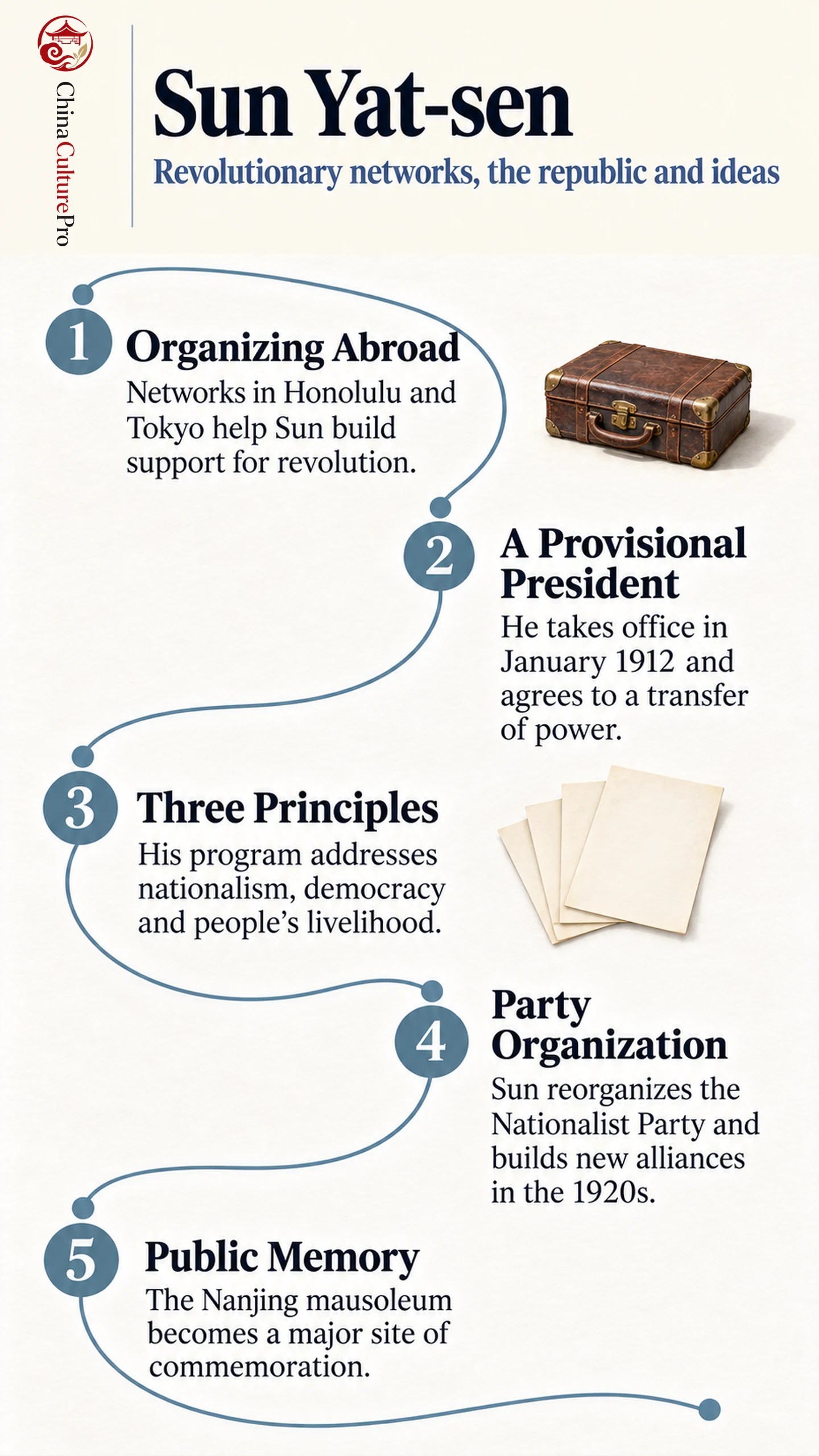
Sun Yat-sen (孙中山, Sūn Zhōngshān) was a revolutionary organizer and the first provisional president of the Republic of China in 1912. He built support for replacing the Qing monarchy and developed a political program based on nationalism, democracy and people’s livelihood.[1][2][3][4][5]
- Networks: He organized in China and abroad, drawing support from overseas communities.
- Presidency: He took office at Nanjing in January 1912 and agreed to a transfer of power during negotiations over Qing abdication.
- Ideas: His program addressed political independence, popular authority and economic welfare.
- Ingatan: Museums, monuments and political institutions have emphasized different parts of his career.[1][2][3][4][5][7][8]
His revolutionary activity lasted decades. His provisional presidency was only one short part of it.
Sun Yat-sen’s career moved between meeting rooms abroad, a provisional government at Nanjing and later party headquarters in southern China. These settings help explain the different things he could do. Raising support for a movement, negotiating a transfer of government and presenting a program for a future state called for different kinds of authority.[1][2][3][6]
From Medical Training to Revolutionary Organizing
Sun was born in Guangdong in 1866. He spent part of his youth in Hawaiʻi and graduated from the Hong Kong College of Medicine for Chinese in 1892. His time overseas connected him with communities in which political ideas, news and money could move between China and other places. Those connections later helped him organize and raise funds.[1][2]
In 1894 he founded the Revive China Society (兴中会, Xīngzhōnghuì) in Honolulu. In 1905 he helped form the Tongmenghui (同盟会, Tóngménghuì) in Tokyo. The Honolulu society and the Tokyo alliance worked on different scales. Both show how expatriate meetings, fundraising and communication could support a movement active in China. The history of Chinese diaspora communities helps explain how such networks operated across borders.[1][2]
Sun’s supporters organized a failed rising at Huizhou in 1900. That year the Qing also faced foreign intervention during the Boxer Rebellion. The two movements had different aims, and both belong to the crises through which the late Qing court tried to retain power.[9][10]
The Revolution and the Provisional Presidency
The Wuchang Uprising in October 1911 set the Xinhai Revolution in motion. Sun was abroad when it began. Local military and political groups drove the early revolt. Provincial declarations of independence then widened the break with the Qing dynasty. Sun returned and was chosen as provisional president. He took office at Nanjing in January 1912.[1][3][4]
The provisional government did not control all the forces that could determine the outcome. Yuan Shikai (袁世凯, Yuán Shìkǎi) had influence over the northern army and the Qing court. Sun agreed to step aside in the negotiations that accompanied the abdication of Puyi and Yuan’s rise to the presidency. This was a transfer within a provisional political settlement. Yuan’s military position and the southern revolutionaries’ claim to a republic both mattered to its outcome.[1][3][4]
The Three Principles of the People
Sun’s Three Principles of the People (三民主义, Sānmín Zhǔyì) are commonly rendered as nationalism, democracy and people’s livelihood. They gave the revolutionary movement a program beyond the removal of the monarchy. The principles addressed how to organize a political community, how people might exercise power and how government might improve material conditions.[1][5]
Sun continued developing the ideas after the republic was founded. His lectures in 1924 are a source for how he explained them late in his life. In his discussion of democracy, he described recall as a way for people to remove an officeholder. The example shows that he was thinking about how citizens could exercise authority between elections as well as how leaders would be selected. The lecture describes a program he wanted to establish.[5]
Building a Party and a New Government
Sun remained politically active after leaving the provisional presidency. The republic faced military competition and disputes over who should control its institutions. He organized from southern China and worked to strengthen the Kuomintang (国民党, Guómíndǎng), also known as the Nationalist Party.[1][6]
The party reorganized in the 1920s. Sun sought Soviet assistance and accepted cooperation with Chinese Communists during this phase. The agreement brought expertise and new participants into the effort to build a party able to organize beyond a single city. Its members and successors later took different paths. Sun died in 1925, before his successors launched the Northern Expedition.[1][6]
How Sun Yat-sen Is Remembered
Sun’s mausoleum at Nanjing became a major site of commemoration after his death. The ceremony transferring his remains there in 1929 brought the party’s public image of its founder into a space built for commemoration. Other sites emphasize his years in Hong Kong, Hawaiʻi or the communities where he raised support. Different political institutions across the Taiwan Strait also incorporated his image into their own commemorative traditions.[1][2][7][8]
Sun Yat-sen and Sun Zhongshan refer to the same historical person. The different forms of his name are one reason that readers may meet him under several labels in accounts of Chinese historical figures. A guide to regional romanization of Chinese names gives context for why English-language names can vary.[1][2]
FAQs About Sun Yat-sen
Was Sun Yat-sen the first president of the Republic of China?
He was its first provisional president and took office at Nanjing in January 1912. Yuan Shikai succeeded him during the early transition from Qing rule.[3][4]
What are the Three Principles of the People?
They are nationalism, democracy and people’s livelihood. Sun developed them as a program for political independence, popular authority and the material welfare of the population.[1][5]
Was Sun Yat-sen at the Wuchang Uprising?
He was abroad when the uprising began in October 1911. He returned to China after the revolt spread and was selected as provisional president.[1][2][3]
Sumber
[1] Hong Kong Museum of History. Building a Statue to Remember: The Life of Dr Sun Yat-sen
[2] University of Hawaiʻi at Mānoa Library. Sun Yat-sen, Hawaiʻi and the Chinese Revolution
[3] United States Department of State Office of the Historian. The Chinese Revolution
[4] Academy of Chinese Studies. The Establishment of the Republic of China
[5] Columbia University Asia for Educators. The Principle of Democracy
[6] Cambridge University Press. The Nationalist Revolution in China
[7] China Heritage. Enshrining the Father of the Republic
[8] Asia Review. A Comparative Study on the Commemoration of Sun Yat-sen across the Taiwan Strait
[9] Dr Sun Yat-sen Museum. Getting to Know Dr Sun Yat-sen
[10] United States Department of State Office of the Historian. Secretary of State John Hay and the Open Door in China