


Quick Answer: How Did Chinese Words Enter English?
English has borrowed words from several Chinese language varieties, sometimes through other languages. A Chinese origin does not mean that the English spelling reproduces modern Mandarin pinyin.[8]
- Check the variety: A Cantonese source and a Mandarin source can produce different English-looking forms.
- Check the route: The language that transmitted a word need not be its ultimate source.
- Check the sense: An established English word can develop a meaning different from its Chinese ancestor.
Use a word’s history to explain it, then read its present English meaning in context.
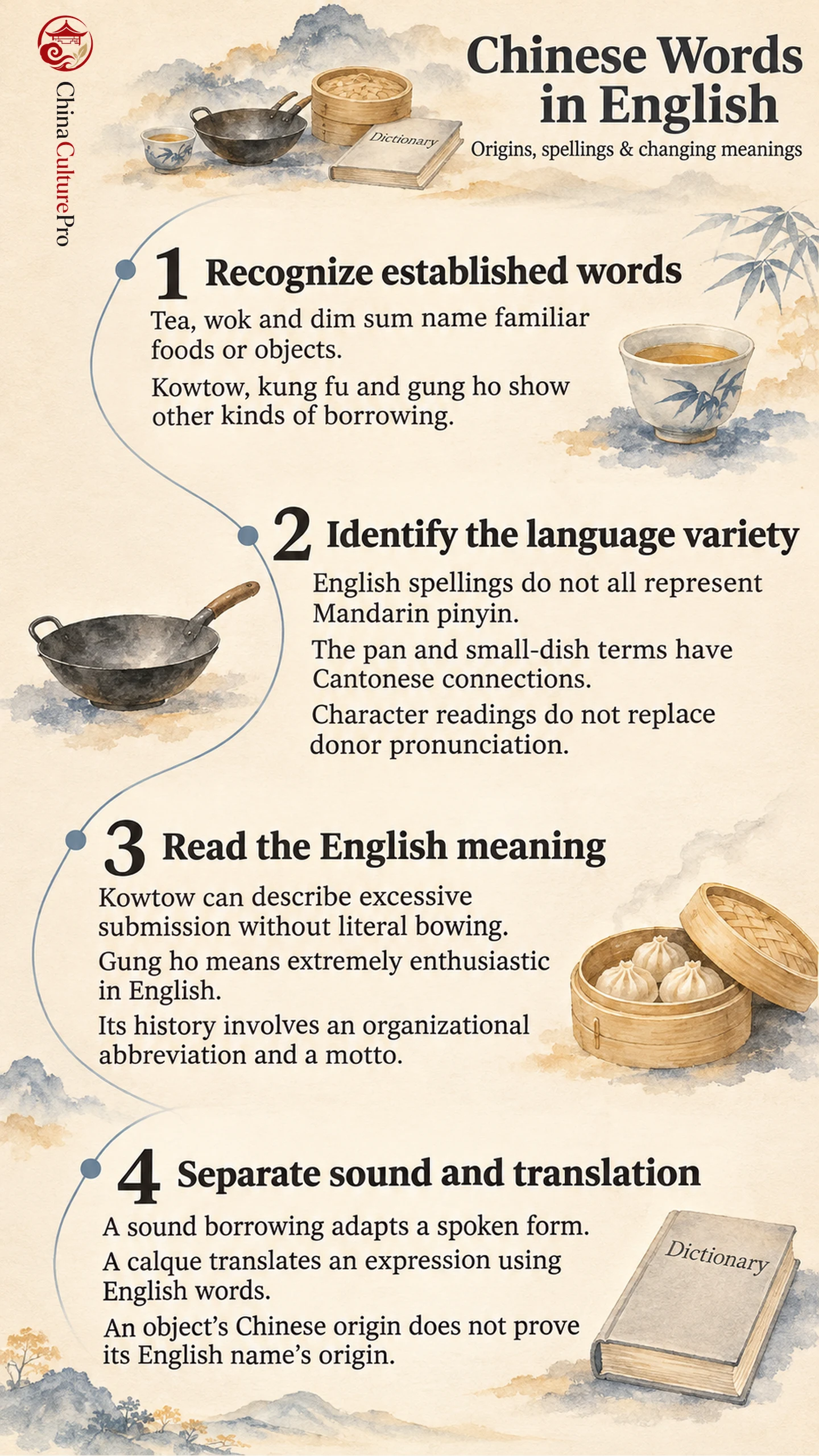
A familiar borrowed word can have a complicated history. Food names, cultural terms and descriptions of behavior may have arrived at different times through different communities.
The examples below are a small documented set, not a claim to list every Chinese contribution to English. The broader Chinese languages and dialects guide explains why identifying the actual language variety matters.
Recognize Six Established Borrowings
The character readings in this table are labelled Mandarin for identification. They are not offered as Cantonese or Xiamen pronunciations, and they do not replace English pronunciation.
| English word and Chinese connection | Meaning in English |
|---|---|
| tea (茶, chá in Mandarin) | The drink made from tea leaves. |
| wok (鑊, huò in Mandarin) | A deep cooking pan associated with Chinese cooking. |
| dim sum (點心, diǎn xīn in Mandarin) | Small dishes in a Cantonese dining tradition. |
| kowtow (叩头, kòu tóu in Mandarin) | To bow deeply, or figuratively to submit excessively. |
| kung fu (功夫, gōng fu in Mandarin) | Chinese martial arts in a common English use. |
| gung ho (工合, gōng hé in Mandarin) | Extremely enthusiastic. |
The drink name traces to a Xiamen Chinese form, while the pan and small-dish terms have Guangdong/Cantonese connections.[1][2][3]
The other three demonstrate that a borrowing can name an action, an art or an attitude, rather than only an imported object.[4][5][6]
The dim sum guide explains the dining tradition behind that food term. Its etymology alone is not a menu or a complete account of the meal.
Why the Spellings Do Not All Match Mandarin
A spelling based on one Chinese variety should not be judged against another variety’s modern romanization. The Cantonese-connected pan name is a useful example: its English form is not an attempted spelling of the Mandarin character reading huò.[2]
Likewise, the small-dish term reflects a Guangdong pronunciation rather than the Mandarin diǎnxīn shown for character identification. The Mandarin and Cantonese comparison gives the larger language context.[3]
A short dictionary etymology may identify an ultimate Chinese source without describing every trade contact or intermediate language. Distinguish those questions, and avoid turning one word’s route into a universal rule for all borrowings.[7]
English spelling also belongs to English once a word is established there. Its difference from pinyin is not automatically a transcription error that a writer should correct.
How Meanings Change After Borrowing
Kowtow can describe a physical act of bowing, but its English figurative use describes excessive submission. An accusation that someone kowtows to a powerful person need not mean that any kneeling happened.[4]
Kung fu illustrates a narrower common English association with martial arts, while its Chinese source is connected with skill or art. For distinctions between modern sporting terminology and wider practice, see wushu and kung fu.[5]
Gung ho needs particular care. It entered English through a military motto associated with the abbreviated Chinese name of the Chinese Industrial Cooperative Society. The motto was interpreted as work together, but the Chinese organizational abbreviation is not simply an ordinary phrase meaning that. The English adjective developed the sense of extreme enthusiasm.[6]
For example, an English description of someone as gung ho about a project comments on enthusiasm. It does not identify that person as a member of the original cooperative movement. This is a teaching illustration, not a historical quotation.[6]
Distinguish a Loanword from a Translated Expression
Sound-based borrowing and a loan translation are different mechanisms. A loan translation, also called a calque, renders an expression through existing words in the receiving language. Paper tiger is an example discussed in Chinese–English borrowing research; its English words do not imitate the Chinese pronunciation.[7]
Keep the origin of an object separate from the origin of its English name. The fact that a product, practice or idea came from China is not enough to establish the name’s etymology. Some proposed word histories are disputed, so a longer internet list is not necessarily a stronger one.[7]
Contact also works in the other direction. English loanwords in Chinese describes how Chinese speakers adapt foreign vocabulary; that is a separate question from the six English words above.
FAQs About Chinese Loanwords in English
Are all Chinese loanwords in English from Mandarin?
No. The examples include different Chinese varieties, and some words have intermediate transmission histories. A modern Mandarin character reading is not proof of the original donor pronunciation.[7]
Does gung ho simply mean work together in Chinese?
No. Its English history involves a motto derived from an organizational abbreviation and interpreted that way. Treating the abbreviation as a normal Chinese translation loses that historical distinction.[6]
Does a word’s Chinese origin fix its modern English meaning?
No. English use can develop figurative or specialized senses. Read the English sentence first, then use etymology to explain the background rather than replace the current meaning.[4]
Sumber
[1] Merriam-Webster. Teh
[2] Merriam-Webster. Wok
[3] Merriam-Webster. Dim sum
[4] Merriam-Webster. Kowtow
[5] Merriam-Webster. Kung fu
[6] Merriam-Webster. Gung ho
[7] Ai Zhong, UCL. Chinese influence on the English lexicon
[8] University of Bath, Academic and Employability Skills. Where does your ketchup come from? 8 English words borrowed from Chinese