


Quick Answer: How Are Chiba and Shakuhachi Connected?
Chiba (尺八, chǐbā) is the Mandarin reading of the characters pronounced shakuhachi in Japanese. Early vertical flutes preserved in Japan document a connection to court music introduced from Tang China. The root-end bamboo instrument familiar from later Japanese shakuhachi music has its own forms and playing traditions.[1][2][3][4]
- Early objects: The Shōsōin repository in Nara preserves early examples of the flute.[1][2]
- Later form: Many Japanese shakuhachi have five finger holes and a blowing edge at the top of the tube.[3][4]
- Performance: Historical uses include court music and, in later Japan, solo and ensemble music.[1][4][5]
The shared name links historical forms that differ in construction and repertory.[1][2][3]
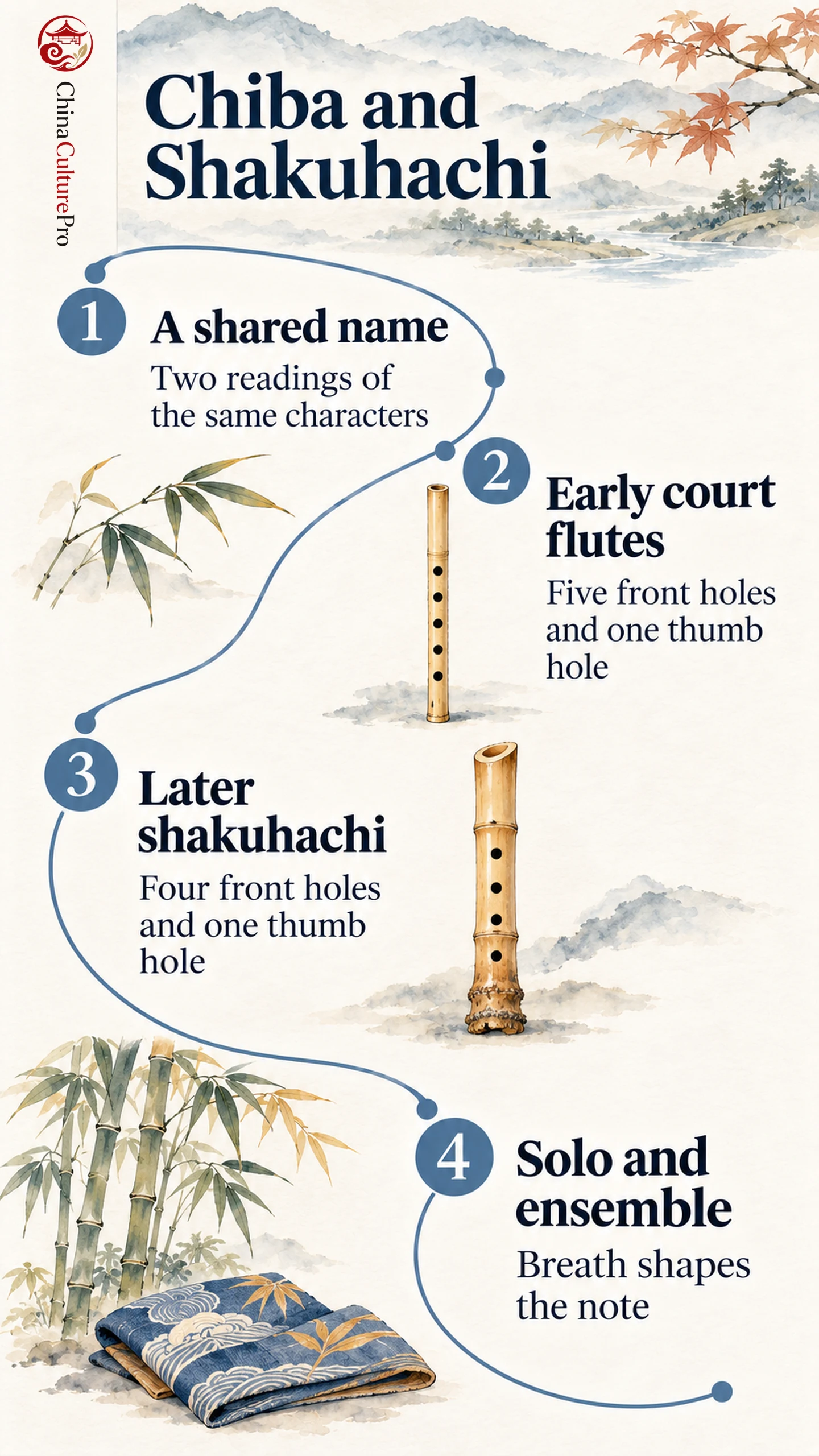
Two flutes can carry the same characters on a museum label and still have different hole patterns. The early court group from Nara and a Japanese instrument made a thousand years later give two points of comparison.
What the Nara Court Flutes Tell Us
Japan’s National Institutes for Cultural Heritage identifies a surviving vertical flute used in tōgaku, court performance introduced from Tang-dynasty China. Related instruments are held in the Shōsōin Imperial Repository at Nara. The European Shakuhachi Society describes the Shōsōin examples as having five front finger holes and a thumb hole.[1][3]
Shin-ya Akedo studied the pipe lengths and tuning systems of early flutes in the Shōsōin and at Hōryūji. He compared the surviving objects as individual pipes, using their dimensions and pitch relationships to examine provenance. Evidence for exchange between Chinese and Japanese court music leaves room for more than one origin or production date within the surviving group.[1][2]
How the Later Japanese Shakuhachi Is Built
A shakuhachi in the Metropolitan Museum of Art, object 89.4.126, is a nineteenth-century Japanese flute made of bamboo, horn and lacquer. It is 55.2 centimeters long. In a root-end design, the bottom section uses bamboo from near the base of the plant. A player directs air across the edge at the top of the tube.[4]
Many later Japanese models have four front finger holes and one thumb hole. A player can shade an opening or vary the angle of the breath to change the pitch or color of a note. The Chinese xiao offers a comparison because it is also a vertical edge-blown flute, though its own forms and repertories differ.[3][5]
From Court Music to Japanese Solo Repertory
The European Shakuhachi Society describes a gap in written records after the flute fell out of the Japanese court ensemble. In the Edo period, the Met associates a later shakuhachi form with the komusō of the Fuke tradition. The flute was also adapted for ensemble playing.[3][4]
One place to hear the later solo tradition is an instrument collection with recordings as well as objects. Grinnell College’s instrument record lists Kohachiro Miyata’s performance of Tsuru no Sugomori. Listen for the changing mix of pitch and audible breath within a phrase. In solo music, those changes can give a single note a shape of its own.[5]
FAQs About Chiba and Shakuhachi
Does shakuhachi name one standard length?
The name refers to one shaku and eight sun in Japanese units. Surviving flutes vary in length. The Met’s nineteenth-century flute measures 55.2 centimeters.[3][4]
Is the chiba another name for the xiao?
Both names can refer to vertical flutes. Museum catalogues use chiba or shakuhachi for instruments with a specific historical name. Xiao refers to Chinese flute traditions with their own forms and uses.[1][2][3]
Sumber
[1] National Institutes for Cultural Heritage, Japan. Vertical Flute (Shakuhachi)
[2] Shin-ya Akedo, Musicological Society of Japan. Temperaments of Early Shakuhachi Pipes
[3] European Shakuhachi Society. Shakuhachi History and Origins
[4] The Metropolitan Museum of Art. Shakuhachi, Object 89.4.126
[5] Grinnell College Musical Instrument Collection. Shakuhachi and Recording