


Quick Answer: What Are Yunluo Cloud Gongs?
The yunluo (云锣, yúnluó), or cloud gongs, is a Chinese percussion instrument made of small tuned gongs suspended in a frame. A player strikes different gongs to change pitch.[1]
- Material: The bronze gongs themselves vibrate when struck.[1]
- Arrangement: A traditional rack can hold ten gongs, each hung separately.[2]
- Range: Some modern orchestral sets have many more pitches.[5]
Read the collection label or score to learn the count and tuning of the set you are looking at.
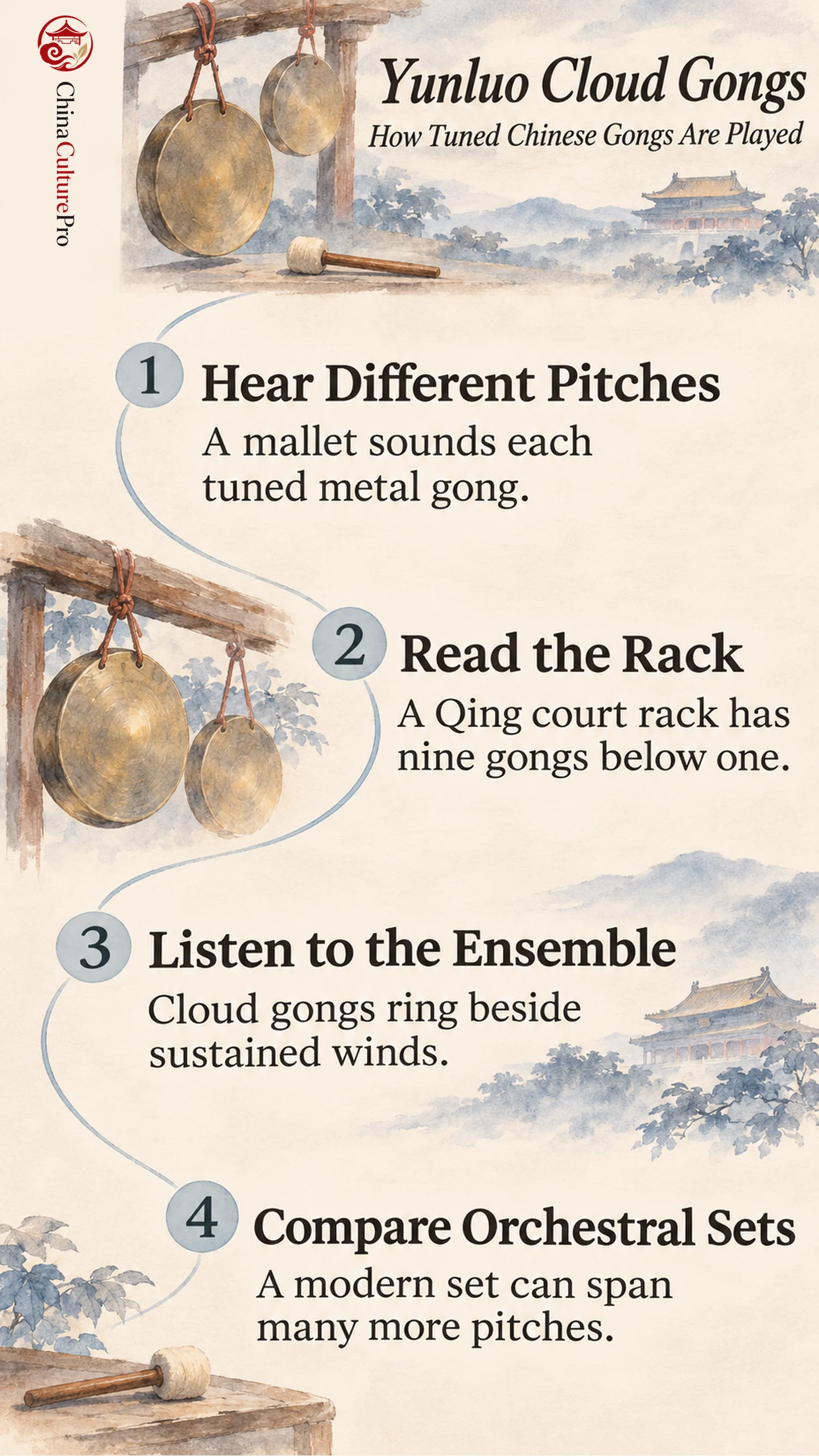
Cloud gongs share one rack, but the player can move from one note to another by striking a different disc. A photograph helps you see where the gongs hang. A recording reveals the part those notes play in an ensemble.
Why the Gongs Give Different Notes
The Met’s nineteenth-century yunluo consists of ten tuned bronze gongs. Their thicknesses differ, allowing discs that look similar across the rack to give different pitches. A small mallet sets each disc vibrating.[1]
The resonating material distinguishes cloud gongs from a tanggu drum, which sounds when its stretched head is struck. When listening to a percussion group, hear how the metal ring out after each hit. Compare the pitch with that of the next disc the player strikes.
Read the Rack Before the Tuning
The Draft History of Qing describes a court rack with three columns: four gongs in the center and three on either side. The extra center gong projects above the nine below it. The gongs hang on cords, and the text describes their order by thickness. It is one documented Qing dynasty arrangement.[2]
The late nineteenth-century writer J. A. Van Aalst noted differences in pitch between sets. Even in a rack that matches a familiar outline, the exact notes depend on its tuning. In paixiao panpipes, the length of each pipe can help explain pitch. On a yunluo, the thickness difference can be hard to see from the front.[6]
Hear the Gongs in Temple Music
The Smithsonian’s recorded Zhihua Temple (智化寺, Zhìhuà Sì) ensemble names Cai Zhenqi on yunluo. In the same performance, a drum and cymbals accompany the flute, double-reed pipe and sheng mouth organ. The sheng and yu guide explains the shared-chamber winds in that family.[3][4]
Use the program to identify the percussion, then listen for a ringing note with a distinct pitch among the sustained wind sounds. The Smithsonian lists the opening of “Zhong-Tang Qu” as the first section of the recording, a place to start hearing the ensemble together.[3]
How the Orchestral Set Changed
The Met describes expanded sets with 24 or more gongs and two mallets in the twentieth century. The Hong Kong Chinese Orchestra’s range table lists 37 gongs spaced in semitones for one orchestral setup. A wider array gives a composer more pitches to use within the percussion section.[1][5]
The name yunluo covers small racks and expanded orchestral sets among Chinese musical instruments. Look for the kind of ensemble or a stated range to see which layout a program has in mind.
FAQs About Yunluo Cloud Gongs
How many gongs does a yunluo have?
The nineteenth-century Met example has ten. The Hong Kong Chinese Orchestra documents an expanded 37-gong set.[1][5]
Can cloud gongs play a melody?
Yes. The gongs have distinct pitches, so the player can make a sequence of notes by striking different gongs.[1]
Are yunluo and tanggu both drums?
Yunluo consists of pitched bronze gongs. Tanggu is a drum with a stretched head.[1]
Sumber
[1] The Metropolitan Museum of Art. Yunluo, Cloud Gong, 89.4.15a
[2] Chinese Text Project. Draft History of Qing, Treatise 76
[3] Smithsonian National Museum of Asian Art. Buddhist Music from Zhihua Temple
[4] Beijing Municipal Government. Heritage Renewed, Values Shared: Jing Music of Zhihua Temple
[5] Hong Kong Chinese Orchestra. Instrumentation and Range Table
[6] J. A. Van Aalst. Chinese Music: Yun-lo