

Quick Answer: What Is the Tanggu Drum?
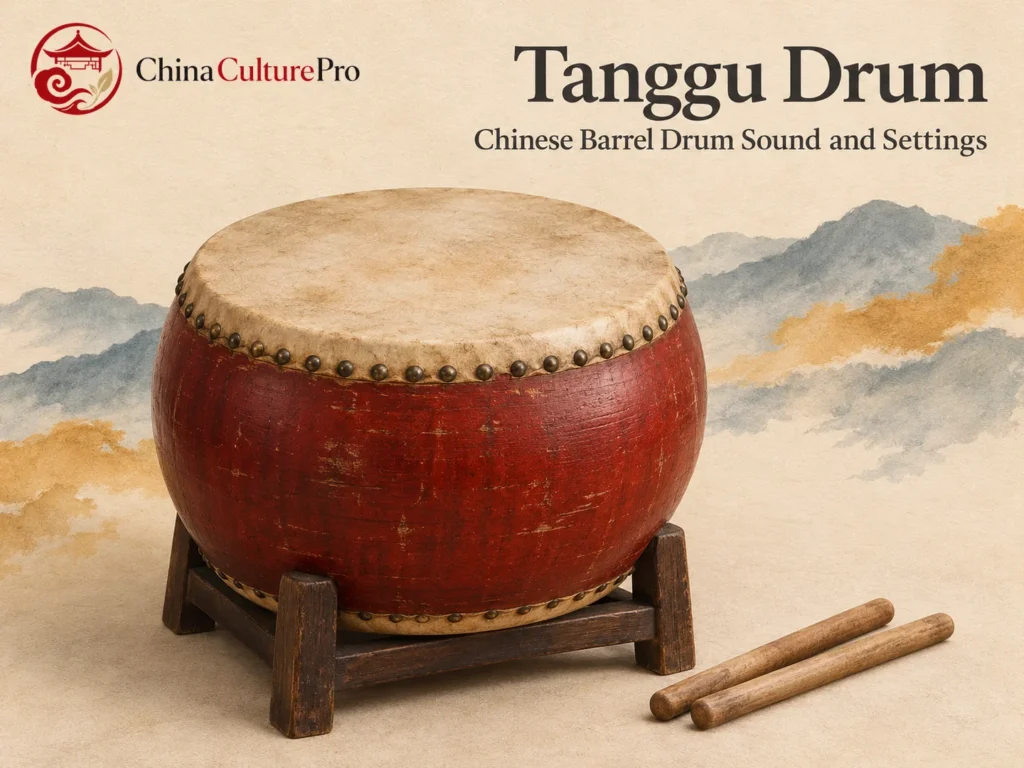
The tanggu (堂鼓, tánggǔ), or hall drum, is a Chinese barrel drum with a membrane stretched over each end. Players change its sound by striking different parts of the drumhead.[2][3]
- Build: A wooden barrel supports two stretched heads.[2]
- Sound: A stroke near the center can sound fuller than one closer to the edge.[1][3]
- Use: Documented contexts include theater, ritual, processions and modern orchestras.[1][2][4]
Watch where the stick lands and listen for the change in tone.

A drum can play several sounds within one short pattern. The tanggu’s wooden shell and stretched heads make its shape easy to recognize. The player’s choice of striking spot helps explain why one beat may boom and another sound brighter.
Read the Shell and Drumheads
The Grinnell collection describes a barrel built from joined wooden staves with stretched hide heads. Each head stretches across one opening in the same hollow shell. The barrel shape widens around the middle, while the heads close the ends.[2]
A nineteenth-century tanggu at the Met measures 55.9 centimeters high and the same across. Its catalog identifies oxhide, wood, lacquer and brass among its materials. The record associates the drum with a Guangzhou maker and lists Shanghai under geography. The place names record different details about the object.[1]
Hear the Difference Between Center and Edge
A drumstick striking near the center tends to give a lower, fuller sound. Moving toward the perimeter gives a brighter attack. The Met describes changes in both tone and volume as the contact point shifts. A near-edge stroke still lands on the head, while a hit on the wooden frame contacts a different material.[1][3]
In a short video, follow a pair of consecutive strokes. Compare where each one lands and how much sound continues after the attack. Comparing strokes on the same drum keeps its size and the recording conditions constant.
Follow the Drum in Theater and Ritual
Grinnell records tanggu use in regional opera groups, temple ensembles and outdoor processional bands. The name and role of a similar-looking drum can vary with the tradition. A guide to Opera Tiongkok provides context for how performance styles differ across regions.[2]
The Met associates its Qing example with theater and Buddhist ritual and notes that related drums can be suspended in a frame or on poles. Look for a support frame or pole in a collection photograph to see how the player could reach the drumhead.[1]
Find the Tanggu in an Orchestra
The Hong Kong Chinese Orchestra’s instrumentation table lists both large and small tanggu in its unpitched percussion section. Its large examples include head sizes of 60, 68, 70 and 80 centimeters. Read the size in the program or instrumentation table when a part calls for the large drum.[4]
In concert, compare the drum’s membrane attack with the ring of a metal gong. Yunluo cloud gongs produce notes from separate suspended metal discs. The overview of Chinese musical instruments puts both in context. The guide to Chinese drums and gongs compares the two families.[5]
FAQs About the Tanggu Drum
Does a tanggu have two drumheads?
Yes. The collection examples described here have membranes across both ends of the barrel.[2]
Does the tanggu play tuned notes?
The Hong Kong Chinese Orchestra classifies it as unpitched. Changing the contact point on the head changes the color of the sound.[3][4]
Is every large Chinese drum called tanggu?
Drum names vary by design, region and ensemble. Check the label for the regional or ensemble name.[2]
Sumber
[1] The Metropolitan Museum of Art. Tanggu, Nineteenth Century
[2] Grinnell College Musical Instrument Collection. Tanggu
[3] Wuhan Qingchuan University. Introduction to Chinese Instruments
[4] Hong Kong Chinese Orchestra. Instrumentation and Range Table
[5] Hong Kong Chinese Orchestra. Percussion Instruments