
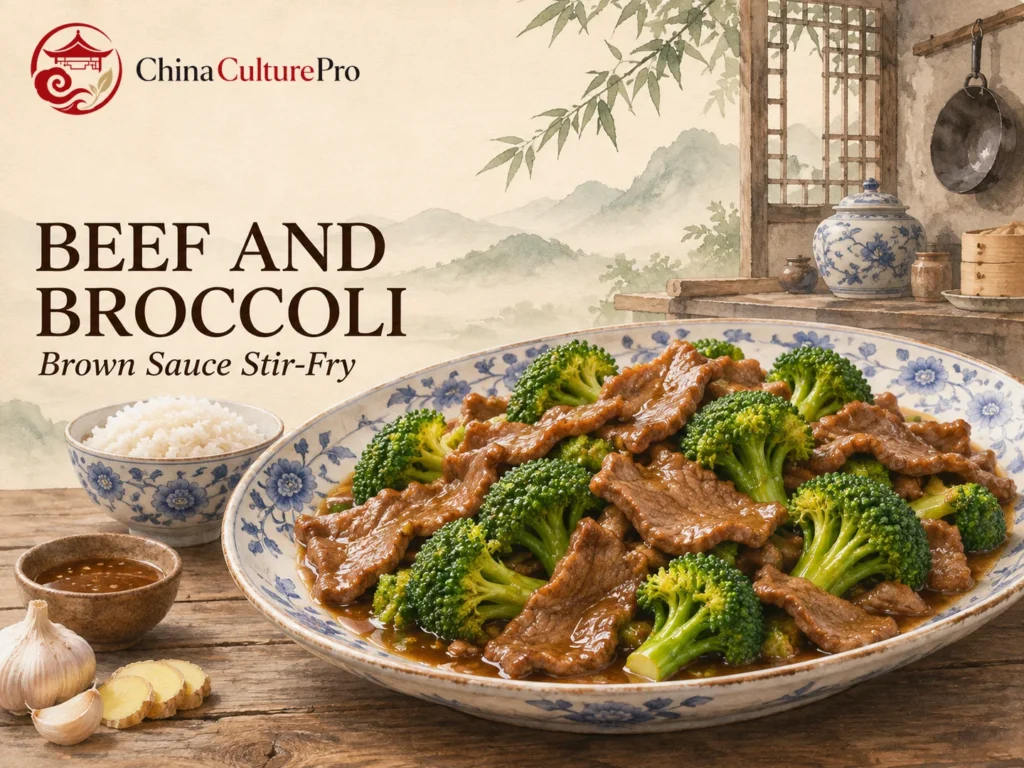

Quick Answer: What Is Beef and Broccoli?
Beef and broccoli (牛肉炒西兰花, niúròu chǎo xīlánhuā) combines sliced beef, broccoli florets and glossy brown sauce in a Chinese-American restaurant-style stir-fry.[1]
- Beef: Slice across the grain and coat before cooking.
- Broccoli: Cook separately first, then drain well.
- Finish: Bring meat, vegetables and sauce together near the end.[2]
This recipe uses oyster sauce (蚝油, háoyóu); soy-only versions also exist.[1][3]
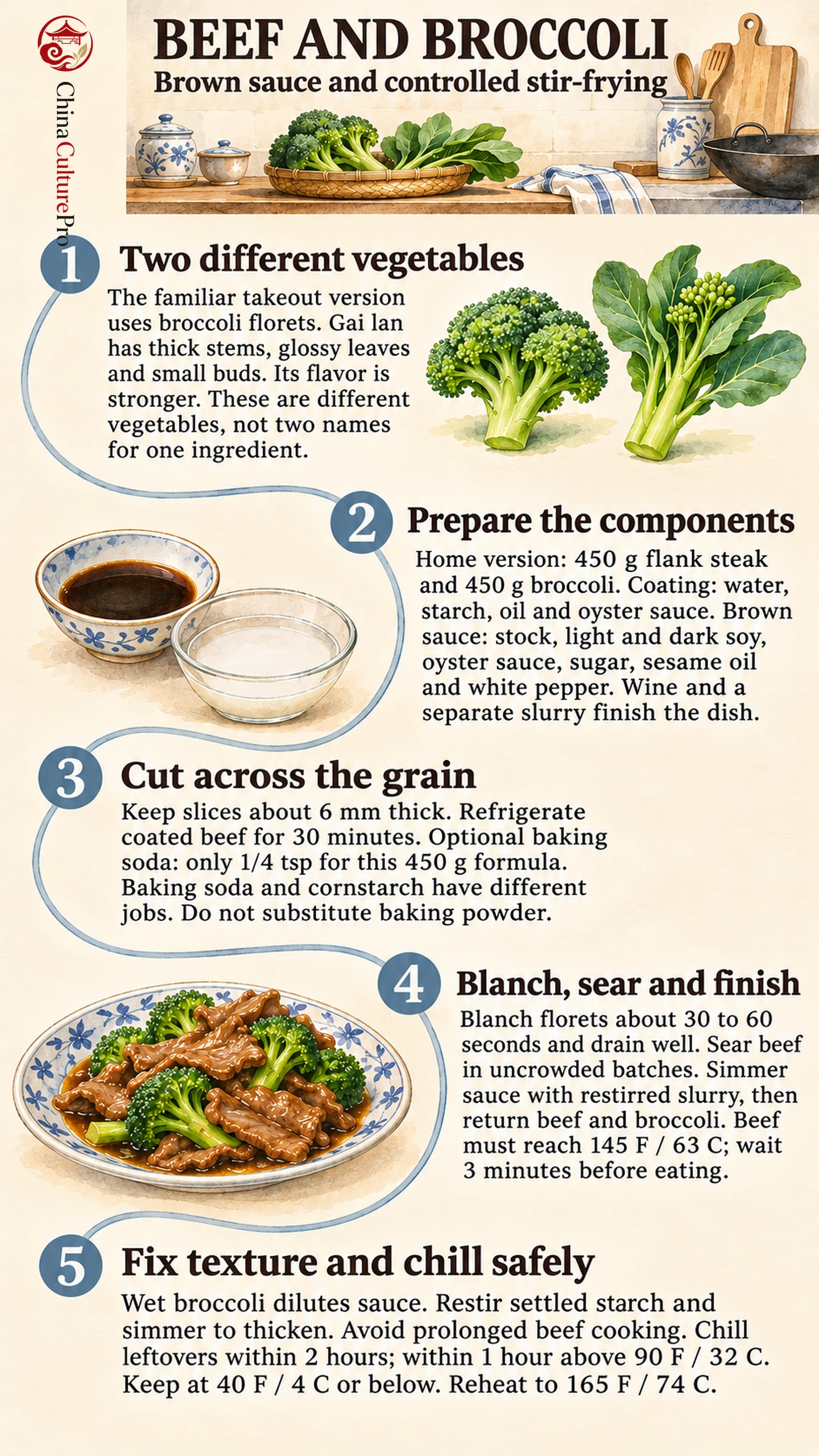
Good beef and broccoli depends on the order of cooking as much as the sauce. Prepare everything before heating the pan: the meat needs space to brown, while the broccoli needs only a brief final toss. Its place in Chinese-American food traditions also explains why another Chinese beef-and-greens dish may look different.
Broccoli Florets and the Gai Lan Connection
The floret version is associated with an adaptation of beef cooked with gai lan (芥蓝, jièlán), a vegetable familiar in Cantonese cuisine. That connection is more secure than a precise inventor or first-serving date.[2][4]
- Broccoli-floret version: The familiar takeout dish combines branching florets with sliced beef and brown sauce.[4]
- Gai lan version: Chinese broccoli supplies thick stems, glossy leaves and small flower buds, with a stronger broccoli-like flavor.[5]
These are different vegetables, not simply two English names for the same ingredient. For the broader savory beef preparation, see Chinese beef with oyster sauce.[4]
Ingredients for a Brown-Sauce Home Version
For roughly four shared servings with rice, use these quantities. All tablespoons are 15 ml and teaspoons are 5 ml; the formula is a home version rather than a universal restaurant standard.
- Main ingredients: 450 g flank steak sliced about 6 mm thick, 450 g broccoli florets, 2 minced garlic cloves, ¼ teaspoon minced ginger and 3 tablespoons neutral cooking oil for the pan, divided.[1][2]
- Beef coating: 3 tablespoons water, 1½ teaspoons cornstarch, 2 teaspoons oil and 1 teaspoon oyster sauce; optionally ¼ teaspoon baking soda.[1]
- Sauce: 160 ml low-sodium chicken stock, 1½ tablespoons light soy sauce (生抽, shēngchōu), 1 teaspoon dark soy sauce (老抽, lǎochōu), 1 tablespoon oyster sauce, 1½ teaspoons sugar, ½ teaspoon sesame oil and a pinch of white pepper.[1]
- Finishing: 1 tablespoon Shaoxing cooking wine (绍兴料酒, Shàoxīng liàojiǔ); a slurry of 2½ tablespoons cornstarch and 3 tablespoons cold water, added gradually as needed.[1]
Slice and Marinate the Beef
Find the direction of the muscle fibers and cut across them. Keep slice thickness consistent instead of mixing thick chunks with thin scraps.[2]
Mix beef with its coating ingredients and refrigerate for 30 minutes.[2][7] Baking soda is an optional tenderizer, distinct from the starch coating; do not substitute baking powder.[3] Our guide to velveting meat explains the wider technique.
How to Stir-Fry Beef and Broccoli
Have a saucepan, colander, wide skillet or wok, clean plate, mixing bowl and food thermometer ready. Mix the sauce and keep the slurry separate before starting.
- Blanch and drain: Lower broccoli into boiling water for about 30–60 seconds, adjusting for floret size and preferred crunch. Drain thoroughly; it will cook again in the sauce.[1]
- Sear in batches: Heat 2 tablespoons of the pan oil in a wide skillet over medium-high heat. Spread the beef in a single layer, working in batches if crowded. Brown both sides and transfer to a clean plate; it will finish cooking shortly.[7]
- Build the sauce: Add the remaining tablespoon of oil, garlic and ginger. Stir briefly until fragrant, then add the cooking wine and mixed sauce. Bring to a simmer, scraping up the browned bits.[1]
- Thicken and combine: Restir the slurry and add it gradually to the simmering sauce, stirring until glossy. Return the beef, its juices and broccoli; toss until coated and the meat is cooked. Add a little stock or water if too thick. Check the beef reaches at least 145°F/63°C; allow three minutes before eating.[6][7]
Use a thermometer rather than surface browning alone to judge safety.[6] Serve the finished dish with rice.[7]
Fixing Watery Sauce and Tough Beef
- Watery sauce: Drain broccoli carefully. Extra vegetable water dilutes both flavor and thickening power; a wet pan can undo the intended sauce balance.[2]
- Uneven coating: Cornstarch settles. Remix the slurry before adding it, and let the sauce simmer to thicken rather than pouring it over the finished plate raw.[7]
- Tough beef: Check grain direction and avoid keeping meat over heat while other ingredients catch up.[2] A wide skillet and smaller batches help on a home burner.[3]
Chill leftovers promptly in shallow containers: within two hours, or one hour above 90°F/32°C. Refrigerate at 40°F/4°C or below and reheat leftovers to 165°F/74°C.[6]
FAQs About Beef and Broccoli
Do I need a wok?
No. A wide skillet works on a home stove. Broccoli can also be briefly steamed in that pan first, then removed before searing the beef.[3]
Can I use frozen broccoli?
Yes. Thaw and drain it well, skip the fresh-broccoli blanching step, and add it near the end to heat through. Expect a softer texture.[3]
Is oyster sauce essential?
It is part of the formula above, but soy-based versions without it also exist. The Oyster sauce and hoisin sauce comparison can help you choose a substitute rather than guessing from the bottle color.[3]
Is beef and broccoli spicy?
This brown-sauce version has no chili. Heat can be added as a variation rather than treated as a defining ingredient.[3]
Sumber
[1] Bill / The Woks of Life. Beef and broccoli
[2] Chung Sun Lau / Made With Lau. Beef and broccoli: The Chinese restaurant way
[3] Maggie Zhu / Omnivore’s Cookbook. Chinese beef and broccoli
[4] Bill / The Woks of Life. Beef with Chinese broccoli
[5] North Carolina State Extension. Chinese broccoli plant description
[6] Centers for Disease Control and Prevention. Preventing food poisoning
[7] Beef. It’s What’s For Dinner. Culinary Center. Asian beef and broccoli