


Quick Answer: What Are Zunyi Lamb Rice Noodles?
Zunyi lamb rice noodles (遵义羊肉粉, Zūnyì yángròu fěn) combine rice noodles, cooked sliced meat and hot meat broth, with chili and fresh green garnishes.[1][2]
- Noodles: Rice sheets or finer rice-noodle strands appear.
- Meat: Local descriptions often specify goat.
- Broth: Meat and bones provide the savory base.
- Finish: Chili oil, toasted chili and herbs shape the bowl.
English “lamb” or “mutton” labels do not guarantee young sheep meat in this Guizhou dish.[1]
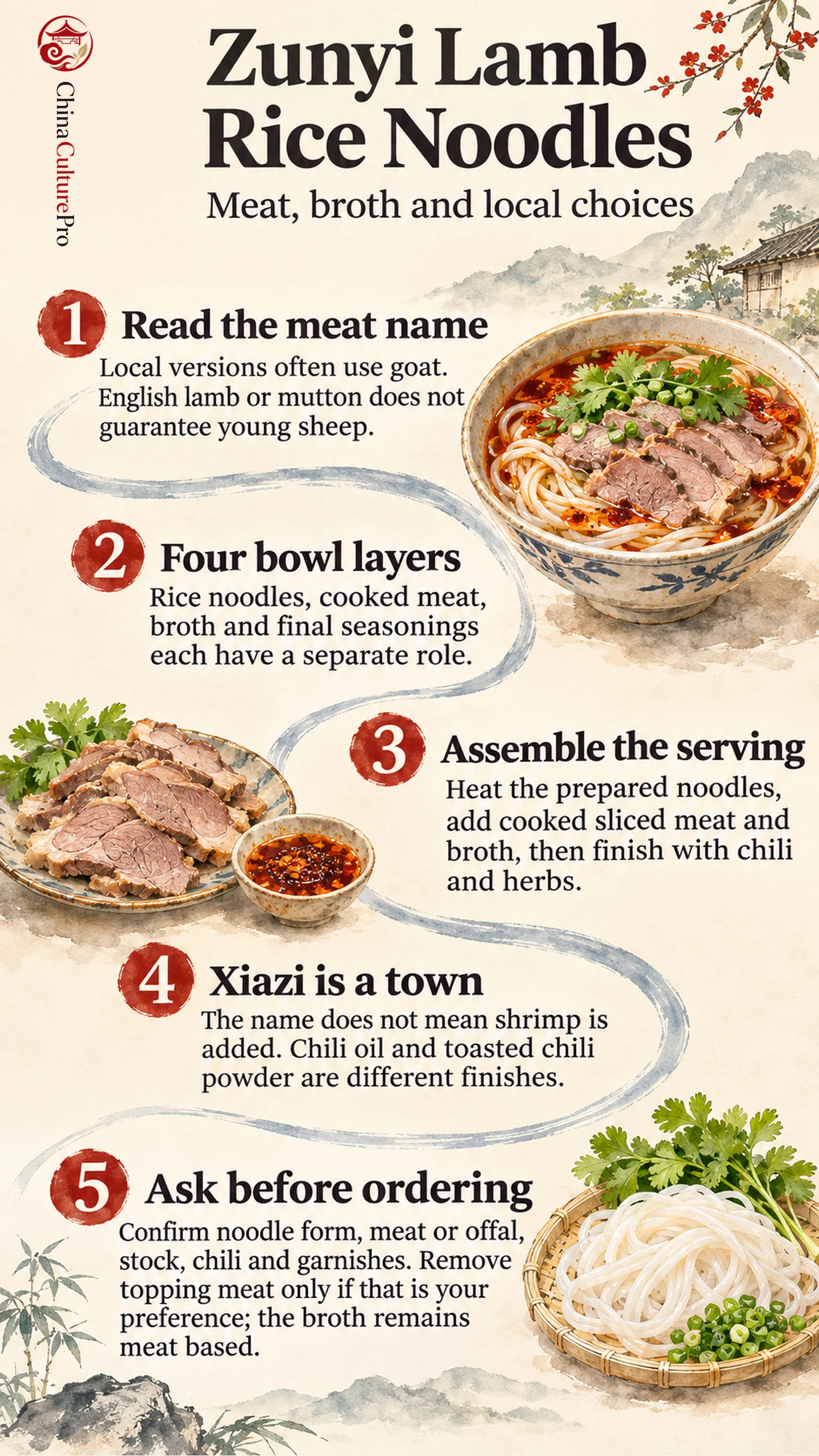
Among Chinese noodles, this bowl is best understood in layers: the rice base, sliced meat, soup and final seasonings have separate roles.
The Noodles, Meat, Broth and Seasonings
Rice noodles provide the staple rather than wheat noodles or rice grains. A local account describes both wider rice sheets and finer strands, so width alone is not a reliable test of the dish’s identity.[1]
The topping is cooked before being sliced. Some preparations press the cooked meat to obtain thin, even pieces; others offer offal as an alternative or addition. The meat is not a raw topping expected to cook only when the soup is poured over it.[2]
| Lapisan makna | Peran | What to ask |
|---|---|---|
| Mi beras | Soft, smooth staple | Which noodle form is available? |
| Cooked meat or offal | Meaty flavor and a separate bite | Is the topping sliced meat, offal or mixed? |
| Meat broth | Connects the bowl’s components | What meats and bones are used? |
| Chili and green garnishes | Heat, toasted aroma and fresh contrast | What is already added before serving? |
Minyak cabai and toasted chili powder are different finishing ingredients. The former distributes chili flavor through oil; the latter brings a roasted aroma. Coriander, green garlic, scallion and sometimes peppercorn powder add further dimensions, rather than replacing the meat stock.[1][2]
How the Bowl Is Assembled
A reported Xiazi-style demonstration separates stock-making, meat preparation and the final noodle order:[2]
- Prepare a broth using meat and bones.
- Cook the topping meat, then prepare it for slicing or portion the selected offal.
- Heat the prepared rice noodles and place them in a bowl.
- Add the cooked topping and hot broth.
- Finish with the kitchen’s chili seasonings and green garnishes.
The stock supplies the soup base; red oil is a separate finishing layer. A broth can remain relatively clear beneath floating chili oil; a red surface does not require a thick, opaque soup. Published descriptions emphasize the broth’s meat flavor, even where the finish is distinctly spicy.[3]
There is no need to assume that every pot contains only one animal ingredient. One account describes a richer version that also uses chicken when making the soup. That is a preparation to check, not an obligatory ingredient across the city.[3]
Zunyi, Xiazi and Guizhou’s Wider Noodle Traditions
Xiazi is a town associated with the dish and its local chilies. Its name can resemble the Chinese word for shrimp, but the place name does not state that shrimp is an ingredient. The distinction is useful when reading a menu headed “Xiazi lamb rice noodles.”[2]
Zunyi is one regional reference within Guizhou food culture. Local writing also distinguishes lamb-noodle traditions associated with Shuicheng, Xingyi and Jinsha. Their existence does not justify treating every bowl sold across the province as the same Zunyi recipe.[5]
The bowl is familiar in breakfast discussions, but its seasonal association is especially visible around the Winter Solstice. Local photo reporting documents people gathering at a lamb-noodle festival at that time. This records a food custom, not a promise that eating it prevents illness or guarantees warmth for the winter.[4]
Ordering and Eating Zunyi Lamb Rice Noodles
Start with the noodle form and meat option. If the species matters, ask whether the kitchen uses goat or sheep; if you avoid offal, say so before assembly. Also ask whether chili oil or toasted chili is already included, rather than relying on the color of the soup.
Adjustments depend on the stall. A request for less chili may be possible at assembly, but it does not mean the prepared stock can be reformulated. Ask about coriander and green garlic separately if you want either omitted.
For gluten avoidance, check the noodle product and all added seasonings. For religious dietary requirements, verify the meat, stock, cooking fat and preparation directly; a lamb label alone is not certification. The bowl remains meat-based even if the topping slices are removed.
Mix the chosen seasonings through the noodles and broth, then take small portions while the soup is comfortably hot. Thin meat slices and soft noodles can be eaten together, while the remaining broth provides a separate way to taste the stock.
FAQs About Zunyi Lamb Rice Noodles
Does Lamb Always Mean Young Sheep?
No. Local descriptions specify goat in familiar preparations. English menu translations are not a reliable statement of the animal’s species or age.
Does Xiazi Mean the Bowl Contains Shrimp?
No. In this name it refers to Xiazi Town. Check ingredients separately if avoiding shellfish; the place name does not answer an allergy question.
Are Zunyi Lamb Rice Noodles Always Spicy?
Chili is a familiar finish, but ask what that kitchen adds and whether it can be reduced. No single heat level follows from the dish name.
Are They Eaten Only at Breakfast?
No. Breakfast is one setting, while winter food festivals also serve the dish. Availability depends on the business rather than a rule restricting the bowl to mornings.[4]
Sumber
[1] Guizhou CPPCC News. 漫谈遵义羊肉粉
[2] Eastday / Shanghai Municipal Agriculture and Rural Affairs Commission. 遵义虾子羊肉粉香飘上海
[3] Guizhou Radio and Television. 醉美遵义风味小吃
[4] Guizhou Radio and Television. 动静影像:冬至,来碗羊肉粉吗?
[5] Guizhou CPPCC News. 贵州:青山绿水间点燃盛夏激情