

Quick Answer: What Is a Banhu?
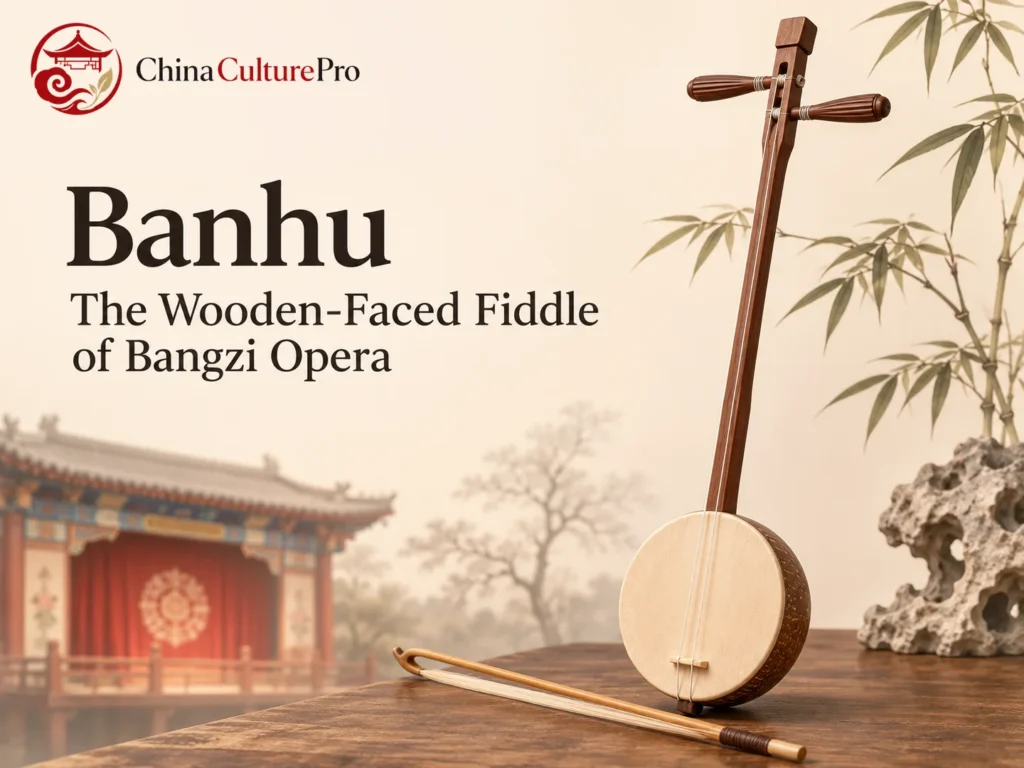
The banhu (板胡, bǎnhú) is a two-string fiddle in the huqin (胡琴, húqín) family. It has a thin wooden face on a rounded resonator, often made from a coconut shell. Its bright, penetrating tone is associated with northern Bangzi opera (梆子腔, bāngzi qiāng) and other regional stage traditions.[1][2]
- Face: A thin board closes the front of the resonator.[1][2]
- Bow: Its hair passes between the two strings.[2]
- Role: The fiddle can lead or follow the sung melody in regional opera.[1]
The wooden face is one of the clearest features to check in a photograph.[1][2]

A photograph from behind may show only a small brown bowl, a long neck and two pegs. Turn the instrument around and the pale board across the front gives the banhu its name. In a recording, the fiddle can remain distinct alongside a voice and percussion.[1][2]
The Board, the Shell and the Bow
The Chinese Music Archive describes a thin board, often made of paulownia, over a coconut-shell or wooden resonator. A bridge carries the string vibration to the board. The neck passes through the resonator. The bow hair sits between the strings, so the player changes which string sounds by moving the hair against it from the inside.[1][2]
The banhu in Auckland Museum made for Wan Wen Lung of the Tainan City Traditional Orchestra is one example. It has a coconut-shell body with a thin wooden front, a rosewood neck and two paler pegs. Another catalogued example has five cutouts at the back of its shell. The cutouts give a view into the resonator from the back. A front view is where you can check for the board.[3][4]
What the Banhu Does in Bangzi Opera
The Chinese Music Archive associates the growth of the banhu with Bangzi opera around the transition from the Ming to the Qing. It lists Hebei Bangzi, Qinqiang in Shaanxi and Yu opera in Henan among the traditions that adopted it. The name covers a family of local opera traditions, each with its own singing and accompaniment practices.[1][2]
Listen for the line of the fiddle close to the singer’s pitch. In an accompanied aria, compare how the voice and fiddle shape the end of a line. A sustained tone lets the fiddle keep sounding beside the voice, while a short bowed turn can connect one sung phrase to the next. The Auckland Museum instrument was made for a musician in a traditional orchestra in Taiwan, documenting another performance setting for the fiddle.[1][3]
How to Tell It Apart From an Erhu or Jinghu
On an erhu, a skin membrane typically covers the front of a short, often polygonal soundbox. The banhu’s rounded bowl and wooden face are a different combination. The jinghu is another high, projecting fiddle, associated with Peking opera. Its small tubular resonator is a better visual clue than pitch alone. The overview of Chinese musical instruments puts all three within the bowed string family.[2][5]
FAQs About the Banhu
Does every banhu have a coconut-shell body?
Coconut shell is a documented traditional material, and some instruments use wood for the bowl. A wooden face across that resonator is the shared feature.[1][2][3]
What does the name banhu mean?
It is commonly rendered as “board fiddle.” The board is the thin wooden soundboard on the front.[2]
Sumber
[1] Chinese Music Archive. Banhu and Other Bowed Instruments
[2] Middle Tennessee State University, Center for Chinese Music and Culture. Instrument Gallery
[3] Auckland Museum. Banhu, Object 2017.82.2
[4] Musical Instrument Museums Online. Banhu Collection Record
[5] China National Peking Opera Company. The Instruments of Peking Opera