

Quick Answer: What Is Suan Cai Yu?
Suan cai yu (酸菜鱼, suāncài yú) is a Sichuan-Chongqing fish dish built around sour preserved greens and a savory broth.
- Fish: Sliced fish is cooked in the broth; it is not preserved by pickling or fermentation.
- Pickled greens: Fermented vegetables provide the signature sourness, salty flavor and contrasting texture.
- Flavor: Sourness leads, with varying amounts of chili heat and peppery tingling alongside it.
The familiar combination does not require one fish species or a fixed level of spice. A pale bowl can still be hot, and the name does not guarantee either a mild or a boneless dish.[1][2][3]
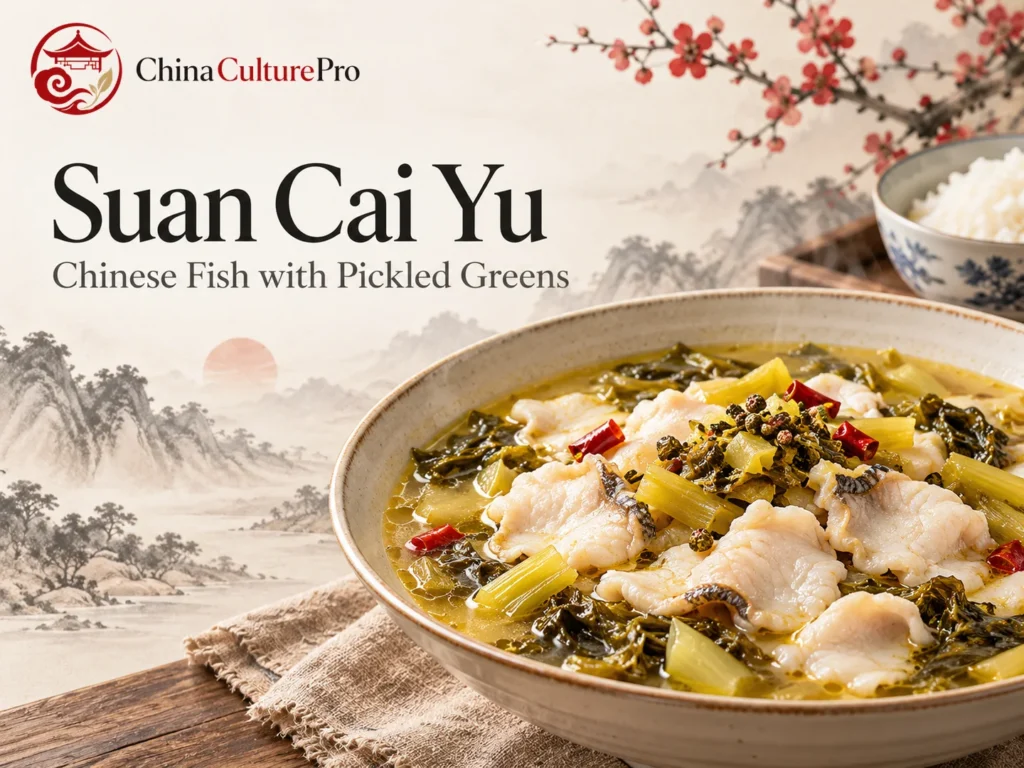
White fish slices, yellow-green preserved vegetables and a sour, savory broth arrive together in one large bowl. On an English menu, “pickled fish” can suggest something quite different. This Chinese food guide separates the fish, the pickles and the flavor behind the name.
Suan Cai: The Pickled Greens Behind the Sourness
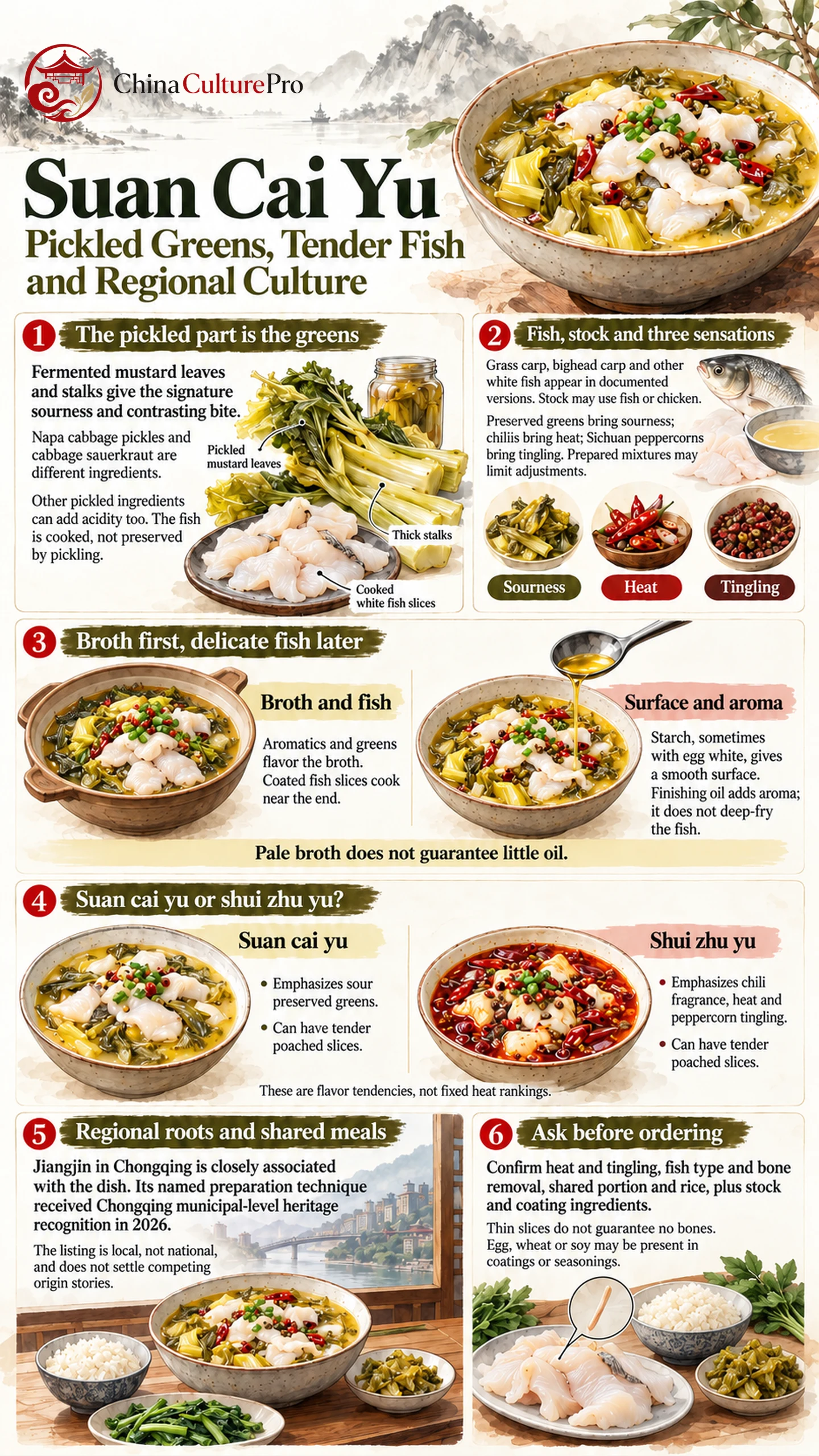
Suan cai (酸菜, suāncài) means sour preserved vegetables. For this dish, the familiar ingredient is fermented mustard greens (芥菜, jiècài), using the leaves and substantial stalks. Their yellow-green to brownish color and crisp-to-tender bite contrast with the soft fish.[1]
Fermentation gives the greens their acidity and develops a flavor beyond simply salting fresh leaves. Lactic acid bacteria play a central role in this process. The greens season the surrounding liquid as well as providing pieces to eat; their role is not just a garnish added to an otherwise finished fish soup.[8]
The word suan cai is broader than one vegetable. Northeastern Chinese versions commonly use napa cabbage, while familiar European sauerkraut uses heading cabbage. They share a preservation approach, but they are not interchangeable descriptions of the raw ingredient. Substituting a cabbage pickle can change the texture, aroma and balance of the finished bowl.
Mustard greens provide the defining sour character, not necessarily every trace of acidity. Other pickled ingredients can contribute too. Nor would vinegar alone reproduce both the fermented vegetable flavor and the pieces of greens that distinguish the dish.[2][3]
Fish, Stock and Aromatics: Common Variations
Grass carp is a familiar choice, while a documented Jiangjin preparation uses bighead carp. Other published versions use catfish, sea bass or tilapia. These examples show a range of suitable fish, not an official approved list. The species affects flavor, fat, texture and bones; the cook also chooses the cut and slice shape.[2][3][4]
A whole-fish preparation can use the head and bones for the soup. A version starting with fillets may use a separately prepared stock instead. Chicken stock also appears in published preparations, so “fish dish” does not establish that the broth contains only fish-derived ingredients.[3][4]
Pickled chilies (泡椒, pàojiāo) contribute heat and can also add sourness. Sichuan peppercorns (花椒, huājiāo) bring a tingling, numbing sensation and aromatic notes. Ginger, pickled ginger and garlic supply additional fragrance. Fresh or dried chilies may join the pickled peppers.[2][3]
These ingredients explain why sourness, chili heat and tingling should be considered separately. They are different sensations, although a prepared stock or pickle mixture may already combine them. A diner’s ability to change each one depends on the kitchen, rather than on the dish’s name.
How the Broth and Tender Fish Are Prepared
Aromatics and preserved vegetables are commonly fried first, then combined with stock or water to develop the soup’s flavor. In a whole-fish version, the head and bones may help build that base before the delicate slices are cooked.[2][3]
Fish slices may be seasoned beforehand and coated lightly with starch; some preparations include egg white. This short seasoning or marinating stage is different from preserving fish by fermentation. A thin coating contributes a smooth surface, while the slices are cooked near the end so they do not remain in the pot throughout the broth-making stage. Egg white is a recipe choice, not a requirement for every version.[2][4]
The finishing oil is another separate operation. Some preparations pour hot oil over chilies, peppercorns or other aromatics to release fragrance at the surface. The fish underneath has been cooked in liquid, rather than deep-fried.[2][3]
These cooking methods help explain the contrast between tender slices, substantial greens and an aromatic soup. They also explain why a pale broth does not guarantee little oil: the stock and the finishing layer are different parts of the bowl.
Suan Cai Yu vs Shui Zhu Yu
Shui zhu yu (水煮鱼, shuǐzhǔ yú), often called Sichuan boiled fish, shares the idea of tender fish slices cooked in seasoned liquid. The main distinction is the broth’s flavor emphasis, rather than one dish being poached and the other fried.[3][5]
| 比較項目 | Suan cai yu | Shui zhu yu |
|---|---|---|
| Defining flavor | Sour, savory preserved-green character | Chili fragrance, heat and peppercorn tingling |
| Typical ingredients | Fermented greens, often with pickled chilies or ginger | Dried chilies and peppercorns, with other seasonings varying |
| Familiar appearance | Pale to golden broth, visible yellow-green vegetables | Often a conspicuous chili-and-oil topping |
| Shared fish texture | Tender slices cooked in the broth | Tender slices cooked in the broth |
The table describes flavor emphasis, not fixed spice levels. Suan cai yu can be strongly spicy; ask about the actual preparation rather than choosing solely by the dish name.
Sichuan-Chongqing Roots and Everyday Dining
Suan cai yu belongs to the wider Sichuan-Chongqing food tradition. Jiangjin in Chongqing is closely associated with its development. Local accounts connect the dish with regional restaurant cooking and its popularity during the 1990s, while also acknowledging competing origin stories. A fisherman’s tale or a restaurant’s remembered history should not be treated as proof of one universally established inventor.[6]
In 2026, Jiangjin suan cai yu preparation technique was listed in Chongqing’s seventh batch of municipal-level intangible cultural heritage projects. The designation concerns a named local practice. It is not national-level recognition of every bowl sold under the general dish name, nor does it impose one recipe on all restaurants.[7]
At the table, its large-bowl presentation fits shared Chinese food culture. Fish, greens and broth can be served alongside rice and vegetable dishes. Both households and restaurants serve the dish, with different ingredient combinations and portions.[4][6]
Ordering Suan Cai Yu: Spice, Bones and Portions
A few questions before ordering are more useful than judging a menu photograph’s color.
- Heat and tingling: Ask about chilies and peppercorns separately. “Less spicy” may not mean less numbing, and a prepared broth may limit changes.
- Fish and bones: Confirm the species and whether the kitchen uses a whole fish or prepared fillets. Thin slices do not guarantee that all small bones have been removed.
- Portions and ingredients: Check whether the bowl is intended for sharing and whether rice is ordered separately. If ingredients matter to your diet, ask about the stock, egg-white coating and compound seasonings, which may introduce wheat or soy.[2][3]
FAQs About Suan Cai Yu
Is the fish itself pickled?
No. The name points to the preserved vegetables cooked with the fish. The fish may be seasoned or briefly marinated before cooking, but that is not the same as fermenting or pickling it for preservation.
Is suan cai yu always spicy?
Heat varies. The sour vegetable character remains central, while chili and peppercorn levels depend on the preparation. A milder version is possible, but ask about the actual broth; its color cannot reliably tell you the heat level.
Is suan cai the same as sauerkraut?
Not exactly. Suan cai can describe different Chinese sour vegetables, but this dish usually uses mustard greens. Familiar European sauerkraut uses cabbage. A cabbage substitution changes the vegetable texture and flavor rather than producing an identical ingredient.
Is suan cai yu boneless?
Not necessarily. Whole-fish versions may contain bones, and fillets still need careful bone removal. Ask how the fish is prepared and remain alert for small bones; neither “sliced fish” nor the dish’s name is a guarantee.
資料來源
[1] Chongqing Agriculture Commission. 川渝腌菜如何“腌”制味蕾盛宴?
[2] Jiangjin Government. 江津酸菜鱼传统制作技艺
[3] Omnivore’s Cookbook. Suan Cai Yu
[4] The Hong Kong Cookery. Sichuan Fish with Pickled Mustard Greens
[5] Omnivore’s Cookbook. Shui Zhu Yu
[6] Chongqing Local Chronicles Office. “酸菜鱼”与江津人邹开喜
[7] Chongqing Government. 第七批市级非物质文化遗产代表性项目名录通知
[8] Yuan Xianling et al. 酸菜中乳酸菌生长曲线、产酸性能及抑菌性能探究