
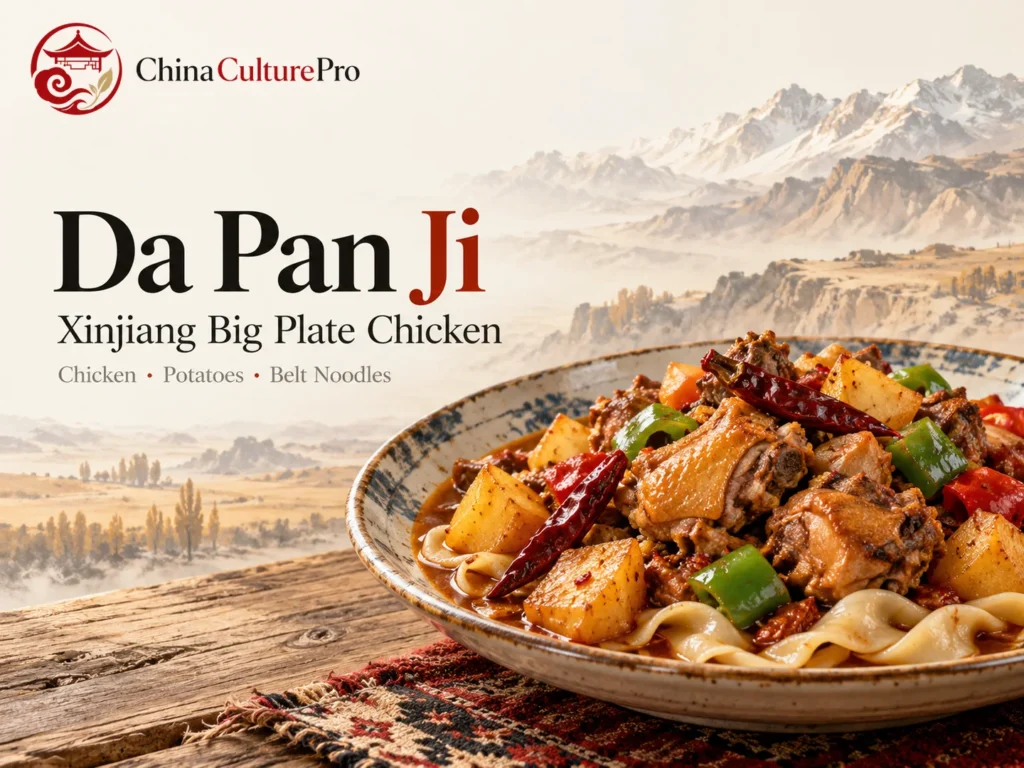

Quick Answer: What Is Da Pan Ji?
Da Pan Ji (大盘鸡, dàpánjī) means “Big Plate Chicken,” a Xinjiang dish particularly associated with Shawan in Tacheng prefecture.[1]
- Dish: Chicken pieces, commonly bone-in, are cooked with potatoes and peppers.
- Flavor: Stir-frying and braising combine meat, vegetables and aromatic seasonings in a savory, often spicy sauce.
- Serving: A generous platter is shared, commonly with wide wheat noodles mixed into its juices.
This guide focuses on the familiar Shawan-style chicken-and-potato dish within Xinjiang cuisine. Recipes and portions vary, and noodles are not automatically included in every order.
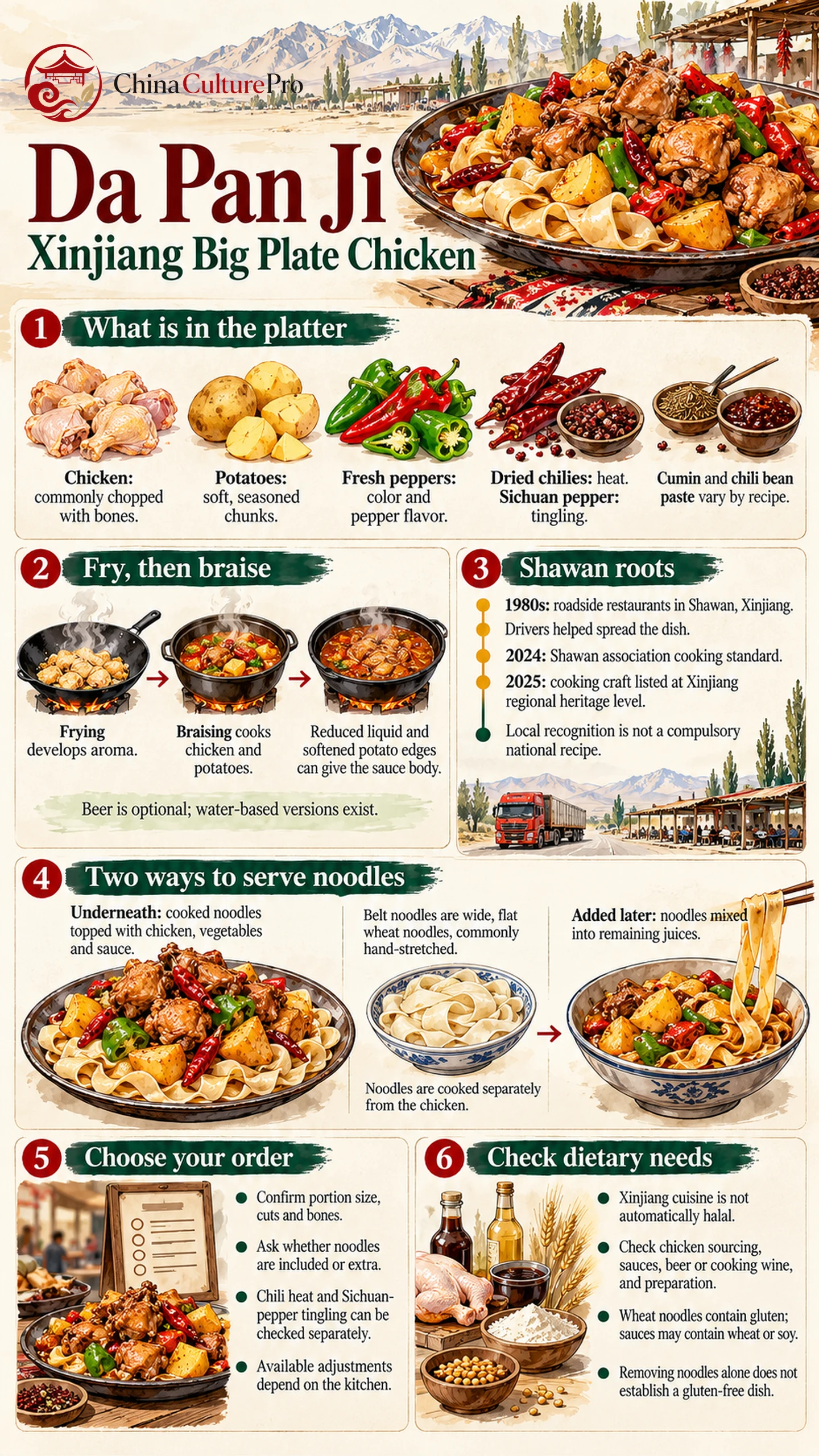
A shared platter of chicken and potatoes may arrive with broad noodles underneath—or with noodles added later. Understanding that combination makes this part of Chinese food easier to order. The key questions concern the chicken, the sauce, the staple accompaniment and the size of the meal.
Shawan Roots and Xinjiang Roadside Food Culture
Shawan, in northern Xinjiang, is central to the dish’s modern history. Local records place its development in roadside restaurants during the 1980s, along the Urumqi–Yining road corridor. Long-distance drivers helped carry its reputation beyond the town as road transport expanded.[1][2]
The generous format suited a meal that brought meat and vegetables together, with a filling staple alongside. Its later spread introduced the dish to restaurants elsewhere in Xinjiang and across China, where cooks adapted it to local preferences.[2] The roadside setting helps explain both the substantial portion and the combination of meat, vegetables and a staple.
Two more recent records give the Shawan tradition a precise local context. A 2024 association standard describes its ingredients and cooking method, including potatoes and a wheat-noodle accompaniment.[3] In 2025, Shawan big plate chicken cooking skills entered Xinjiang’s sixth regional-level intangible cultural heritage list.[4] The designation recognizes the local craft. It does not turn every restaurant’s version into the same recipe, and the association standard is not a compulsory nationwide formula.
Chicken, Potatoes, Peppers and the Flavor Base
The familiar combination balances substantial chicken pieces, soft potatoes and fresh vegetables. A whole bird chopped through the bone is characteristic of restaurant versions; boneless thigh adaptations also exist.[5] The table separates these ingredients’ functions from choices that depend on the kitchen.
| 材料類別 | 帶來甚麼 | 可能有甚麼差異 |
|---|---|---|
| 雞肉 | The main meat, with skin and bones common in chopped whole-bird versions | Particular cuts and boneless adaptations |
| Potatoes | Soft texture and a surface that takes up the surrounding seasoning | Chunk size and softness; potatoes are central to the Shawan style discussed here |
| Fresh peppers and alliums | Color, fresh pepper flavor and aromatic notes from onion, scallion, ginger or garlic | Vegetable combinations and whether fresh peppers are mild or hot |
| Dried chilies and spices | Chilies supply heat; Sichuan pepper (花椒, huājiāo) supplies tingling; spices such as star anise add aroma | Spice mixtures and the balance of heat, tingling and fragrance |
| Sauces and cooking liquid | Salt and soy sauce build savoriness; doubanjiang (豆瓣酱, dòubànjiàng) adds fermented chili-bean flavor in some versions | Water, stock, beer or cooking wine; bean paste is not universal |
Cumin appears in some recipes, but it is not a requirement for every plate.[7] Its use is a recipe choice, rather than a reliable marker of one regional school. The mixture of spices and sauces can change while the chicken, potato and pepper combination remains recognizable.
How the Chicken, Potatoes and Sauce Come Together
Da Pan Ji combines two Chinese cooking methods: an initial frying stage and cooking in seasoned liquid. Three functions explain the finished texture:
- Developing aroma: Chicken and seasonings are fried to develop flavor before liquid cooking. Kitchens differ over when sugar, spices or prepared sauces enter the pan; there is no need to impose one exact order on every version.
- Cooking the substantial pieces: Braising brings the chicken and potatoes to a tender finish in the surrounding liquid. Potatoes cook as part of the dish, absorbing seasoning rather than simply being scattered over finished meat.
- Finishing the sauce and vegetables: Reducing the liquid and softened potato edges can give the sauce body. Fresh vegetables may be added later to preserve some shape and bite.[3][6]
The result can be relatively loose and saucy or more reduced. Either way, the liquid belongs to the dish’s flavor and texture. Beer is one optional cooking liquid, not a required explanation for tender chicken.
Belt Noodles: Why They Belong with Big Plate Chicken
Belt noodles (皮带面, pídài miàn) are wide, flat wheat noodles whose name describes their ribbon-like shape. Their broad surface carries the chicken’s sauce, while their chew contrasts with the soft potatoes. They belong to the wheat-based part of the Chinese noodle family.
Hand-stretching is a common way to shape them, although cut-noodle adaptations also exist.[5][7] The hand-pulled noodle technique explains their formation; it does not make every wide noodle dish the same as Da Pan Ji.
The noodles are cooked separately from the chicken. One serving pattern lays them beneath the meat and vegetables, with sauce poured over the top.[5] Another brings noodles after diners have eaten some chicken and potatoes, allowing them to mix the noodles into the remaining juices.[2]
Neither pattern creates a compulsory eating sequence. If the platter arrives without noodles, ask whether they are coming separately or need to be ordered. The Shawan association standard itself describes supplying wheat belt noodles according to customer demand.[3]
Ordering Da Pan Ji and Checking Ingredients
Menu wording gives a starting point, rather than the complete contents of your order. Use these checks:
- Portion and noodles: Ask about available sizes or a half portion, how much the order contains and whether noodles are included. A “big plate” does not guarantee a fixed number of diners or free additional noodles. Say whether you want the staple served immediately or later, if the kitchen offers that choice.
- Chicken and bones: Confirm whether the dish uses chopped bone-in pieces or a boneless version. Make your preference clear before ordering; not every restaurant can change its preparation. Eat carefully around small bones or fragments.
- Heat and tingling: Ask separately about chili intensity and Sichuan-pepper tingling. A premixed seasoning base may limit adjustments, even when a server can offer a milder version.
- Dietary requirements: Check chicken sourcing, seasonings and preparation if you need halal food. Ask about beer and cooking wine. Wheat noodles contain gluten; soy sauce and compound sauces may introduce wheat or soy ingredients. Removing noodles alone does not establish a gluten-free meal; also check the sauce recipe and shared utensils.
A Chinese food name can identify the dish without revealing every ingredient or kitchen practice.
FAQs About Da Pan Ji
Is da pan ji always spicy?
A chili-led flavor is characteristic, but its intensity varies. Some kitchens can make a milder plate; others use a prepared base that is harder to adjust. Chili heat and Sichuan-pepper tingling are separate sensations, so mention both preferences.
Does da pan ji always come with noodles?
Wide noodles are a classic accompaniment, but they may be included, served separately or ordered as an extra. They can sit under the chicken or be mixed into the sauce later. Confirm the arrangement when placing your order.
Is da pan ji halal?
Not automatically. Ask about the restaurant’s halal preparation, chicken sourcing and seasonings rather than relying on the Xinjiang name. Beer or cooking wine appears in some recipes, so check those ingredients and any shared-equipment concerns before ordering.[6][7]
Does da pan ji have bones?
Usually expect bones in a traditional chopped-chicken version. Boneless adaptations exist, but that does not mean every restaurant offers deboning or interchangeable cuts. Ask specifically, and take care with smaller pieces that may contain bone fragments.
Does da pan ji have to be made with beer?
No. Water-based versions exist, while other recipes use beer or stock. A beer-free dish may still contain cooking wine. If you avoid alcohol, ask about all liquid seasonings instead of checking only whether beer is used.[6][7]
資料來源
[1] Shawan Municipal Bureau of Culture, Radio, Television and Tourism. 沙湾大盘鸡
[2] Tacheng Prefecture Administrative Office. 新疆沙湾大盘鸡:公路边一道江湖菜名扬四海
[3] Xinjiang Quality Inspection and Testing Association. 沙湾大盘鸡 烹饪技术规范 T/XJZJXH 0001—2024
[4] Tacheng Prefecture Administrative Office. 祝贺!沙湾大盘鸡烹饪技艺凭硬核实力入选自治区非遗代表性项目
[5] Wei Guo, Red House Spice. Big Plate Chicken with Belt Noodles (Da Pan Ji/大盘鸡)
[6] Lee Kum Kee. Big Plate Chicken
[7] Leanne Kitchen, SBS Food. Big plate chicken with hand-cut noodles (da pan ji)