
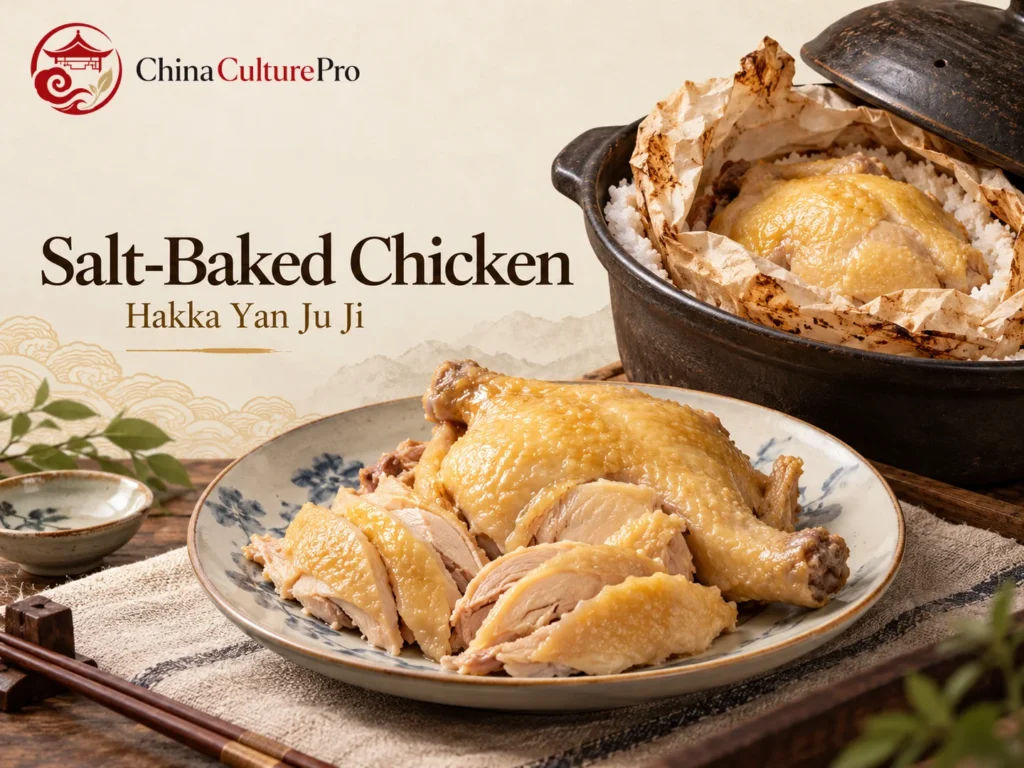

Quick Answer: What Is Chinese Salt-Baked Chicken?
Chinese salt-baked chicken (盐焗鸡, yánjú jī), often written Yan Ju Ji, is a Hakka chicken dish associated with Guangdong.
- Method: Traditionally, a whole chicken is wrapped in paper and cooked inside heated coarse salt.
- Flavor: Savory chicken and aromatic seasoning are central; the dish does not require a sweet glaze or chili sauce.
- Serving: The cooked bird may be chopped into portions or pulled into strips for sharing.
The name alone does not guarantee a salt-bed method: modern versions can reproduce the seasoning through other cooking techniques. [1][5][6]

A chicken buried in salt sounds as though it should taste overwhelmingly salty. On a Hakka menu, however, the name also describes a cooking method. Understanding the heated salt, paper wrapping and aromatic seasoning helps explain both the traditional dish and the different versions sold today.
How Hot Salt Cooks a Wrapped Chicken
In the traditional method, heated coarse salt surrounds the paper-wrapped bird inside a covered vessel. The salt acts as a heating medium, bringing heat to the parcel from below, around the sides and above. The chicken cooks inside its wrapping rather than being submerged in a pot of water. The paper separates the meat from loose salt crystals, and it is removed before serving. [1][6]
This explains why a large mound of cooking salt does not translate directly into an equally large quantity of salt on the plate. Seasoning applied to the chicken and the salt surrounding its wrapper have different jobs. The exterior salt bed is principally part of the cooking setup, not a condiment to spoon over the finished meat. [6][7]
“Baked” can also be misleading if it makes you picture an uncovered bird roasting in an oven. A covered wok or pot can provide the traditional cooking environment; a household oven is not essential. Within Chinese cooking methods, the useful distinction is the salt-enclosed parcel. It is not raw salted chicken, and the name is not a promise of crisp roast skin. [1][6]
Chicken, Sand Ginger and the Flavor Profile
Expect recognizable chicken flavor, savory skin and meat that can be tender while retaining some bite. Traditional descriptions vary between soft skin and a pleasantly firm, springy surface. Neither description means the brittle, browned skin associated with Cantonese roast goose. Color and texture also depend on the bird and the kitchen’s method. [1][3]
Sand ginger (沙姜, shājiāng) supplies a particularly distinctive aroma in many versions and accompanying dips. It is Kaempferia galanga, an aromatic rhizome in the ginger family, rather than ordinary ginger under another name. Its fragrance has a camphor-like note; replacing it with everyday ginger changes the aromatic profile. [4][6]
Other seasonings vary. A documented version includes ginger, spring onion, rice wine, five-spice and soy sauce, while another uses sand ginger and white pepper without a soy glaze. These are examples of variation, not an ingredient checklist for every restaurant. A dark seasoning or a more yellow finish cannot establish the full recipe by appearance alone. [5][6]
Salt-baked chicken is therefore best understood through its savory character and preparation, rather than one fixed shade of yellow or a compulsory sauce. Chili heat is not what defines it.
Traditional Salt Baking and Modern Adaptations
Menus can preserve a familiar dish name while changing how the chicken is heated. Ask about the method if experiencing the hot-salt preparation is your main reason for ordering.
| 版本 | What heats the chicken | What the diner should understand |
|---|---|---|
| Traditional salt-bed chicken | Heated coarse salt surrounds a wrapped bird in a covered vessel | The salt bed is a cooking medium; the paper parcel distinguishes the process |
| Seasoned steamed or poached chicken | Steam or liquid cooks a salted, seasoned bird | The flavor can resemble the named dish even though no hot-salt burial is used |
| Oven adaptation without a salt bed | Oven heat cooks the seasoned chicken | This simplifies equipment and handling; it does not reproduce the traditional salt enclosure |
The first two methods are documented in professional cooking accounts, and an oven-only adaptation also exists. These differences explain why two plates bearing the same English name may have different skin, aroma and moisture. They do not justify treating every adaptation as one uniform recipe. [5][7]
If a menu mentions seasoning powder, that identifies a seasoning choice, not proof of how the bird was cooked. Ask the kitchen to distinguish its seasoning from its heating method.
Hakka Roots in Guangdong
Within Chinese food, this dish belongs to Hakka food culture in Guangdong, with strong associations in the Dongjiang area around Huizhou and in Meizhou. It also appears in the wider restaurant setting of Cantonese cuisine; a Guangdong restaurant menu can contain distinct regional traditions rather than one interchangeable style. [2][3][5]
A concrete heritage milestone is the recognition of the Meijiang District Hakka salt-baked chicken craft in Guangdong’s fifth provincial intangible cultural heritage batch in 2013. That designation concerns a local transmitted skill. It is not a national recipe standard or evidence that every dish sold under this name follows one formula. [2]
Stories about merchants, salt storage and migration often accompany the dish. They help explain its cultural associations, but do not establish a verifiable sole inventor or exact invention year. The clearer contemporary context is a dish used for hospitality and shared meals: Huizhou accounts describe it as a banquet favorite, served with sand-ginger oil and salt. [3]
Serving and Ordering Salt-Baked Chicken
A shared platter may contain chopped, bone-in pieces, or meat pulled from the carcass with the skin arranged over it. A shredded presentation does not necessarily mean that everything underneath is boneless. Check before ordering if bones are a concern. Rice and vegetables can turn the platter into a meal; the chicken need not come with rice included. [5][6]
Dips are separate choices. Sand-ginger oil is a regional accompaniment, while ginger-spring-onion sauce appears in other documented versions. Try the chicken before adding a dip: the meat has already been seasoned. [3][5]
Useful checks include:
- Method and portion: Ask whether it is cooked in hot salt, steamed, poached or oven-roasted, and whether the order is a whole bird or a smaller portion.
- Bones and skin: Confirm the presentation instead of assuming that “shredded” means fully deboned.
- Seasonings and sauces: Ask about cooking wine, sesame or peanut oil, soy sauce and any separate dip. None is guaranteed by the dish name alone.
- Dietary requirements: For gluten avoidance, check the actual soy sauce and compound seasonings. For an allergy or alcohol restriction, ask about ingredients and kitchen handling rather than relying on the plain-looking meat.
The same approach helps with other Chinese food names: translate the name, then confirm the preparation that matters to you.
FAQs About Chinese Salt-Baked Chicken
Is salt-baked chicken very salty?
It should be savory, but its name does not specify a salt level. The cooking salt surrounds a wrapper; the marinade and any dip determine additional seasoning. Restaurants differ, so request the dip separately if you want more control.
Is salt-baked chicken the same as white-cut chicken?
No. White-cut chicken (白切鸡, báiqiē jī) is cooked gently in water or stock; traditional salt baking heats a wrapped bird inside salt. Some modern versions overlap in their use of poaching, which makes asking about the method useful. [5][8]
Do you eat the salt around the chicken?
No. The surrounding coarse salt and paper wrapping are removed. Eat the cooked chicken and any accompanying sauce, not the material used to enclose it.
Is Chinese salt-baked chicken gluten-free?
It can be made without wheat ingredients, but the name is no guarantee. Soy sauce, seasoning blends, dips and shared equipment require separate checking. Plain chicken and salt do not establish the status of the finished dish.
資料來源
[1] Jiaoling County Government. 客家盐焗鸡
[2] Meijiang District Taxation Bureau. “盐”值担当,税惠添彩!梅江税务守护客家美食非遗技艺
[3] Nanfang Plus. 惠州非遗廿四味|雨水节气品东江盐焗鸡,养脾脏之气
[4] National Parks Board, Singapore. Kaempferia galanga
[5] Tony Tan, Cuisine. Hakka Salt-Baked Chicken
[6] Judy Leung, The Woks of Life. Salt Baked Chicken
[7] Bill, Judy, Sarah and Kaitlin Leung, Epicurious. Easy Salt-Baked Chicken
[8] Mary Tang, SBS Food. White cut chicken