

Quick Answer: What Are Chinese Tea Eggs?
Chinese tea eggs (茶叶蛋, cháyèdàn), often written cha ye dan on English menus, are cooked eggs seasoned in a savory liquid containing tea.
- Eggs: Whole chicken eggs are the usual base, with the shell retained during much of the preparation.
- Flavor: Tea, salty seasonings and aromatic spices contribute different parts of the finished taste.
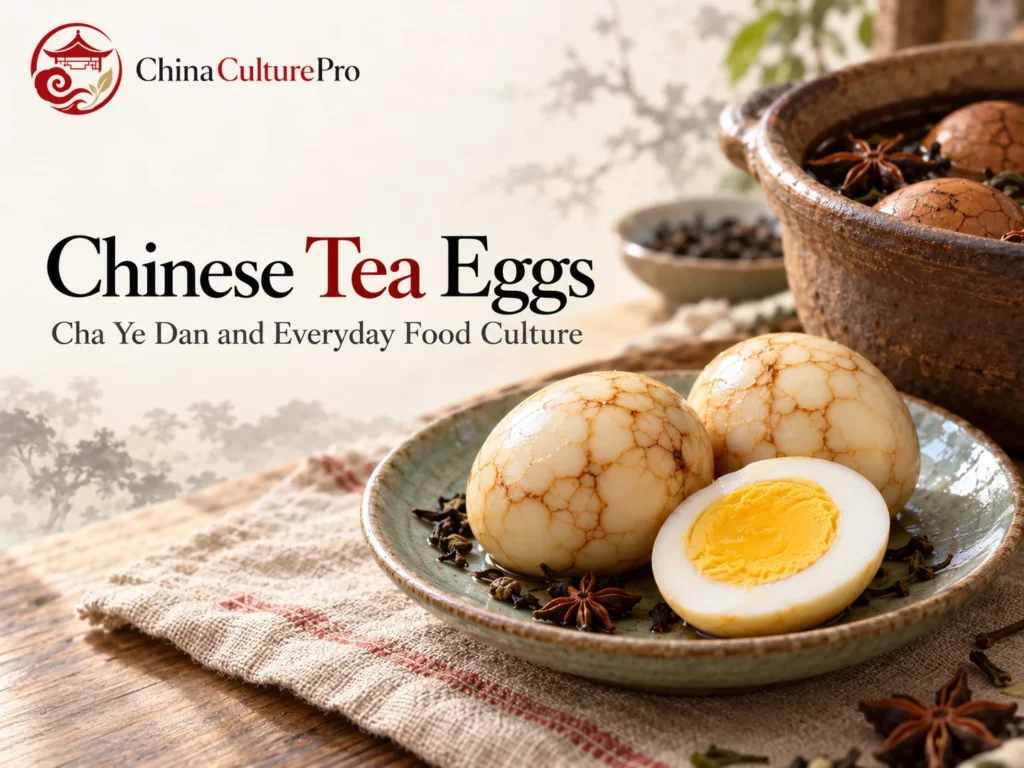
- 外觀: Cracked shells allow the liquid to leave brown, web-like lines on the peeled egg white.
Households and vendors vary the tea, seasonings and egg texture. The familiar pattern helps with recognition, but it is not a fixed recipe or a measure of freshness.[1][2]

A pot of brown eggs at a breakfast counter can look unremarkable until one is peeled. Beneath the shell, dark lines cross the white like marble. This Chinese food guide explains the seasoning, the pattern and the everyday meal behind that appearance.
Tea, Soy Sauce and Spices: What Shapes the Flavor
Black tea (红茶, hóngchá) is a common choice, contributing its aroma to the seasoning liquid. Green tea and oolong also appear in published preparations. Loose leaves and tea bags are both used, so neither format alone defines the dish.[1]
醬油 supplies savory flavor and also deepens the liquid’s color; salt adjusts the seasoning. Dark soy can make coloring more pronounced, but brownness does not come from tea alone.[1][2]
Star anise, cassia cinnamon and bay leaf are familiar aromatic additions. A kitchen may use a smaller selection or a different blend, and sugar is another recipe choice. Spice fragrance does not necessarily mean chili heat. There is no compulsory national checklist of aromatics.[1][3]
The white is usually set and seasoned around its surface. The yolk may be firm and crumbly or softer, depending on the preparation. These are texture choices rather than evidence of separate northern and southern schools.[3]
How Tea Eggs Get Their Marbled Pattern
The pattern begins with a cooked egg whose white can hold its shape. Its shell is cracked but left around the egg as it encounters the seasoning liquid. The cracks create routes for the colored liquid to reach the white, producing darker lines along those paths. Peeling reveals the pattern; it does not create it.[2]
Three things should be kept separate. Shell cracks are physical gaps. The marble effect is staining on the edible white. The liquid may look uniformly dark even though staining beneath the shell is uneven. Coverage and contact with the liquid affect the finished appearance.[1][2]
Preparations also differ in how cooking and soaking are combined. Some simmer the cracked eggs again; others emphasize marinating cooked eggs. An ice-water bath or a second prolonged boil is not what defines every version. The shared visual principle is contact between the seasoning liquid and the white through the shell cracks.[2][3][4]
Tea Eggs in Everyday Chinese Food Culture
At a Chinese breakfast counter, a seasoned egg can accompany other foods rather than form an entire meal. Vendors offer them as a convenient addition, and home cooks also prepare them for later meals. A halved egg can sit on noodle soup; it need not be eaten only as a standalone snack.[2][3]
Their place in Chinese street food extends beyond a movable cart. Breakfast shops, household kitchens and convenience-store shelves represent different ways of preparing or buying the same recognizable food. Some retail products are already peeled and packaged, while freshly served versions may still have their cracked shells.[3]
This is everyday savory food rather than a dish reserved for one festival or formal banquet. Home cooks and vendors can give it different balances of tea, salt, sweetness and spices. Those differences are better described through the actual ingredients than assigned to rigid regional schools.[4]
Tea Eggs, Soy Sauce Eggs and Century Eggs
Lu dan (卤蛋, lǔdàn) is a broader braised-egg label, so tea eggs and soy-seasoned eggs need not be mutually exclusive categories. The table compares a familiar tea egg with a tea-free soy egg and a differently processed preserved egg.
| 食品 | Seasoning or processing | Appearance after peeling |
|---|---|---|
| Tea eggs | Cooked eggs infused with tea and savory seasonings, often through cracked shells | Brown lines across an otherwise lighter egg white |
| Tea-free soy sauce eggs | Cooked eggs seasoned in soy-based liquid without tea | Often more evenly brown when marinated after peeling; treatment varies |
| Century eggs (皮蛋, pídàn) | Eggs transformed by alkaline curing rather than tea-braising | Dark, translucent, gel-like white and a changed yolk |
Century eggs are a different food-processing category; some curing mixtures can even contain tea without making the result a tea egg. The decisive difference is alkaline curing, not simply the presence of a dark ingredient or a brown exterior.[5]
Buying, Serving and Checking Ingredients
Remove the shell before eating. Ask whether a fresh egg is served hot or chilled, and treat its storage conditions separately from its seasoning. Seasoning does not replace safe temperature control.[6]
- Freshly prepared eggs: Choose properly hot-held or refrigerated food. Refrigerate leftovers promptly; do not use reheating as a way to rescue eggs that were held unsafely.[6][7]
- Packaged products: Follow the label’s storage and opening instructions. A sealed retail pack and an egg taken from a counter pot do not automatically have the same keeping conditions.
- Ingredient restrictions: Eggs are an allergen. Soy sauce commonly contains soy and may contain wheat, so a plain-looking egg is not automatically gluten-free. Check the actual sauce and other ingredients.[8]
Tea eggs are not vegan because they contain eggs. For an egg-inclusive vegetarian diet, still ask whether the seasoning liquid contains meat stock or other animal-derived additions.
FAQs About Chinese Tea Eggs
Are tea eggs always hard-boiled?
Classic versions have fully set yolks, but softer-yolk adaptations exist. The shell pattern cannot tell you which is inside. If doneness matters, ask about the actual product; food-safety guidance favors eggs with firm whites and yolks.[3][6]
Do tea eggs taste strongly of tea?
Not necessarily. Tea shares the flavor with salt, soy sauce and spices. One egg may have an obvious tea aroma, while another tastes mainly savory and aromatic. A dark exterior does not guarantee a strong tea flavor.
Are tea eggs smoked?
Smoking is not a required cooking stage. A preparation may use smoked tea, which contributes a smoky note, but that is different from placing the whole egg in a smoker. Many versions use other teas.[4]
Can tea eggs be eaten cold?
Yes, when fully cooked and properly chilled and handled. Cold serving is different from leaving cooked eggs unrefrigerated. If storage has been unsafe, warming the egg afterward is not a reliable fix.[6][7]
資料來源
[1] Red House Spice. Chinese Tea Eggs
[2] The Woks of Life. Tea Eggs
[3] Omnivore’s Cookbook. Chinese Tea Eggs
[4] SAVEUR. Cha Ye Dan
[5] Hong Kong Science Museum. How Do Duck Eggs Become Century Eggs?