
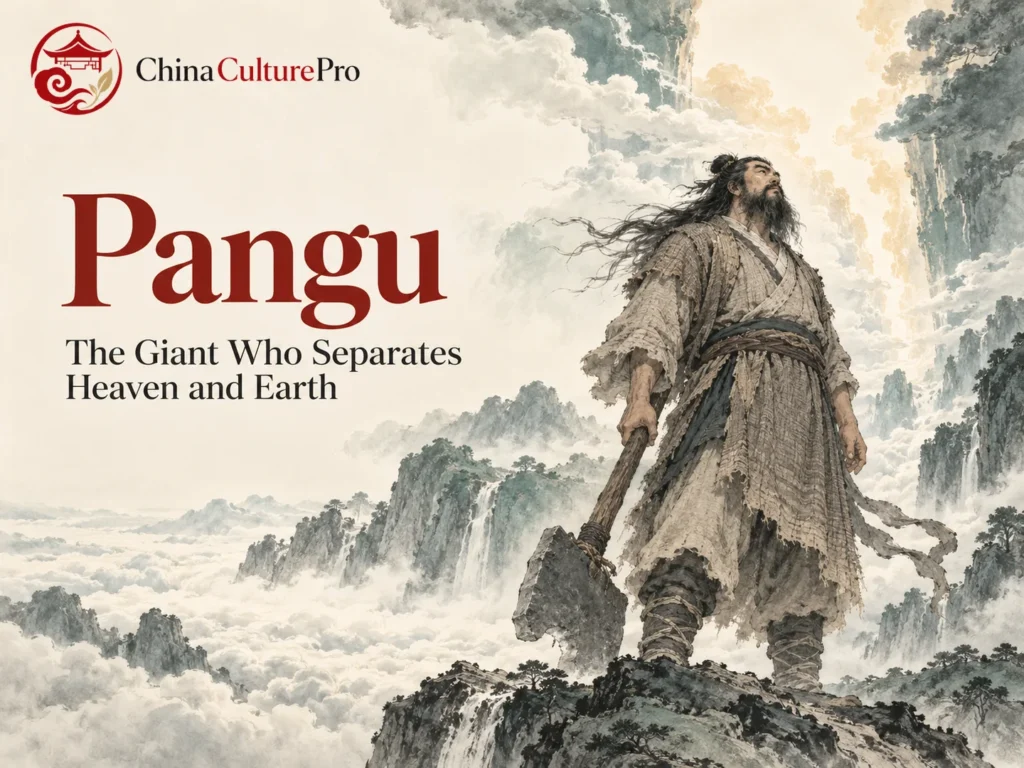

Quick Answer: Who Is Pangu?
Pangu (盘古, Pángǔ) is a giant in Chinese creation mythology whose story explains the separation of heaven and earth. Two familiar episodes give him different roles:
- Separation: He grows between heaven and earth as the world opens out from egg-like chaos.
- Transformation: In another account, his dying body becomes features of the natural world.
- Versions: An axe appears in some retellings, while early quoted passages describe separation without one.
These episodes often appear together in retellings. Pangu belongs to a varied body of narratives rather than one universally binding creation story.

An immense figure stands between a rising sky and a thickening earth. Elsewhere, his breath becomes wind and his blood becomes rivers. These images belong to related Pangu traditions whose details vary by account. This guide places the giant within Chinese mythology and distinguishes the story from the texts and pictures that transmit it.
The Cosmic Egg and the Growing World
An early account begins with egg-like chaos and Pangu inside. After 18,000 years, heaven and earth open apart: clear yang becomes heaven; turbid yin becomes earth. Here yin and yang (阴阳, yīnyáng) describe contrasting cosmic qualities.[1]
Pangu remains between the two. Heaven rises, earth thickens and the giant grows taller, each by one zhang (丈, zhàng), a traditional unit of length, every day. This continues for another 18,000 years. The first span precedes the opening; the second describes continued expansion. Reducing both to one period changes the sequence in this particular passage.[1]
Read these vast spans as part of the story’s cosmic scale. They are not a geological timetable or a way to calculate the age of the earth. Nor does an old unit need an exact modern conversion for the image to work: the giant and the widening world grow together.
How Pangu’s Body Becomes the World
A different passage describes Pangu’s approaching death and the transformation of his body. Instead of constructing a landscape from separate materials, he becomes its substance. The following correspondences belong to that account.[2]
| Part or attribute of Pangu | What it becomes |
|---|---|
| Breath and voice | Wind and clouds; thunder |
| Left eye and right eye | Sun and moon |
| Limbs and body | The four extremities and five mountains |
| Blood | Rivers |
| Flesh | Fields and soil |
| Head hair and beard; body hair | Stars; plants and trees |
| Teeth and bones; sweat | Metals and stone; rain |
The same excerpt also makes insects on his body into human beings. This human-origin motif belongs to the particular account. The passage describes transformation at death; it does not explicitly say that Pangu deliberately kills himself as a sacrifice.[2]
This episode answers a different question from the growing giant: how the world acquires its contents, rather than how sky and earth become separate. The two can sit together in a retelling without being mistaken for a single continuous surviving early text.
Where the Written Accounts Come From
Two important accounts are associated with Xu Zheng (徐整, Xú Zhěng), active in the third century: the Sanwu Liji (三五历纪, Sānwǔ Lìjì) and Wuyun Linianji (五运历年记, Wǔyùn Lìniánjì). Their Pangu passages are known through quotations in later works. Identifying an earlier attributed source is different from possessing its original manuscript.[3]
The Song-period encyclopedia Taiping Yulan (太平御览, Tàipíng Yùlǎn) preserves the egg-like chaos and growing-world passage quoted above. The Qing-period compilation Yishi (绎史, Yìshǐ) preserves the body-transformation passage under the other title. Their compilation dates identify later witnesses, not the first imagining of Pangu.[3]
The third-century association also cannot establish the exact beginning of oral storytelling. A written record tells us that a version was being transmitted; it does not prove that the story had just been invented. Claims of one identifiable inventor, prehistoric eyewitness tradition or securely established original birthplace need evidence beyond the familiar plot.
The Axe, Images and Changing Versions
The axe is a recognizable way to picture a giant opening the world. In one documented retelling, Pangu lifts lighter matter, presses down heavier matter and uses an axe to split what still clings together. The axe is a genuine narrative variant, not something to dismiss simply because another account omits it.[4]
However, the Sanwu Liji passage quoted in Taiping Yulan describes separation and growth without mentioning that tool. A cover illustration or statue with an axe therefore should not be treated as a literal transcription of every early passage. Identify the version an image illustrates.[1]
A dated object provides a reference point for visual retellings. The Library of Congress holds an illustrated manuscript copied around 1900 from an 1820 work, including a scene of Pangu creating the world. Those dates identify a particular object and its source work. They do not date the beginning of Pangu mythology. As with other subjects in Chinese painting, an image offers a particular presentation of a story rather than a complete record of all its versions.[5]
What Pangu’s Story Explains
The story works through separation and continuity. Sky and earth become distinct, yet the giant’s body later connects the landscape to a living form. One way to read these images is as a movement from an undifferentiated beginning toward a world of recognizable relationships. This is an interpretation of the narrative, not a claim about what every Chinese reader believes.
Other stories perform different jobs. Nüwa (女娲, Nǚwā) repairs a damaged sky in one important tradition; that task is not identical to Pangu’s separation of heaven and earth. Comparing them does not require inventing a family relationship or a single timeline.[4]
The wider guide to Chinese creation myths places Pangu beside human-origin stories and accounts of cosmic process. Keeping their questions distinct makes the traditions easier to understand than merging every creator into one sequence.
FAQs About Pangu
Does Pangu always use an axe?
No. An axe appears in some versions, but the early Sanwu Liji passage preserved in Taiping Yulan does not mention one. The image depends on the retelling.
Did Pangu create human beings?
One body-transformation account makes insects on his body into people. Other Chinese traditions explain human origins differently, so this is not a universal answer across all creation stories.
Is Pangu the only Chinese creator?
No. Chinese traditions contain several accounts of beginnings, including stories about different deities and explanations of cosmic development that do not center on a giant.
How old is the Pangu myth?
Important written accounts are attributed to the third-century writer Xu Zheng and survive through later quotations. That gives a textual reference point, not a precise birth date for an oral tradition.
資料來源
[1] Taiping Yulan, Chinese text via Wikisource. Volume 2: The Sanwu Liji Excerpt
[2] Yishi, Chinese text via Wikisource. Volume 1: Wuyun Linianji and Related Excerpts
[3] Paul R. Goldin, Monumenta Serica. The Myth That China Has No Creation Myth
[4] Hong Kong Space Museum. Chinese Starlore: Legends of the Origin of Heaven and Earth
[5] Library of Congress. World Treasures: Pangu Creates the World