


Quick Answer: Who Is Nezha?
Nezha (哪吒, Nézhā) is a youthful warrior deity whose stories span Chinese religion, classical fiction and modern animation. He is also known as the Third Prince (三太子, Sān Tàizǐ).
- Religious figure: His development connects Indian antecedents, Buddhist transmission and Chinese devotional traditions.
- Story character: Sea battles, conflict with his father and a lotus-body rebirth are central to a familiar literary version.
- Visual identity: A ring, flowing sash, spear and fiery wheels often identify him in art.
These elements have different histories. No single film, novel or temple image contains every version of Nezha.
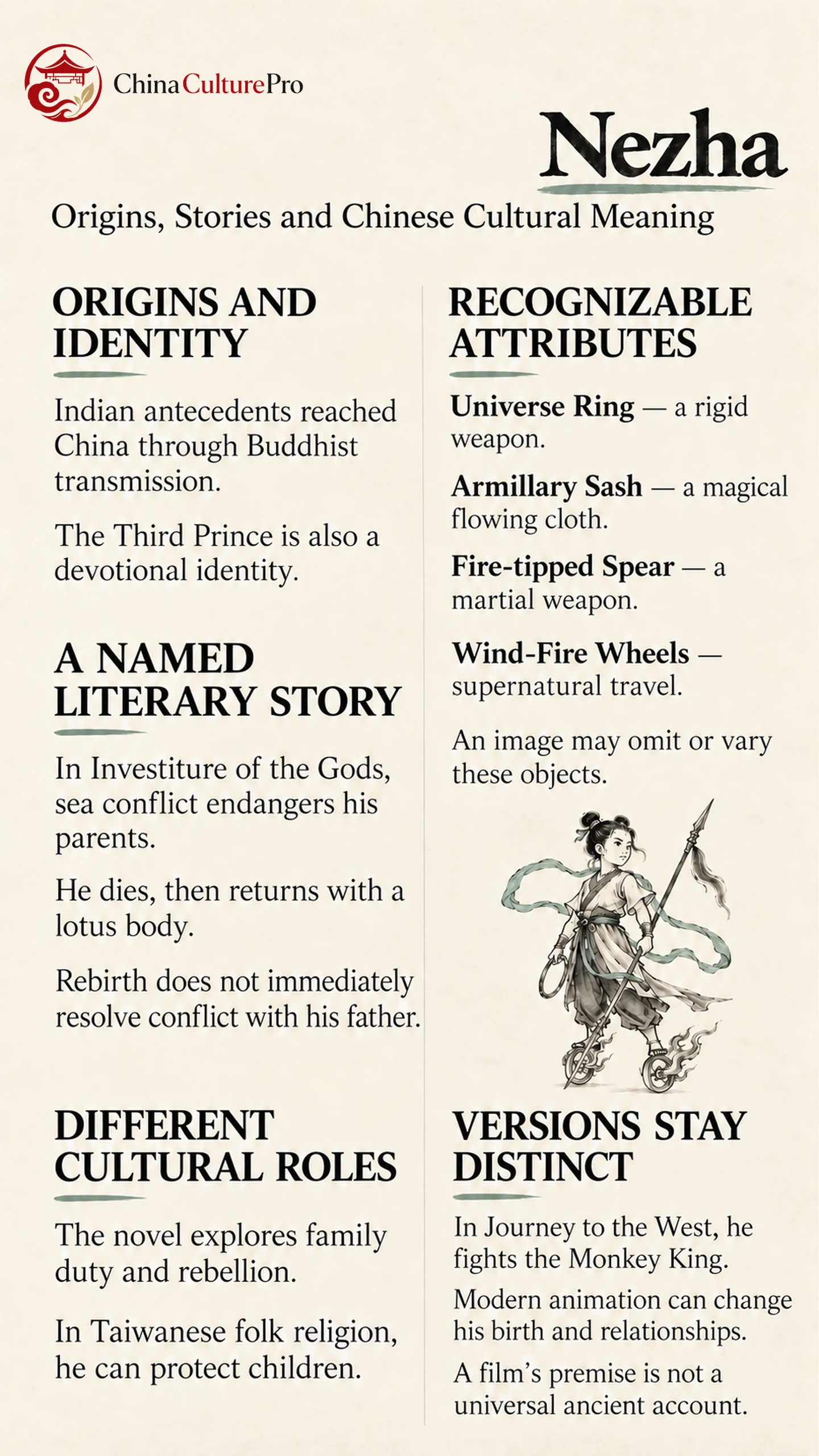
A young warrior rides fiery wheels, carrying a spear while a long sash streams behind him. The image is recognizable, but the figure’s meaning depends on context. Nezha can be a challenging child in a novel, a protective deity in a temple or a reimagined hero in Chinese mythology on screen.
Religious Origins and the Third Prince
Nezha’s history reaches beyond the Chinese novels that made his adventures widely familiar. His antecedents include the Indian figure Nalakūbara, transmitted through esoteric Buddhist traditions and subsequently reshaped in Chinese literature and worship. Religious transmission and a fictional birth story are different questions.[1]
The title Third Prince is especially clear in Investiture of the Gods (封神演义, Fēngshén Yǎnyì): Nezha is the third son of Li Jing (李靖, Lǐ Jìng) and Lady Yin (殷夫人, Yīn Fūrén).[3] The title also belongs to his devotional identity. A wooden image from Taiwan combines a youthful appearance with armor and recognizable divine attributes.[2]
He cannot be placed exclusively on one side of a simple Chinese Buddhism versus Daoism division. His religious reception crosses those traditions.[1]
The Sea Conflict and Lotus Rebirth
Investiture of the Gods gives Nezha a dramatic family story. After an extraordinary pregnancy, his mother gives birth to a ball of flesh. Li Jing breaks it open, revealing a child already accompanied by a golden ring and red sash. The immortal Taiyi Zhenren (太乙真人, Tàiyǐ Zhēnrén) becomes his teacher.[3]
At the waterside, Nezha’s play disturbs the underwater palace. Conflict escalates into the deaths of a sea official and Ao Bing (敖丙, Áo Bǐng), a Dragon King’s son. The episode has consequences beyond a heroic victory: Nezha has provoked a dispute that endangers his parents.[3]
In the following chapter, he accepts responsibility and dies to release his parents from the dragon kings’ claims.[4] The story continues after death. Li Jing destroys a shrine established for his son; Taiyi then constructs a new body from lotus material and restores Nezha. Rebirth does not immediately heal the family conflict: the transformed son pursues his father in anger.[5]
This sequence is specific to the novel. A retelling that changes the dragon prince’s role or makes parental affection the central theme is reshaping the story, not necessarily repeating these chapters.
How to Recognize Nezha in Art
Four attributes frequently appear together, although an individual painting or sculpture may omit one or show a different configuration.
| Attribute | Appearance or function | What to notice |
|---|---|---|
| Universe Ring (乾坤圈, qiánkūn quān) | A rigid golden ring used as a weapon. | It is separate from the flowing sash. |
| Armillary Sash (混天绫, hùntiān líng) | A long magical cloth associated with his movement and combat. | Its ribbon-like form creates a different visual outline from the ring. |
| Fire-tipped Spear (火尖枪, huǒjiān qiāng) | A long-shafted weapon held in the hand. | It belongs to his martial identity. |
| Wind-Fire Wheels (风火轮, fēnghuǒ lún) | Paired wheels beneath his feet that enable rapid movement. | They are a means of travel, not part of his body. |
The ring and sash are present at his birth in this novel.[3] The spear and wheels accompany his lotus-body return.[5] A circa-1850 painting shows the youthful deity with a spear and other familiar attributes, demonstrating that this visual vocabulary predates modern animation.[6]
An artwork’s date records that particular depiction. It does not establish the first appearance of every object or every episode associated with the character.
Family Duty, Rebellion and Protection
Nezha’s story brings family obligation into conflict with a child’s independence and violence. Filial piety (孝, xiào) is part of this tension: his attempt to take responsibility for danger to his parents coexists with later hostility toward his father. Treating the narrative only as a lesson in obedience misses its disturbing contradictions.[1]
His role in Chinese folk religion adds a different perspective. In Taiwanese devotional contexts, the youthful deity can be a protector of children as well as a martial guardian. This does not mean that every community explains his protection in the same way or that a novel supplies a complete account of temple practice.[9]
His literary rebellion and religious protection serve different purposes: interpreting a story and relating to a deity through worship.
Nezha in Novels and Modern Animation
Nezha also appears in Journey to the West (西游记, Xīyóujì). In its fourth chapter, he is a heavenly warrior sent against Sun Wukong (孙悟空, Sūn Wùkōng). They are distinct characters and opponents in that episode, not two names for the same hero. That role differs from the family-centered sequence in Investiture of the Gods.[8]
Modern Chinese animation can reshape the premise itself. The animated film Ne Zha uses a spiritual pill and a sorcery pill to frame a question about destructive destiny and personal choice. That specific setup belongs to the film’s retelling.[7]
When comparing versions, identify what has changed: Nezha’s birth, his relationship with Ao Bing, his parents’ attitudes or the circumstances of rebirth. Familiar names and weapons can remain while the moral emphasis shifts substantially.
FAQs About Nezha
Is Nezha a god or a demon?
He is worshipped as a deity. A novel or film may give him a troubling birth or destructive potential, but those plot elements do not define every religious tradition.
Why is Nezha called the Third Prince?
In Investiture of the Gods, he is Li Jing’s third son. The title is also used in worship and in names for his images.
Why does Nezha have a lotus body?
In the novel’s rebirth episode, his teacher makes him a new body from lotus material after his death. The episode changes his relationship to the body inherited from his parents.
Are Nezha and Sun Wukong the same character?
No. Nezha is the youthful warrior deity; Sun Wukong is the Monkey King. Journey to the West depicts them fighting each other.
資料來源
[1] Meir Shahar, University of Hawai‘i Press. Oedipal God: The Chinese Nezha and His Indian Origins
[2] National Museum of Taiwan History. Wooden Statue of the Prince
[3] Chinese text via Wikisource. Investiture of the Gods, Chapter 12
[4] Chinese text via Wikisource. Investiture of the Gods, Chapter 13
[5] Chinese text via Wikisource. Investiture of the Gods, Chapter 14
[6] Wellcome Collection. Nezha, a Chinese Deity with Spear
[7] Well Go USA Entertainment. Ne Zha: Official Synopsis
[8] Chinese text via Wikisource. Journey to the West, Chapter 4
[9] National Museum of Taiwan History. Wooden Statue of the Marshal of the Central Altar