


Quick Answer: What Is Twice-Cooked Pork?
Twice-cooked pork (回锅肉, huíguōròu), also called Hui Guo Rou or double-cooked pork, is a Sichuan dish defined by its return to the wok after an initial cooking stage.
- Method: A whole piece of pork is first cooked in water, then cooled, sliced and stir-fried.
- Typical plate: Thin slices combine connected fat and lean meat with aromatic vegetables and a coating of sauce.
- Flavor: Pork richness meets savory fermented seasonings, chile heat and a gentle sweet finish.
The cooking sequence identifies the dish; the pork cut, vegetables and selection of sauces can vary between kitchens.
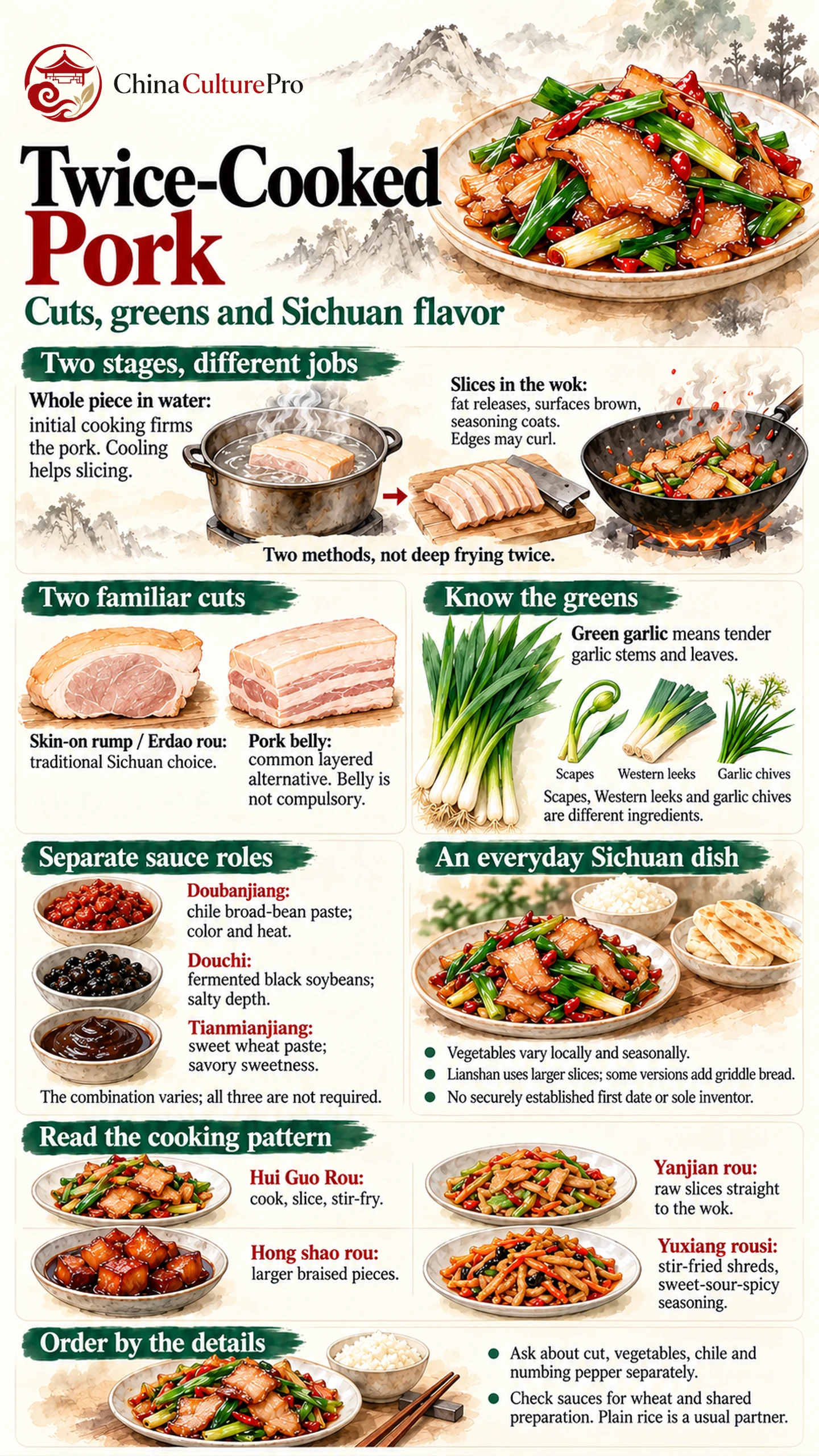
The English name can suggest pork fried twice or yesterday’s meat reheated. This guide explains the two cooking stages, the slices they produce, and the vegetables and fermented seasonings that distinguish this familiar dish within Chinese food.
Why the Pork Is Cooked Twice
The two cooking stages serve different purposes. First, the pork is cooked as one piece in water. It firms up, and cooling makes it easier to cut into connected slices containing skin, fat and lean meat. This prepares the shape that the second stage will transform; it is not simply another round of frying.
In the wok, the slices release some fat and develop a more fragrant, lightly browned surface. Their edges may contract and curve, creating the shallow lamp-dish curl (灯盏窝, dēngzhǎnwō). The name describes a small, cupped shape rather than a uniformly rolled strip. Seasonings coat the slices, while the vegetables add their own aroma and texture.[1]
That curl is a recognizable traditional feature, but every slice need not look identical. A home version may have flatter pieces with browned edges. The result should still be recognizable as sliced pork finished with its seasonings, rather than battered pieces enclosed in a crunchy shell.
“Back in the pot” describes the return for a second cooking stage. It does not require the same physical vessel, overnight leftovers or two deep-frying sessions. For the broader technique behind the final stage, see Chinese wok cooking.
Which Pork Cuts Are Used?
The traditional Sichuan choice is a fatty, skin-on rump or upper hind-leg cut known locally as erdao rou (二刀肉, èrdāo ròu). Its connected skin, fat and lean meat give a slice contrasting textures. It should not be confused with a uniformly lean pork loin.
Pork belly (五花肉, wǔhuāròu) is a common alternative, with visible alternating layers of fat and lean. Its availability makes it familiar in home and restaurant versions outside as well as within China. A belly-based plate can still follow the defining two-stage method; the English dish name does not specify one anatomical cut.[2]
The two choices need not look alike on the plate. Rump slices may have a broader lean section beneath a fatty edge, while belly shows more distinct bands. The useful menu question is which cut the kitchen uses, rather than whether any plate without belly is incorrect.
Garlic Greens and Fermented Sauces
Here, green garlic (蒜苗, suànmiáo) means the tender stems and leaves of the garlic plant. Its pale stalks and leafy green ends add a fresh, garlicky contrast to the pork. Garlic scapes are flowering stalks; Western leeks and garlic chives are different vegetables. Regional Chinese usage can make the word suanmiao ambiguous, so the physical ingredient matters more than a loose English translation.[3]
Other Chinese vegetables, including peppers and onions, appear in some versions. They change the vegetable component rather than the meaning of “twice-cooked.”
- Chile broad-bean paste: Doubanjiang (豆瓣酱, dòubànjiàng), particularly the Pixian style, contributes red-brown color, fermented bean aroma and chile heat. Its ingredients include broad beans and chiles, rather than just crushed fresh peppers.[4]
- Fermented black soybeans: Douchi (豆豉, dòuchǐ) add concentrated salty, fermented depth. They are distinct from the broad beans in the chile paste.
- Sweet wheat paste: Tianmianjiang (甜面酱, tiánmiànjiàng) brings a savory sweetness and a fuller sauce flavor. Despite English labels such as “sweet bean sauce,” wheat can be central to this seasoning.[5]
Kitchens combine these seasonings differently, sometimes with soy sauce. The mix determines how beany, hot or sweet the finished plate tastes; none of these combinations is a universal checklist.
Sichuan Home Cooking and Regional Variations
Within Sichuan cuisine, hui guo rou belongs to everyday shared meals as well as restaurant menus. Its appeal is the combination of fragrant pork, vegetables and assertive fermented seasoning. A red, glossy appearance does not automatically imply the pronounced numbing sensation associated with Sichuan pepper.
The vegetable partner can follow local habits and seasonal availability. Green peppers, garlic scapes, preserved vegetables or dried cowpeas appear in regional accounts. These are variations to name accurately, rather than ingredients to relabel as green garlic. Lianshan, in Guanghan, offers a particularly recognizable version with much larger pork slices; some presentations include pieces of griddle bread that take up the meat’s flavor.[6]
Such local differences do not establish a single inventor for the wider dish. Its precise first date and creator remain uncertain. Stories linking it to offerings or a chance use of cooked meat are traditions about its past, not enough evidence to assign a documented moment of invention.
Twice-Cooked Pork vs Other Chinese Pork Dishes
Preparation and meat shape give more useful clues than red color or a general “spicy pork” label. These are common patterns, not rules covering every restaurant adaptation.
| Блюдо | Main cooking pattern | Form and flavor |
|---|---|---|
| Twice-cooked pork | Whole pork cooked first, then sliced and stir-fried | Thin, sometimes cupped slices; savory fermented sauce, chile warmth and a sweet edge. |
| Salt-fried pork: yanjian rou (盐煎肉, yánjiānròu) | Raw pork sliced and cooked directly in the wok | Often skinless slices; fragrant bean seasoning and heat. Some versions also use a little sugar.[7] |
| Red-braised pork: hong shao rou (红烧肉, hóngshāoròu) | Larger pieces braised; preliminary blanching or searing may occur | Tender chunks with a rich braising glaze, rather than a final stir-fry of thin slices.[8] |
| Fish-fragrant pork: yuxiang rousi (鱼香肉丝, yúxiāng ròusī) | Raw pork cut into shreds and stir-fried | Fine strips in a sweet, sour, salty and spicy seasoning with ginger, garlic and scallion; the flavor name does not require fish.[1] |
The closest method contrast is with yanjian rou: pre-cooked slices versus raw slices entering the wok. Braised pork is distinguished by its larger pieces and braising stage, even when it has already been blanched or browned. Using belly alone cannot identify any one of these dishes.
How to Order and Eat Hui Guo Rou
Use the full Chinese food name when ordering, then ask about the details that matter to you:
- Meat and vegetables: Confirm the cut and whether the accompanying vegetable is green garlic, peppers, onions or another local choice.
- Seasoning: Ask about chile heat, fermented sauce intensity and any Sichuan pepper separately. “Sichuan” alone does not specify the balance.
- Dietary needs: Check the actual pastes and sauces, plus shared preparation equipment when relevant. Appearance cannot reveal wheat ingredients or allergen cross-contact.[9][10]
The dish is commonly eaten with plain rice, which provides a mild partner for the savory sauce. Check whether rice is included or ordered separately. The Chinese rice dishes guide explains other rice accompaniments and complete rice meals.
FAQs About Twice-Cooked Pork
Is twice-cooked pork fried twice?
No. The familiar method combines an initial cooking in water with a later stir-fry of the sliced pork. “Twice-cooked” describes those two stages, not two rounds of deep-frying or a requirement to reheat yesterday’s leftovers.
Is twice-cooked pork always very spicy?
No. Heat varies with the chile paste, its quantity and any additional peppers or seasonings. Some plates emphasize savory bean flavor with mild warmth. Numbing Sichuan pepper is a separate flavor choice, not a requirement of the dish name.
Does hui guo rou have to use pork belly?
No. Skin-on fatty rump or upper hind-leg meat has strong traditional Sichuan precedent. Belly is a widely used alternative. Both provide connected fat and lean, although their slices show different patterns.
Is twice-cooked pork gluten-free?
Not automatically. Sweet wheat paste, some doubanjiang and many soy sauces contain wheat. Check every product and the kitchen’s handling practices; pork and vegetables alone do not establish whether the finished plate is gluten-free.[9]
Источники
[1] Sichuan Administration for Market Regulation. DB51/T 3126—2023: Tianfu Tourism Food Preparation Specifications — Dishes, sections B.3–B.5
[2] Fuchsia Dunlop, NPR excerpt hosted by VPM. Twice-Cooked Pork
[3] Hubei Foreign Affairs Office. 趣说方言《蒜苗与蒜薹》 — on regional allium terminology
[4] Mission of China to the European Union. 郫县豆瓣:中欧地理标志协定产品推介(四十二)
[5] Lu Haichao et al.. 面酱连续蒸面机在甜面酱生产中应用 — sweet wheat paste fermentation research
[6] Sichuan Provincial Local Chronicles Office. 【美食】连山回锅肉 — regional variations and historical uncertainty
[7] CCTV, Tiantian Yinshi. 生爆盐煎肉, 24 August 2015
[8] CCTV, Shi Lai Yun Zhuan. 老醋红烧肉, 8 September 2013
[9] U.S. Food and Drug Administration. Questions and Answers on the Gluten-Free Food Labeling Final Rule
[10] Food Allergy Research & Education. Avoiding Cross-Contact