
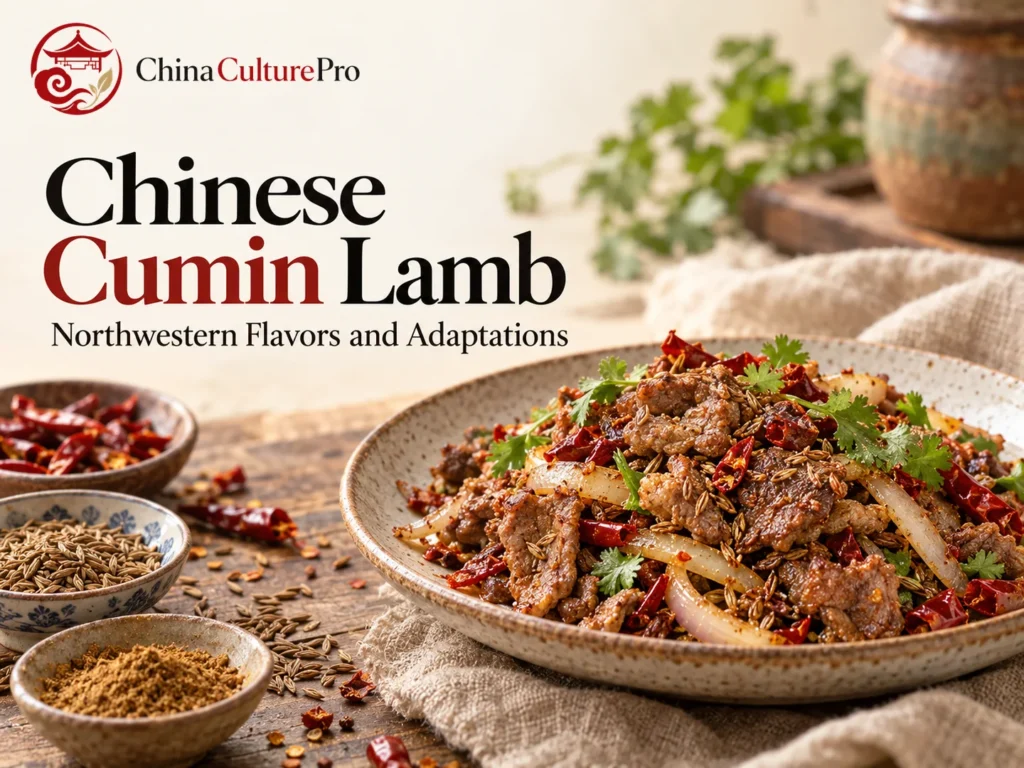

Quick Answer: What Is Chinese Cumin Lamb?
Chinese cumin lamb (孜然羊肉, zīrán yángròu) is a lamb dish strongly associated with northwestern Chinese flavors, commonly served as a plated stir-fry.
- Meat: Lamb appears as thin slices, strips or small pieces, depending on the preparation.
- Flavor: Cumin leads; chile, numbing pepper and other aromatics vary between versions.
- Presentation: Spices cling to the meat and accompanying vegetables, usually without a pool of thick gravy.
The name does not prescribe one cut of lamb, fixed heat level or mandatory onion-and-cilantro combination. Cumin-seasoned skewers share a flavor vocabulary, but their grilled, skewered presentation makes them a different dish.
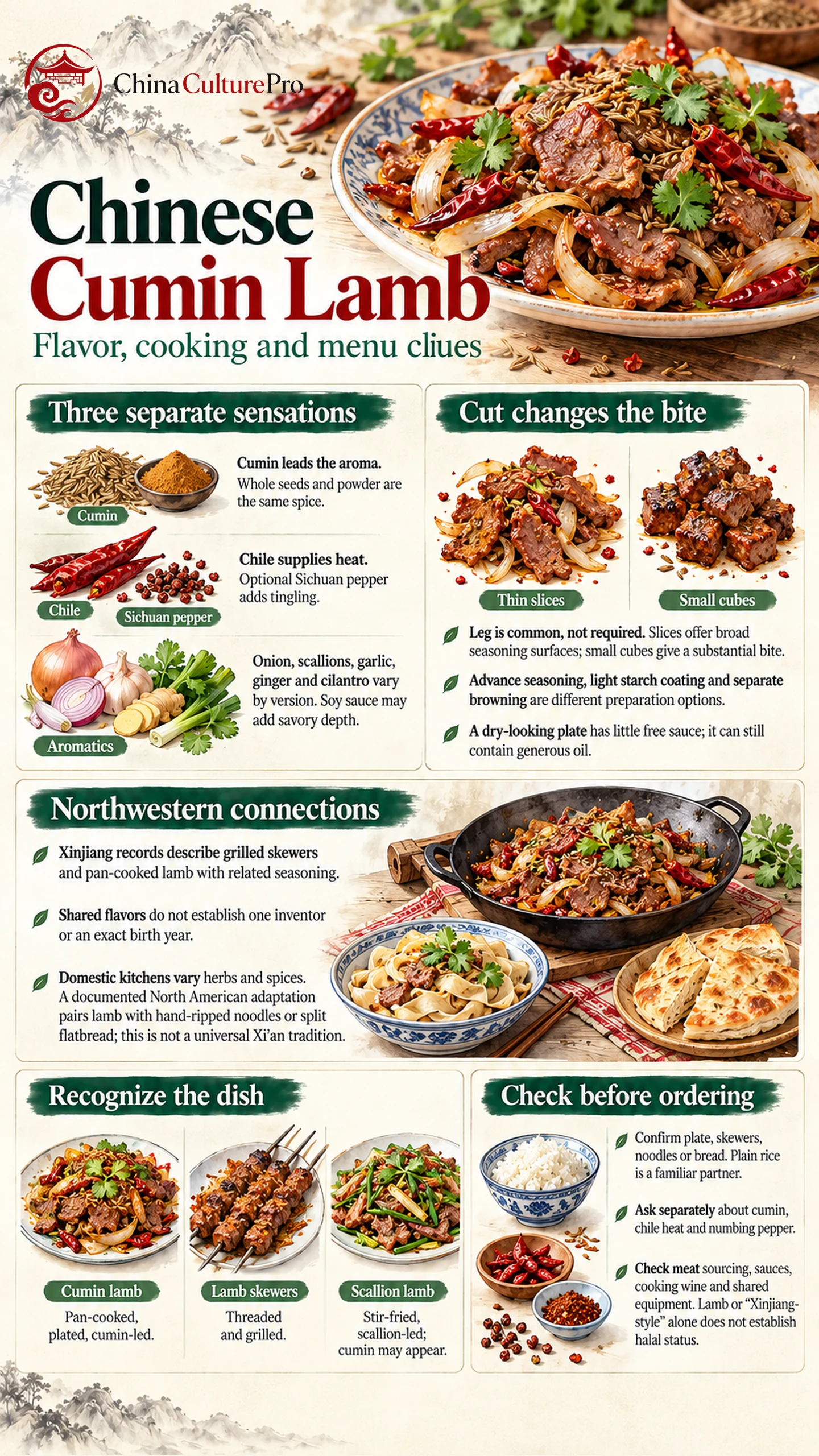
On a Chinese food menu, this lamb dish stands out for its cumin fragrance and spice-coated surface. A typical plate has little free sauce. Knowing its flavor and cooking cues helps distinguish it from grilled skewers and other lamb stir-fries.
Cumin, Chili and Aromatics: Separate Flavor Roles
Cumin, called ziran (孜然, zīrán), supplies the dish’s characteristic earthy, warm fragrance. Whole seeds and ground cumin are forms of the same spice. Seeds leave recognizable flecks and a textured bite; powder spreads readily across the meat. Some preparations combine both; a plate without obvious whole seeds may still be strongly cumin-seasoned.[1]
- Cumin fragrance: This is the defining aroma, distinct from how hot the food tastes.
- Chile heat: Dried chiles or chile powder supply heat and, depending on preparation, a toasted aroma. Red color alone cannot tell you how hot a serving will be.
- Numbing pepper: Sichuan pepper, or huajiao (花椒, huājiāo), adds a separate tingling sensation. It is optional; Sichuan peppercorns are not an automatic ingredient in every cumin lamb dish.
Onion, scallions, garlic, ginger and cilantro provide other layers of aroma. Onion can contribute sweetness, while cilantro brings a fresh herbal contrast to browned meat. A kitchen may choose several of these without using them all. One documented preparation explicitly lists Sichuan pepper as optional.[2]
Some versions use light soy sauce for savory seasoning. It supports the lamb and spices rather than replacing cumin as the main flavor. The dish can therefore taste deeply seasoned without having a thick soy-based sauce.
How the Lamb Is Cut and Cooked
Leg meat is a common choice in documented preparations, but the dish name does not require a single cut. Thin slices give a different bite from small cubes: slices offer broad surfaces for seasoning, while small cubes give a more substantial bite. A cut’s connective tissue and the way it is sliced also affect tenderness.[3]
Preparation varies before the meat reaches the serving plate. Some cooks season it in advance; some add a light starch coating; others brown the meat separately before combining it with aromatics and spices. These choices affect surface texture and how seasoning adheres. They should not be treated as one mandatory restaurant procedure.[1]
A televised pan-cooked lamb preparation, for example, browns the lamb, removes it, then returns it to the pan with scallions and spices. This is a documented variation rather than a rule that every serving must follow.[4]
The recognizable result is often browned lamb with a coating of spice and little free liquid. Within Chinese wok cooking, this is a presentation cue, not proof of one exclusive technique. A dry-looking plate can still contain generous oil, which carries spice aromas and coats the ingredients. Browning contributes surface flavor; the finished tenderness still depends on the cut and how it is handled.
Northwestern Roots and Restaurant Adaptations
The lamb-and-cumin association is particularly strong in Xinjiang cuisine. A regional food record describes both seasoned lamb skewers and chaokaorou (炒烤肉, chǎokǎoròu), a preparation of lamb slices cooked in a pan. This gives a concrete local connection between grilled-meat flavors and pan cooking. It does not establish that every restaurant dish called cumin lamb is identical to chaokaorou.[5]
Xinjiang’s diverse food traditions also intersect with Chinese Muslim foodways. That context helps explain the prominence of lamb, but it should not turn a broad regional label into a single recipe or a certification claim. Neither one inventor nor an exact birth year for the nationwide restaurant dish is established by these records.
As the dish circulates, kitchens vary the amount of cilantro, onion, chile and optional numbing pepper. Finding it in a Sichuan or Hunan restaurant tells you where it is being served; it does not by itself prove a Sichuan or Hunan origin. Changes in cut and surface texture can be as noticeable as changes in spice.[2][4]
A documented North American adaptation pairs spicy cumin lamb with hand-ripped noodles or places it inside a split flatbread. These formats connect with biang biang noodles and the filled-bread format of roujiamo, but this particular combination should not be presented as a universal Xi’an tradition. The cookbook author describes those combinations as unusual in Xi’an.[6]
Overseas versions can remain strongly spiced. Their location alone does not predict greater sweetness, milder chile or the absence of numbing pepper.
Cumin Lamb vs Lamb Skewers and Scallion Lamb
Look at the cooking method and main flavor cue together. A shared jar of cumin does not make these three dishes interchangeable:
| Блюдо | Cooking and serving form | Main recognition cue |
|---|---|---|
| Cumin lamb | Lamb slices or small pieces pan-cooked and served on a plate. | Cumin is the leading aroma; spices coat the meat and any accompanying vegetables. |
| Lamb skewers: yangrouchuan (羊肉串, yángròuchuàn) | Pieces of lamb threaded onto skewers and grilled. | Grilled surfaces accompany cumin-and-chile seasoning in familiar Xinjiang-style versions. |
| Scallion lamb: congbao yangrou (葱爆羊肉, cōngbào yángròu) | Lamb stir-fried with prominent scallions. | Scallion aroma leads the identification; exact seasonings vary, so the name is not a guarantee of no cumin. |
The skewer version belongs to Chinese barbecue, even when its spices closely resemble those on a cumin lamb plate. Pan-cooked lamb can develop browned edges, but those edges do not make it grilled meat.[5]
A documented scallion-lamb preparation emphasizes scallions and savory seasonings. Other kitchens may add cumin; the useful distinction is the dish’s overall emphasis, rather than treating one ingredient as a rigid naming test.[7]
How to Order and Eat Chinese Cumin Lamb
Read the full Chinese dish name and confirm what arrives with it. Three checks clarify most menu differences:
- Format: Ask whether it is a shared plate, skewers, a noodle dish or a filled flatbread. Plain rice is a familiar accompaniment to the plated version.
- Seasoning: Discuss cumin strength, chile heat and numbing pepper separately. Confirm onion and cilantro if either matters to you.
- Ingredients and handling: Check meat sourcing, soy sauce, mixed seasonings and cooking wine. Some versions use Shaoxing cooking wine; its presence cannot be inferred from the finished plate.[1]
“Xinjiang-style” and “lamb” do not establish halal status. Confirm suitable meat sourcing, all ingredients and preparation arrangements.[8] For gluten restrictions or allergies, check sauces, including possible wheat in soy sauce, and shared equipment as well as the visible meat. Removing a garnish does not remove ingredients already mixed through the dish.
FAQs About Chinese Cumin Lamb
Is Chinese cumin lamb always spicy?
No. Cumin supplies aroma rather than chile heat. The heat depends on the chiles used, while Sichuan pepper adds a different numbing sensation when included. Ask about both separately if you want a fragrant version with little heat or no tingling.
Is cumin lamb a Sichuan dish?
Its flavor identity is strongly associated with northwestern China, particularly Xinjiang. Sichuan restaurants may serve versions with numbing pepper, but the presence of that spice does not establish a Sichuan origin. Restaurant location and the dish’s broader regional associations are different questions.
Is cumin lamb the same as lamb skewers?
No. They may share cumin-and-chile seasoning, but the usual plated dish is pan-cooked, while skewers are grilled on sticks. Their serving forms and cooking surfaces differ. Choose by the full menu description rather than assuming that all cumin-seasoned lamb is the same item.
Is cumin lamb always halal?
No. Lamb is only one part of the assessment. Suitable meat sourcing, seasonings, possible cooking wine and preparation arrangements all matter. A Xinjiang-style label alone is insufficient; ask the restaurant directly about the specific dish and its halal assurances.
Источники
[1] Judy, The Woks of Life. Xinjiang Cumin Lamb
[2] Maggie Zhu, Omnivore’s Cookbook. Real-Deal Xinjiang Cumin Lamb (孜然羊肉)
[3] Nagi Maehashi, RecipeTin Eats. Xinjiang Cumin Lamb Stir Fry
[4] CCTV-1. 《天天饮食》20140612:炒烤羊肉
[5] China National Radio, Xinjiang. 《新疆名优小吃精品汇萃》系列篇
[6] Jason Wang with Jessica Chou, authorized cookbook excerpt in TASTE. Spicy Cumin Lamb
[7] CCTV-1. 《天天饮食》20131111:辣炒拼葱爆羊肉
[8] IFANCA Pakistan. FAQs: halal ingredients and food preparation