

Quick Answer: What Is Thailand’s Chinese Vegetarian Festival?
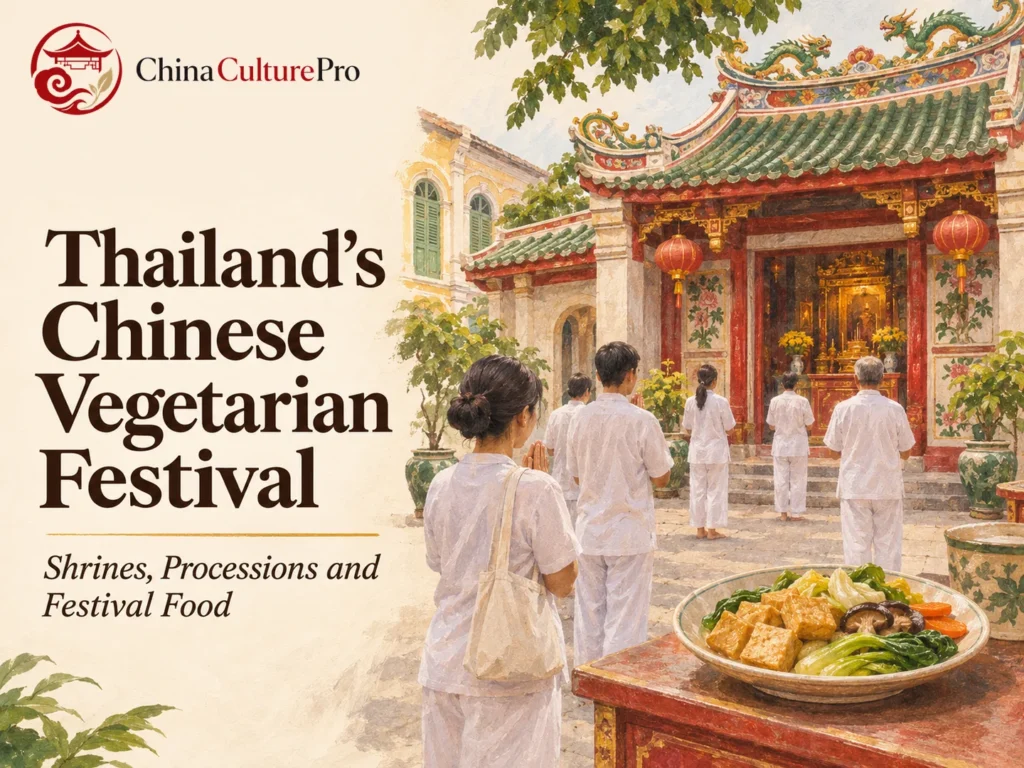
Thailand’s Chinese Vegetarian Festival is an annual religious observance with food traditions, shrine ceremonies and public gatherings. Phuket’s Hokkien Chinese community calls it Jia Chai. The festival honors the Nine Emperor Gods (九皇爷, Jiǔhuángyé) and typically runs for nine days beginning in the ninth month of the Chinese lunar calendar. Bangkok and other places in Thailand hold their own observances. [1][2][3][4]
- Calendar: The lunar date gives the festival its place in the year. Gregorian dates shift. [1][2]
- Shrines: Phuket’s shrine communities organize ceremonies and processions. [1][2]
- Food: Je cooking commonly leaves out animal foods and some pungent plants. [3][5]
Use the local shrine or organizer’s account to understand how a particular city observes the festival.
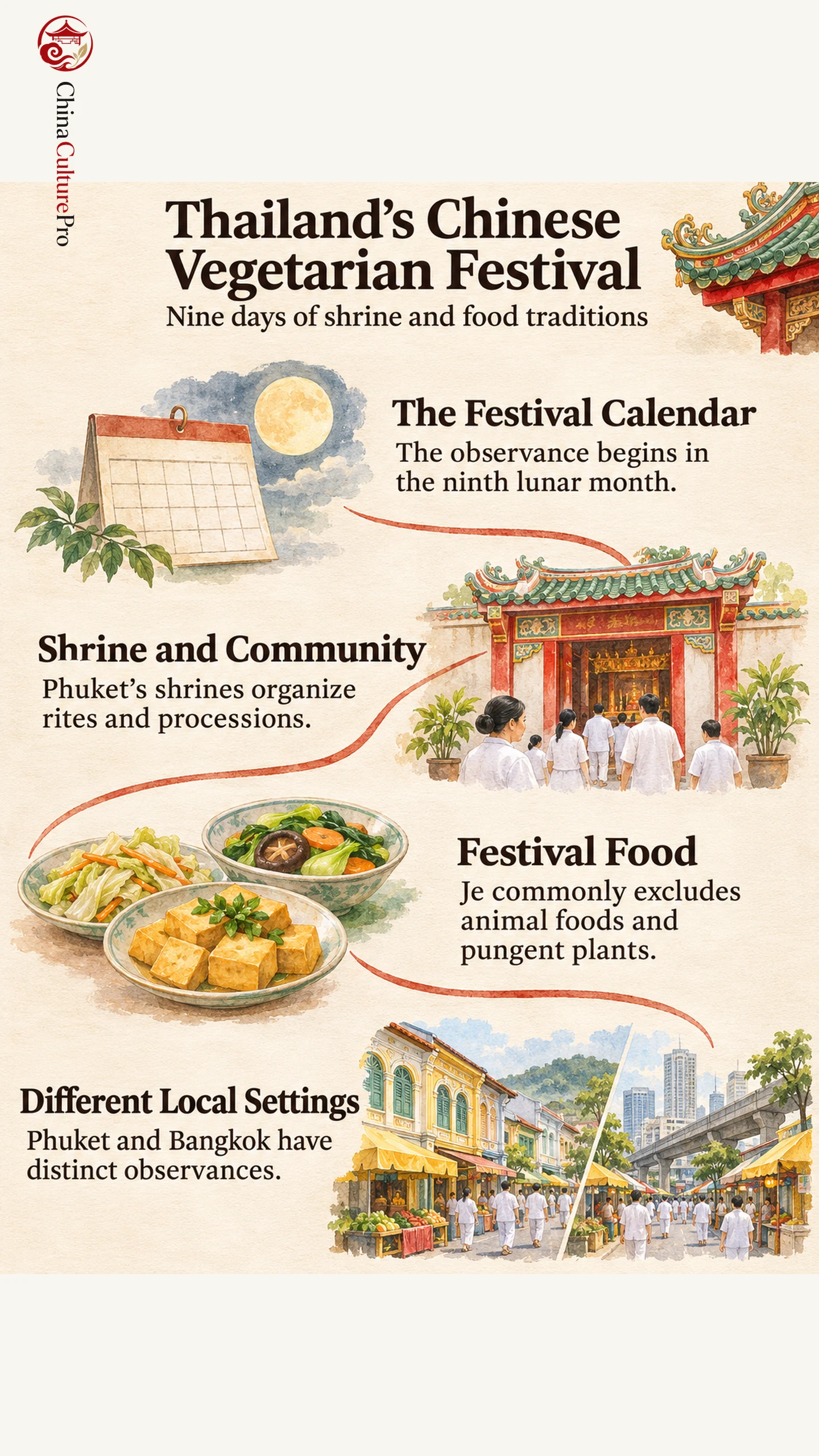
At the same point in the lunar year, a Phuket shrine and a Bangkok food stall may both be part of the Vegetarian Festival. Each shows a different side of it. Shrines bring people together for worship and processions, while food vendors make the observance visible in markets and streets. [1][2][4]
Why the Festival Follows the Ninth Lunar Month
The Tourism Authority of Thailand describes Phuket’s annual observance as beginning in the ninth month of the Chinese lunar calendar and continuing for nine days and nights. Dates on the Gregorian calendar change from year to year. The Chinese lunar calendar guide explains why an observance tied to a lunar month moves on a Gregorian calendar. [1][2]
The festival’s name also changes with context. Jia Chai is the local name used in Phuket’s Hokkien Chinese tradition. Vegetarian Festival is the usual English label in Thai tourism materials. The wider Nine Emperor Gods Festival helps explain the religious context behind the food-centered English name. [1][2][3]
Why Shrines Matter in Phuket
Accounts of the Phuket festival often connect its early history with Kathu, an area associated with tin mining and Chinese migration. A Southeast Asian festival study records several dates and versions of the origin story, including one that credits an opera troupe in the 1820s. The study treats that account as one local explanation of the festival’s beginnings and notes the uncertainty about the year. [3]
In Phuket, shrines organize ceremonies to welcome the gods and arrange public processions. The tourism authority identifies Jui Tui as one example. A shrine is a local institution with people responsible for the ceremonies, and several shrines can take part in the same observance. The guide to Chinese diaspora temples explains other ways migrant communities organized around places of worship. [1][2]
What Je Food Means During the Festival
Je, also written jay in English, commonly describes festival food prepared without meat, fish, eggs or dairy. Cooks also commonly omit pungent ingredients such as garlic and onion. The restrictions belong to an observance of purification and discipline for participants. During the festival, some shops and stalls prepare dishes according to those restrictions. [1][4][5]
Look for dishes built around tofu, mushrooms, vegetables or noodles. A label can tell you which tradition a vendor follows, but a recipe or ingredient question gives you more detail about a specific dish. The guide to Chinese vegetarian food gives broader context for plant-based dishes in several Chinese cooking traditions. [4][5]
How Phuket and Bangkok Observances Differ
Phuket’s tourism materials emphasize shrines and processions in Hokkien Chinese neighborhoods. In Bangkok, the tourism authority also documents Vegetarian Festival observances in Yaowarat, the city’s Chinatown. The national notices show celebrations across several Thai provinces, with different organizers and activities. The shrine or district’s own program tells you what is held locally. [2][4]
Look at the local setting to understand what you are seeing. A shrine ceremony, a street procession and a food market can each be part of the festival. A shrine community and a market vendor contribute to the same observance in different ways. The Chinese diaspora culture guide gives other examples of how an inherited practice takes shape in a local community. [1][2][4]
FAQs About Thailand’s Chinese Vegetarian Festival
How long does the Phuket Vegetarian Festival last?
Phuket’s core observance lasts nine days and nights and begins in the ninth month of the Chinese lunar calendar. Its Gregorian dates change each year. [1][2]
Is je food the same as ordinary vegetarian food?
Je commonly excludes animal products and pungent plants such as garlic and onion. Ask about a specific preparation if the exact ingredients matter to you. [4][5]
Is the festival held only in Phuket?
Phuket is a prominent location. Bangkok and several other places in Thailand also hold local Vegetarian Festival observances. [2][4]
Источники
[1] Tourism Authority of Thailand. The Vegetarian Festival: A Century-Spanning Ritual of Faith
[2] Tourism Authority of Thailand Newsroom. TAT Highlights Phuket Vegetarian Festival 2026
[3] Singapore Chinese Cultural Centre. The Nine Emperor Gods Festival in Southeast Asia
[4] Tourism Authority of Thailand Newsroom. Thailand Celebrates Vegetarian Festival 2026 Across the Country
[5] Visit Thailand. Vegetarian, Vegan and Halal Food in Thailand