

Quick Answer: How Did Chinese New Year Become a Public Festival in Helsinki?
Helsinki and Beijing helped launch a public celebration of the Spring Festival (春节, chūnjié) at Helsinki’s Lasipalatsi Square in 2007. The event brought Chinese New Year traditions into a central civic space. Later programmes used other streets, neighbourhood cultural centres and a community-led market fair. [1][2][3][4][5][6]
- First public celebration: It took place on 17 February 2007 at Lasipalatsi Square.
- Recognizable traditions: Dragon and lion dances, lanterns and market stalls have featured across editions.
- Changing locations: A 2023 programme used Keskuskatu and multiple cultural centres. In 2026 the Folk Fair was announced for Narinkkatori. [1][2][4][5]
Dates, venues and producers can change with the yearly programme. [4][5]

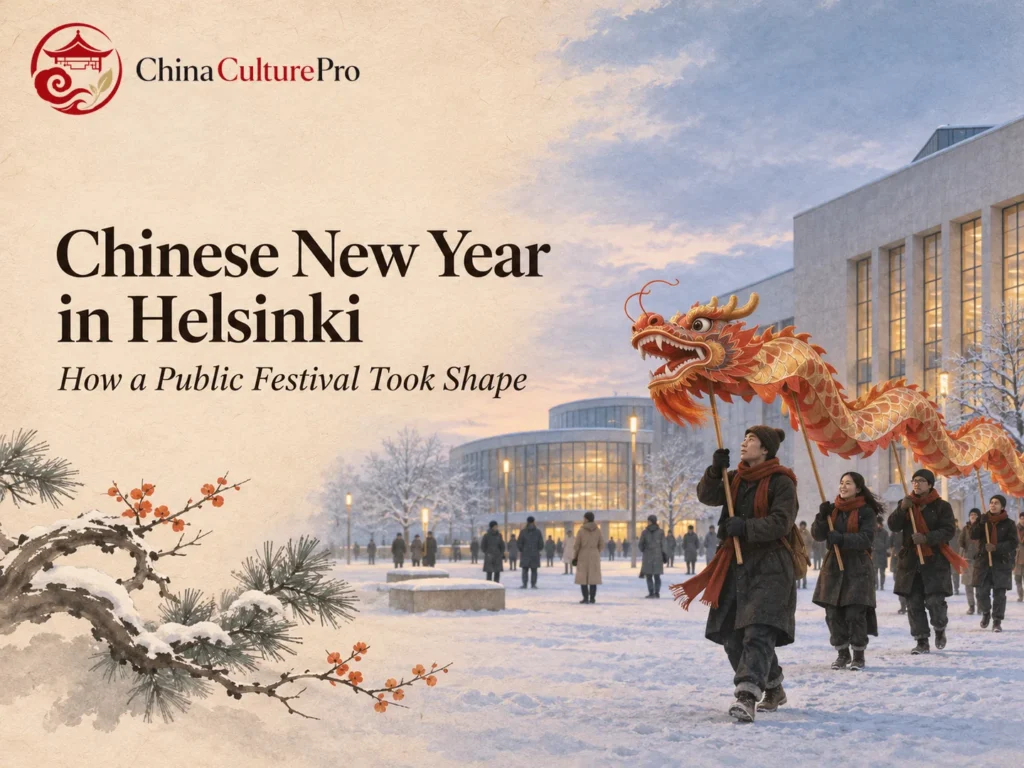
A photograph in Helsinki’s city archive shows a dragon dance in Lasipalatsi Square on 17 February 2007. The city’s first public Chinese New Year festival was taking shape downtown. The square placed a celebration tied to Chinese family life in view of anyone passing through the winter city centre. [2][3]
How the First Festival Took Shape in 2007
Helsinki and Beijing co-hosted the first public festival. Helsinki’s 2007 cultural office report credits the city cultural office, the Finland–China Society and the Chinese embassy with producing the event. The city described it as open to everyone, making the festival a public event from its first edition. [2][3]
The festival archive identifies lanterns, market stalls and dragon and lion dances among the recurring elements. A market stall or a dance gave passersby a way to take part without needing to know the festival calendar. For the wider custom and its family setting, see the guide to Chinese New Year. [1][2][4]
How Helsinki Made the Festival Its Own
The 2023 festival listed ice carving and dragon and lion dances on Keskuskatu. The winter sculptures also appeared at cultural centres including Caisa in Kallio, Stoa in Itäkeskus and Vuotalo in Vuosaari. Helsinki and Beijing still hosted that edition. The Helsinki Events Foundation produced it with Caisa and the Finland–China Society. Alongside the city-centre programme, the cultural centres organized activities of their own, giving local visitors more than one place to join the celebration. [4]
The same programme listed a dance procession in Citycenter and a digital programme from Beijing on the Helsinki channel. Its organizers also described a local tradition of marking the turn of the Chinese year at 6 p.m. In the Finnish winter, that is midnight in Beijing. The programme offered a way to mark the same change of year from two cities. [4]
What the 2026 Folk Fair Shows About Community Participation
For the February 2026 Folk Fair, the organizer’s page listed Narinkkatori in Kamppi. It named the Chinese Finnish Friendship Association as organizer, working with other Chinese communities. This edition illustrates a shift in how the public programme was presented, from an original city-to-city partnership to a fair credited to local community organizations. [2][5][6]
A central square lets a festival reach people who were never invited to a private celebration or a community hall. A neighbourhood cultural centre can connect it with recurring local activities. Both are familiar ways that Chinese diaspora communities share seasonal customs. The guide to Chinatown culture explains how festivals work in places with long-established gathering districts. [2][3][4][5]
Three Editions and Their Public Spaces
| Год | Public space | What the archive records |
|---|---|---|
| 2007 | Lasipalatsi Square | Helsinki and Beijing co-hosted the first public festival. |
| 2023 | Keskuskatu and neighbourhood cultural centres | Ice carving, performances and additional programmes across the city. |
| 2026 | Narinkkatori, Kamppi | A community-organized Folk Fair was announced for the central square. |
Helsinki’s records describe particular editions and their settings. For another European example with a distinct history and programme, see Chinese New Year in London. [2][4][5]
FAQs About Chinese New Year in Helsinki
When did Helsinki first hold a public Chinese New Year festival?
The city’s records date the first open public event to 17 February 2007 at Lasipalatsi Square. [2][3]
Has the festival always taken place in the same square?
No. A 2023 programme used Keskuskatu and several cultural centres, and the 2026 Folk Fair listing gave Narinkkatori as the venue. [4][5]
Источники
[1] Helsinki Chinese New Year. History of the Festival
[2] Helsinki Cultural Office. 2007 Annual Report
[3] City of Helsinki History. An Ethnically and Culturally Diverse Helsinki
[4] Helsinki Events Foundation. Helsinki’s Chinese New Year Festival on Keskuskatu
[5] Helsinki Chinese New Year. Spring Festival and the 2026 Helsinki Folk Fair
[6] Chinese Finnish Friendship Association. Happy Chinese New Year in Finland Folk Fair