


Quick Answer: What Is Teochew Opera?
Teochew opera (潮剧, Cháojù) is a form of Китайская опера sung and spoken in Teochew. It developed in eastern Guangdong and became part of the theater life of Teochew-speaking communities elsewhere. Additional voices can join a soloist from offstage.[1][3][4][5]
- Language: The same regional speech is heard in dialogue and song.[1][4][5]
- Ensemble: Listen for the moment the lead voice is joined by other singers.[3]
- Repertoire: Some traditional plays reached wider audiences as opera films.[1][6][7]
Start with one sung passage and listen for the difference between the lead voice and the offstage answer.
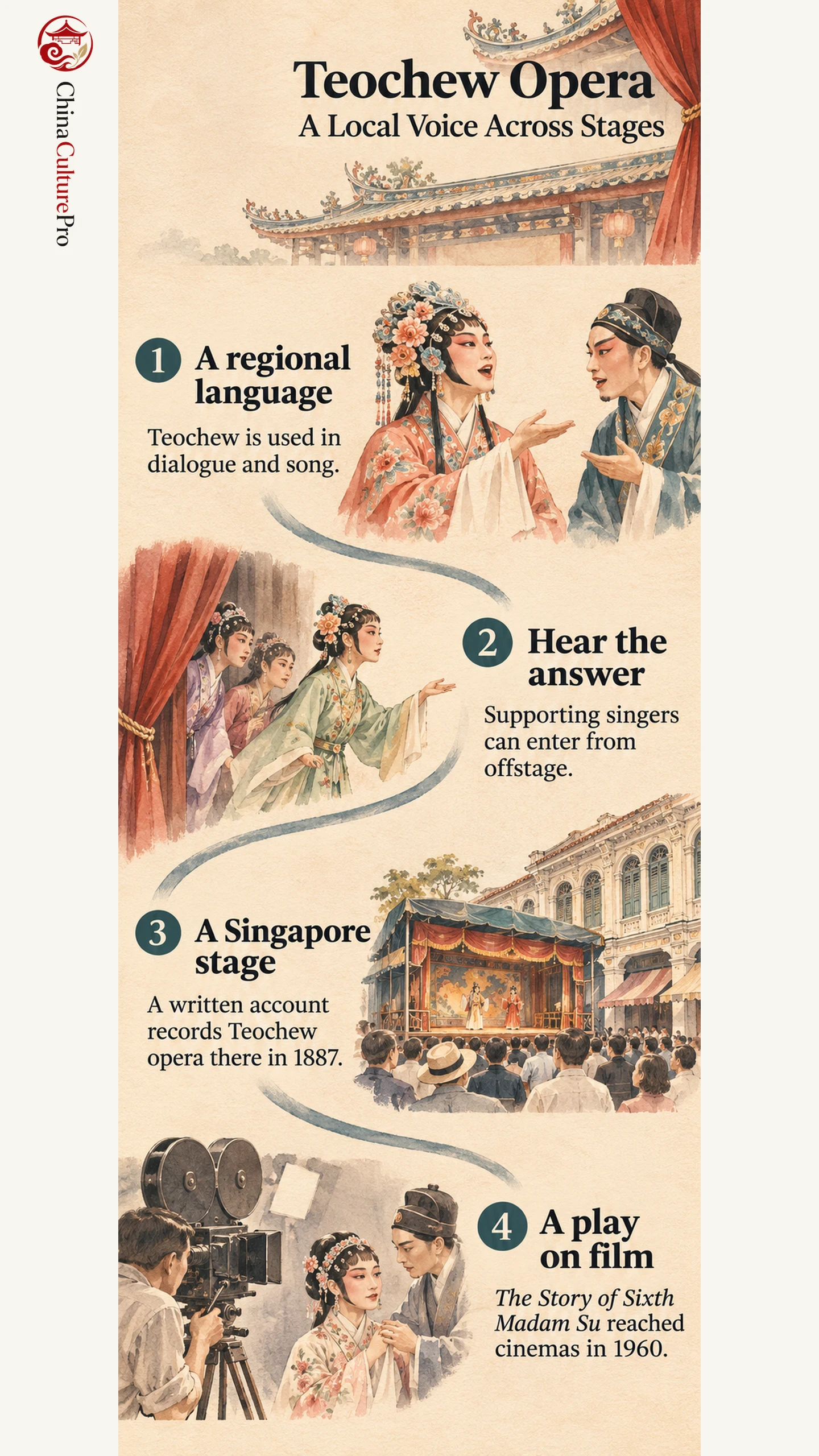
A single voice holds the attention onstage. When others join from out of sight, the phrase can suddenly fill the room.
A Chaozhou Tradition Across Several Cities
The genre belongs to the family of southern theater traditions that grew out of early southern drama. It identifies eastern Guangdong and southern Fujian among its main areas of circulation. Communities overseas also built local companies and settings for the form.[1][4][5]
One published account places Teochew opera in Singapore by 1887. Nineteenth-century performances took place near temples and in streets where the community lived. In Bangkok, researchers have documented the continuing role of theater in community ritual settings.[4][5]
Listen for the Supporting Voices
Supporting voices are known as bangsheng (帮声, bāngshēng). The supporting voices can carry part of a line while the audience’s attention stays on the actor. Listen for where the other voices enter in relation to the soloist.[3]
The repertoire includes sequences of named melodies and singing organized around variations of rhythmic patterns. As you listen, pick out the point where the beat changes and notice how the words fit the new pace.[2][3]
A Play That Traveled on Film
The Story of Sixth Madam Su (苏六娘, Sū Liùniáng) is a traditional work and was released as a film in 1960. The Hong Kong Film Archive places it in a period when Teochew-language films drew wider audiences. Its distributor in Singapore was Kong Ngee. The film ran for an extended period there.[1][6][7]
The national heritage entry also lists Tale of the Lychee and Mirror (荔镜记, Lìjìng Jì). Titles can circulate between traditions. The genre and cast credits help identify the version you are hearing.[1][6]
FAQs About Teochew Opera
Are Chaoju and Teochew opera two names for the same form?
Yes. Chaoju is the Mandarin pinyin form of the Chinese name. Teochew opera and Chaozhou opera are common English labels.[1][4][5]
Is Teochew opera the same as Cantonese opera?
They are distinct stage traditions associated with Guangdong. Teochew opera uses Teochew speech. The guide to Cantonese opera explains the other form and its repertory.[1][4]
Источники
[1] China Intangible Cultural Heritage Network. Teochew Opera
[2] China Intangible Cultural Heritage Network. Teochew Opera in Jieyang
[3] China Intangible Cultural Heritage Network. Chaozhou Intangible Heritage
[4] Сингапурский китайский культурный центр. Teochew Opera in Singapore
[5] Binghamton University. Chaozhou Theater in Diasporic Communities
[6] Hong Kong Film Archive. Chaozhou Dialect Films
[7] Hong Kong Baptist University. Teochew Film Circulation in Southeast Asia