
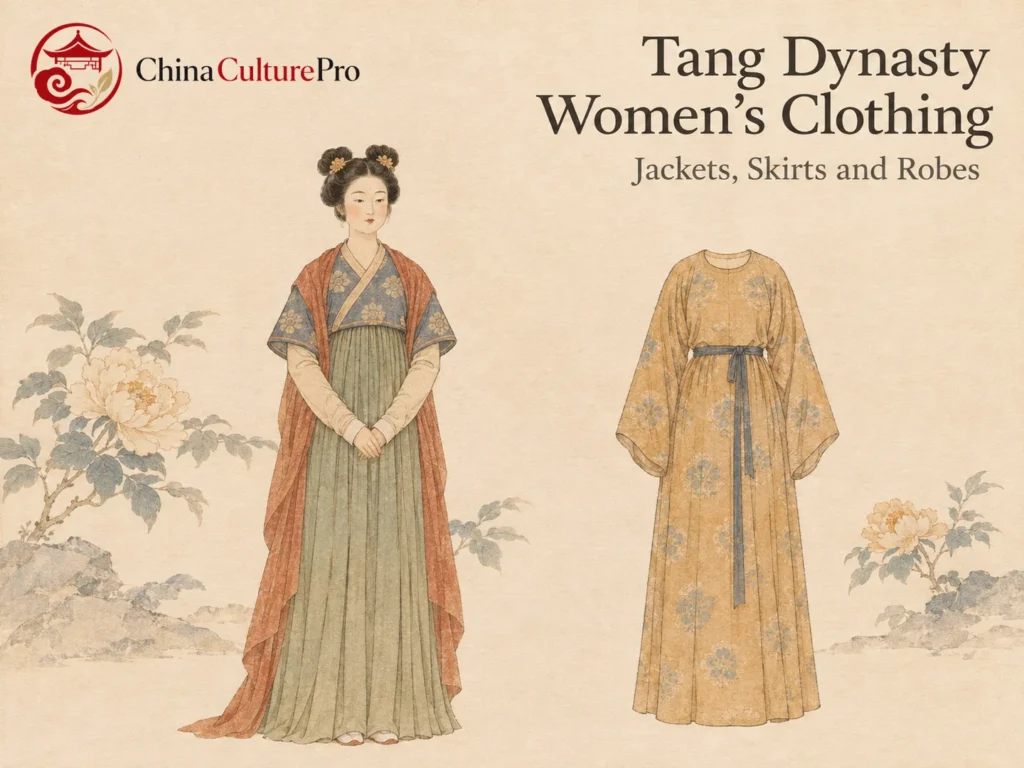

Quick Answer: What Did Tang Women Wear?
A short jacket, a separate high skirt and a draped scarf form one recognizable combination in Tang dynasty art. Other figures wear belted robes, trousers or boots. Museum objects preserve several choices for layering, collars and skirt height.[1][2][4][5][7]
- Jacket and skirt: A painted wooden attendant has a short jacket over a high-waisted garment.[2]
- Scarf and extra layer: A glazed ceramic figure shows a shoulder scarf over a layered top and skirt.[1]
- Robes and trousers: Other figurines show round collars or turned lapels, sometimes with trousers.[4][5]
Start with a dated object before choosing a garment pattern or interpreting its colors.

The skirt band catches your eye first on many Tang figures. To see how the outfit was assembled, trace the jacket sleeves, the closure and any scarf across the shoulders. A second figure in a belted robe shows how much the outline could change.
Read the Jacket, Skirt and Scarf
The National Museum of China catalogs a sancai (三彩, sāncǎi) glazed woman with a narrow-sleeved crossed top, a short-sleeved layer and a long skirt tied high. A pibo (披帛, pībó), or draped scarf, runs over her shoulders. The shorter sleeves end above the narrow ones, so you can distinguish the two upper layers even in a front view.[1]
At the Metropolitan Museum of Art, a late seventh- to early eighth-century wooden attendant shows another short jacket and high waist. A study of High Tang murals also identifies different skirt-band heights, including positions at the waist and higher on the torso. Ruqun (襦裙, rúqún) is a useful label for a jacket-and-skirt combination. Qixiong ruqun describes the chest-high version you may encounter in modern clothing listings.[2][7]
Check the shoulder line before treating every long strip of cloth as a belt. A scarf can fall to either side of the body, while a skirt tie belongs at the top edge of the lower garment. On some images part of the scarf or waistband disappears behind the arms.
Compare the Surviving Silk
The China National Silk Museum catalogs a short silk top with fronts that overlap slightly and sleeves that widen. It also presents a silk skirt with straps, patterned bands and decoration near the hem. Treat the top and skirt as separate examples. The museum presents them together in its discussion of Tang textiles.[3]
The skirt’s dyed pattern gives a textile detail that glaze cannot supply. A glaze records the ceramic surface, while patterned silk can be examined for joins, edges and the placement of color. For a closer look at one historical way to transfer repeated patterns to cloth, see Chinese clamp-resist dyeing.[3]
Compare the evidence for each part. A textile can tell you how a sleeve widens from the shoulder toward the cuff. A figure can show where that sleeve sits when the arm is bent. For a later set of objects and images, the Song women’s clothing guide applies the same method to surviving gauze layers and skirts.
Where Robes and Trousers Fit
A National Museum figurine combines a double-bun hairstyle with a round-collared robe, a belt and boots. Another wears a turned-lapel blue robe with trousers and a felt hat. On the round-collar figure, trace the curved neckline before looking for the fastening. On the other, the folded lapels frame a deeper opening.[4][5]
Museum research discusses hufu (胡服, húfú), a historical term for dress associated with peoples beyond the Central Plains, alongside dress conventionally associated with men. A robe can share features with both categories. Look at the collar, belt, trousers, shoes and headwear together before drawing conclusions about how the garments were worn.[6]
Choose a Reference for Modern Wear
Pick a dated image or garment and note where the jacket ends, how the skirt is supported and how much the sleeves cover. If the source shows a scarf, leave room to drape it so the upper layers remain visible. When you sit down or lift your arms, check that the skirt band stays where you want it and that the jacket does not pull.
For a belted robe, check how far the front opens when you walk and whether the belt leaves the sleeves free to move. If you plan to add buyao hair ornaments, use a separate reference for the ornament and check whether your chosen hairstyle can hold it securely. The hanfu dressing guide covers fitting the layers in sequence.
FAQs About Tang Dynasty Women’s Clothing
Were all Tang skirts tied at the chest?
Mural evidence includes skirt bands at different heights. The mural study records bands at the waist and higher on the torso.[7]
Can a ceramic figurine tell us which fabric was worn?
A figurine can show the silhouette, the visible layers and how the wearer carried them. Use cataloged textiles for evidence of weave, seams or the dyes in a surviving piece.[1][3]
Did Tang women ever wear round-collar robes?
Yes. A National Museum of China figure depicts a woman with a round-collared robe, a belt and boots. The individual figure establishes a documented combination.[4]
Источники
[1] National Museum of China. Three-Color Glazed Female Figurine
[2] The Metropolitan Museum of Art. Female Attendant
[3] China National Silk Museum. Tang Garments and Dyed Silks
[4] National Museum of China. Female Figurine in Conventionally Male Clothing
[5] National Museum of China. Female Figurine in a Turned-Lapel Robe
[6] National Museum of China. Tang Women in Male Clothing and Western-Region Dress
[7] Journal of Donghua University. Research on Women’s Dress in High Tang Murals