

Quick Answer: Who Was King Fuchai of Wu?
King Fuchai of Wu (吴王夫差, Wú Wáng Fūchāi, reigned 495–473 BCE) ruled during the late Spring and Autumn period. He defeated the neighboring state of Yue (越, Yuè) early in his reign. Yue later recovered and conquered Wu.[2]
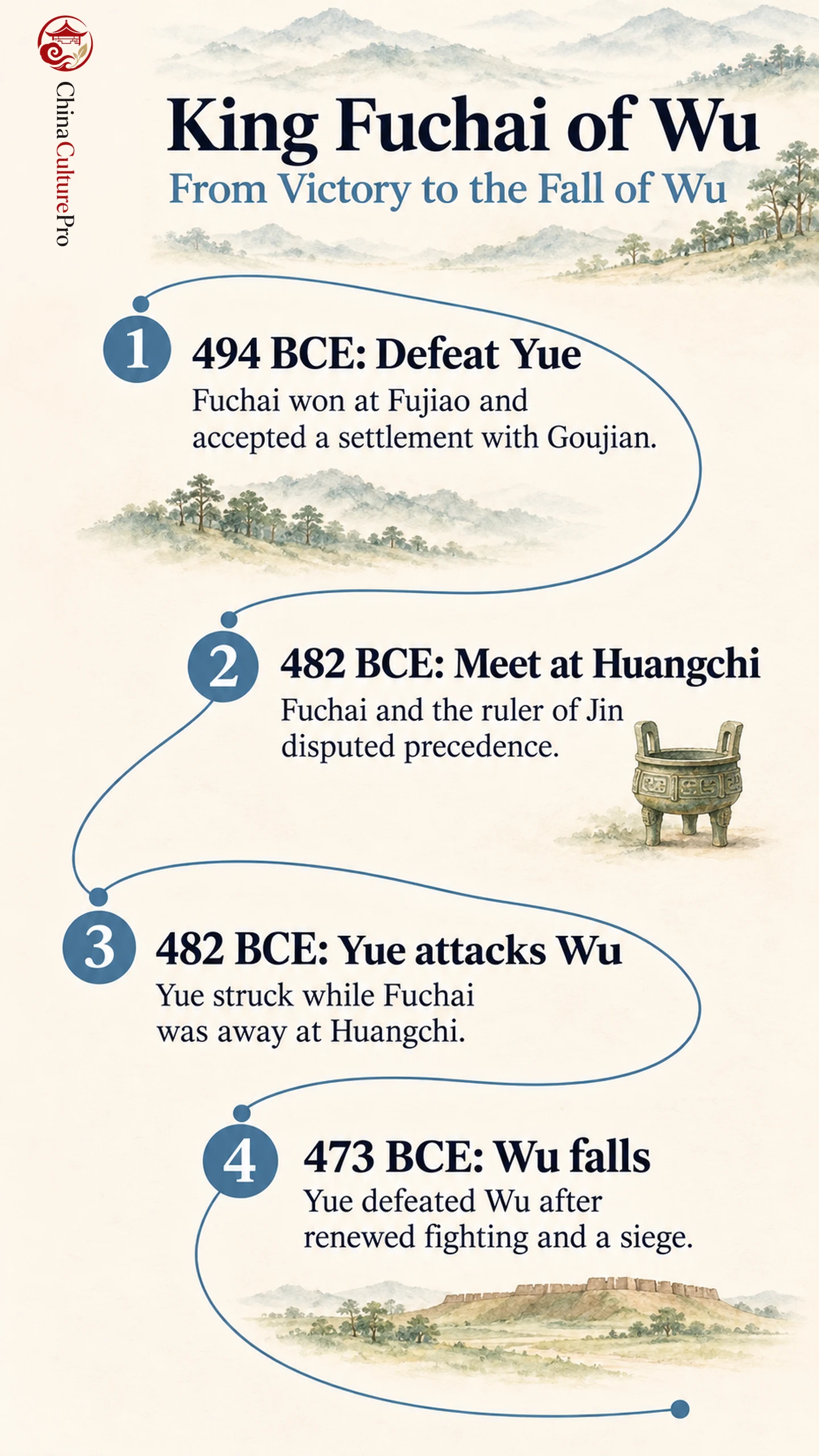
- 494 BCE: Fuchai defeated Yue, and its ruler Goujian (勾践, Gōujiàn) sought peace.[1][2]
- 482 BCE: Fuchai attended an interstate meeting at Huangchi (黄池, Huángchí) while Yue launched an attack on Wu.[2][3]
- 473 BCE: Yue conquered Wu, ending Fuchai’s reign.[2]
Surviving bronzes preserve evidence of his name and Wu’s diplomatic activity.[3][4]
The contest between Fuchai and Goujian is remembered for the reversal of their fortunes. The meeting at Huangchi helps explain the timing. Wu was bidding for recognition in the north when Yue brought the war back to its territory.
How Fuchai Defeated Yue in 494 BCE
Fuchai’s victory at Fujiao (夫椒, Fūjiāo) reversed an earlier defeat of Wu. The «Цзо чжуань» says Goujian withdrew to Kuaiji (会稽, Kuàijī) and sent an intermediary to ask for peace. Fuchai agreed despite the objection of his adviser Wu Zixu (伍子胥, Wǔ Zǐxū).[1]
The settlement left Yue under its own ruler. In several early accounts, Wu Zixu’s warning foreshadows the defeat of Wu. Historian Yuri Pines shows how ancient authors made this episode a lesson about listening to advice. The lesson shaped how they explained the reversal.[2]
Why Fuchai Went North to Huangchi
Wu’s forces defeated Qi (齐, Qí) at Ailing (艾陵, Àilíng) in 484 BCE. At Huangchi two years later, Fuchai sought recognition among rulers within the wider Zhou political world. The ruler of Jin (晋, Jìn) also claimed precedence.[3]
A covenant gave rival rulers a public occasion to acknowledge rank and establish leadership. Fuchai made a claim about his standing within the Zhou royal lineage, and Jin’s ruler advanced a claim of his own.[3]
How Yue Returned and Wu Fell
Yue forces struck Wu while Fuchai was away at Huangchi. According to Sima Qian, they captured the crown prince. Wu negotiated peace after the attack, but it did not end the conflict. Yue returned, defeated Wu again and eventually besieged it.[5]
When defeat was final, Sima Qian says Goujian proposed relocating Fuchai to Yongdong and giving him a small settlement. Fuchai refused and took his own life.[5]
What Fuchai’s Bronze Weapons Tell Us
The National Museum of China holds a bronze sword measuring 59.1 centimeters that bears Fuchai’s name. The inscription names the king as the person for whom the sword was made. The museum documents several swords with similar forms and inscriptions.[4]
Olivia Milburn discusses a pair of bronze vessels whose inscriptions connect their making to a gift from the king of Wu at Huangchi. The vessels give material evidence of an exchange at Huangchi. The inscriptions leave the question of ceremonial precedence open.[3]
FAQs About King Fuchai of Wu
Did Fuchai win at Huangchi?
Accounts disagree over precedence. The Zuo Tradition gives priority to Jin, while the Discourses of the States presents Wu as taking the lead.[3]
What happened to Wu Zixu?
Sima Qian says Fuchai eventually ordered his adviser to kill himself. Some early texts use the episode to warn rulers about dismissing advice.[2][5]
Is there just one sword of King Fuchai?
The National Museum of China records nine named examples. The inscription connects the weapons with the king, while the history of each individual sword requires separate evidence.[4]
Источники
[1] Zuo Tradition. Zuo Tradition, annals of Duke Ai of Lu
[2] Yuri Pines. Didactic Narrative and the Art of Self-Strengthening
[3] Olivia Milburn. Cherishing Antiquity, The Cultural Construction of an Ancient Chinese Kingdom
[4] National Museum of China. King Fuchai of Wu Bronze Sword
[5] Sima Qian. Records of the Grand Historian, Hereditary House of Wu