

Quick Answer: Who Was Zhang Zhongjing?
Zhang Zhongjing (张仲景, Zhāng Zhòngjǐng), also known by his personal name Zhang Ji (张机, Zhāng Jī), was a physician traditionally placed near the end of the Eastern Han. The Treatise on Cold Damage (伤寒论, Shānghán Lùn) and Essentials of the Golden Cabinet (金匮要略, Jīnguì Yàolüè) transmit medical writing associated with him.[1][2][3][4]
- Life: The surviving sources offer only a limited account of his biography.
- Books: Later compilers and editors helped form the texts now available.
- Reading: The titles and categories belong to the history of medicine.
His reputation rests on a textual tradition that continued to change after his lifetime.
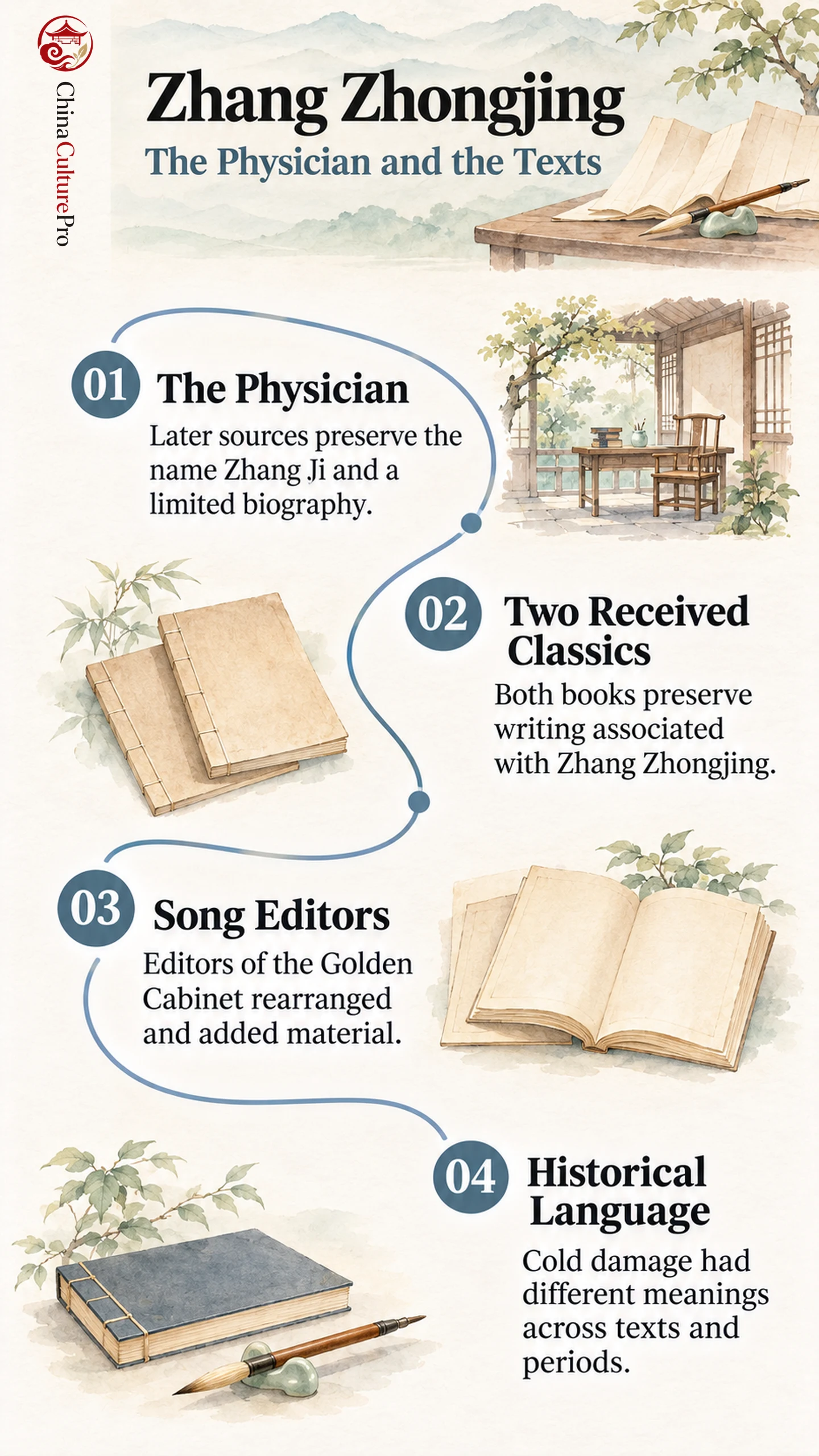
A Song editor could turn a difficult manuscript into a book readers could search. That kind of decision helps explain what survives under Zhang Zhongjing’s name. His legacy includes the early material and the work of the people who arranged it.
What the Sources Can Establish About His Life
Scholars generally place Zhang near the end of the Eastern Han dynasty. Modern references give differing approximate years. The Song preface says that the standard Han history contained no biography of Zhang. It drew on a later record of physicians for details including his association with Nanyang and a claim that he held office in Changsha.[1][2][4]
The preface attributed to Zhang describes deaths among his relatives and presents that experience as a reason for compiling medical knowledge. It gives an account of the work’s purpose as preserved in a received text. Since the original compilation is lost, the received preface alone gives limited support for precise biographical claims.[1][2]
Why Two Medical Classics Bear His Name
The two books are conventionally traced to a lost compilation, the Treatise on Cold Damage and Miscellaneous Disorders (伤寒杂病论, Shānghán Zábìng Lùn). Later sources credit Wang Shuhe (王叔和, Wáng Shūhé) with collecting and arranging material associated with Zhang. Both Wang’s early role and the later Song revisions matter to the history of the texts.[1][2][3][4]
The received Treatise on Cold Damage groups short passages around patterns of illness and changing signs. The Essentials of the Golden Cabinet covers miscellaneous disorders, with material on a broader range of subjects, including illness in pregnancy. The division reflects a history of compilation. A reader comparing them is dealing with transmitted books shaped by later choices about order and scope.[1][3][4]
What Later Editors Changed
The Song preface to the Essentials says Wang Zhu found an earlier abridged text in an imperial collection. The editors explain that the source divided descriptions and prescriptions among different parts of the text. They moved prescriptions next to the corresponding descriptions to make them easier to find. They also added material drawn from other books. Their account is evidence for how the edition was made and what they wanted its organization to accomplish.[3]
Li Cheng used a Northern Song edition of the Treatise as the source for a separate Southern Song selection. The Library of Congress records a copy printed in 1171. Li put the selected prescriptions first and the classified material second. That example from Chinese medical history shows that editors continued to select and reorder the material even after it had entered print.[5]
How to Read Cold Damage as a Historical Term
Cold damage is a historical term with a range of meanings. Some historical writers used it for illness they attributed to cold. Others applied the term more widely to illnesses involving fever or epidemics. A translation into a familiar English phrase can conceal those different uses. This is one reason histories of traditional Chinese medicine identify the author, edition and context when explaining such categories.[1][4]
FAQs About Zhang Zhongjing
Was Zhang Zhongjing his personal name?
Zhang Ji was his personal name. Zhongjing was his courtesy name and is the form by which he is best known.
Did Zhang write the surviving editions himself?
The works preserve writings associated with Zhang. The extant books reflect later compilation, Song editing and further transmission through copies and prints.
Is cold damage the same as the common cold?
The historical term covered different categories across texts and periods. It has no direct equivalence to a single modern diagnosis.
Источники
[1] Constance A. Cook, Cambridge University Press. Medicine and Healing in Ancient East Asia
[2] Received prefaces to the Treatise on Cold Damage. Authorial and Song editorial prefaces
[3] Lin Yi and colleagues. Preface to the Essentials of the Golden Cabinet
[4] Volker Scheid, East Asian Science, Technology, and Medicine. Transmitting Chinese Medicine
[5] Library of Congress. Essentials for Cold Damage Disorders and Prescriptions, in Two Juan