


Quick Answer: What Is Jin Chinese?
Jin Chinese(晉語,Jìnyǔ)is a group of northern Chinese varieties associated with much of Shanxi and neighboring areas. The linguistic label is more specific than “speech from Shanxi,” which can include varieties classified differently.[1]
- Geography: Its distribution crosses provincial borders.
- Sound: The entering tone(入聲,rùshēng)is central to how Jin has been distinguished and studied.
- Variation: Local sound systems and word forms differ; one city’s speech cannot represent every community.
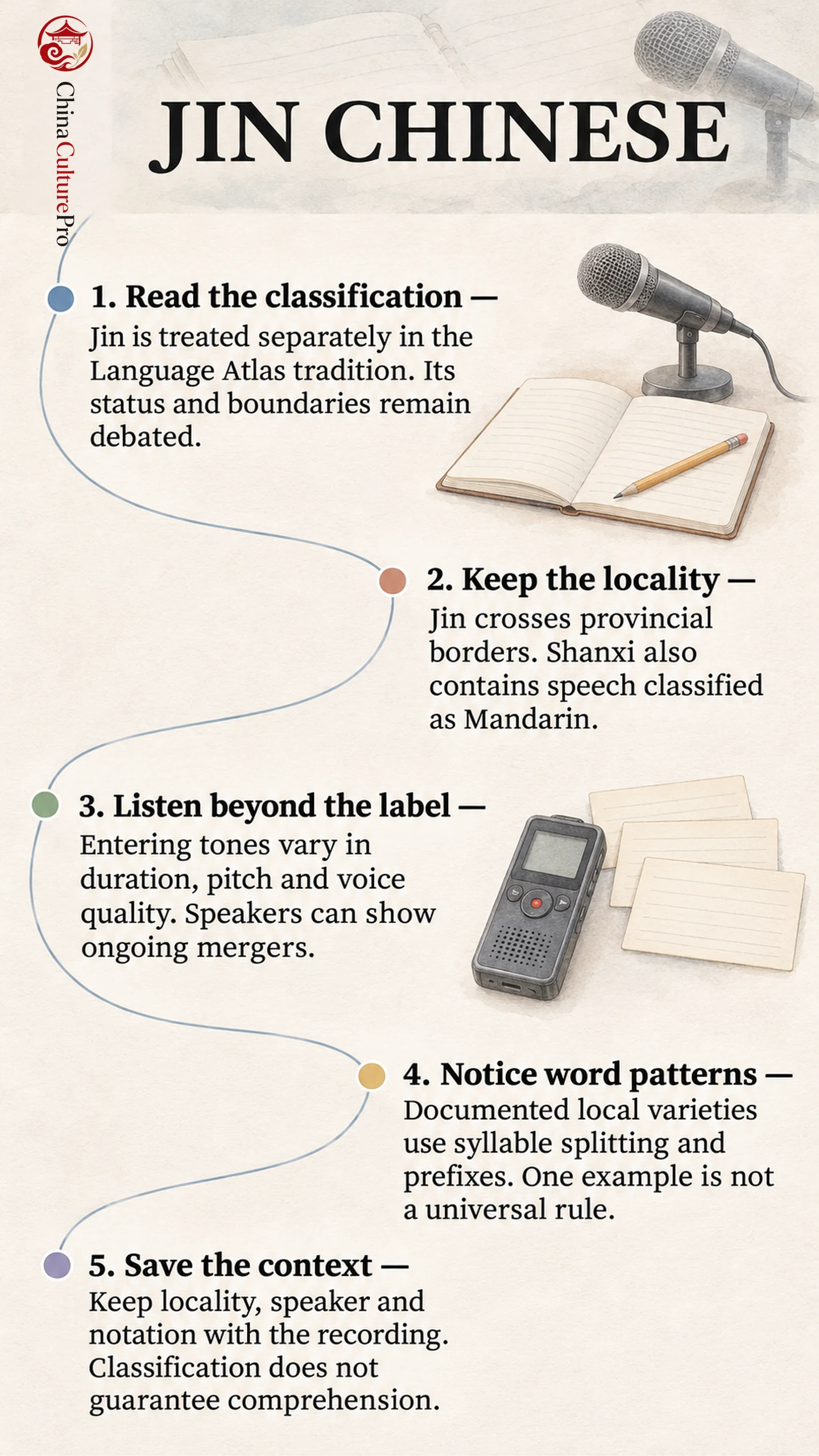
Treat “Jin” as the start of a description, then ask which locality and which classification the source uses.
A speaker from Taiyuan and a speaker from another Shanxi town need not use the same local forms. A province-wide label can conceal differences that matter when listening to a recording or interpreting a dictionary entry. Its classification, geographical range and actual speech features answer different questions.
What the Jin Label Classifies
In the influential classification associated with Li Rong’s 1985 proposal, Jin denotes the varieties in Shanxi and adjacent areas that retain an entering-tone category. The Language Atlas of China adopted Jin as a group separate from Mandarin. This classification remains influential, but its independence and exact boundaries continue to be debated.[2]
The question concerns the grouping of related speech varieties, not whether their speakers possess a distinct local way of speaking. Different sources can describe the same locality while placing it under a separate Jin heading or discussing it within a broader Mandarin framework. Check that framework before interpreting a map or comparing two accounts.
The distinction between Chinese language and dialect groups is therefore useful context. “Shanxi speech” names a geographical setting; “Jin” names a linguistic classification. Neither should be treated as the name of one uniform accent.[1]
Where Jin Is Spoken Beyond a Provincial Border
Jin’s main area lies in Shanxi, extending into neighboring parts of Shaanxi, Inner Mongolia, Hebei and Henan. These are portions of provinces and regions, not a statement that their entire populations speak Jin. A regional overview also distinguishes much of southern Shanxi’s Mandarin speech from the Jin core.[3]
A historical-phonology database makes the local scale concrete: its Jin list includes Taiyuan, Pingyao and Datong, while Yuncheng and Linfen appear under Mandarin. Such labels organize particular dialect-point materials. They do not eliminate transition zones or identify the everyday speech of every resident in a modern municipality.[4]
For a heritage or listening task, retain the town or county name attached to the recording. Two samples labeled only “Shanxi dialect” may not provide the comparison you expect. The locality is part of the linguistic evidence, rather than an optional biographical detail.
Entering Tones and Variation in Actual Speech
Entering-tone syllables in Jin are often described with a glottal ending, but their phonetic realization needs closer attention. A study using first-hand data from sixty-four localities found short or moderately short entering tones with different pitch contours and creaky-voice qualities. “Entering tone” does not mean one identical sound throughout the region.[5]
Taiyuan illustrates why a familiar tone count also needs a date and speaker context. A perception study started from its traditional five-tone description and examined twenty-five participants. It found particularly strong confusion between two entering-tone categories, alongside other developing mergers. That is evidence about the tested Taiyuan speakers, not a finding that all Jin varieties have lost their distinctions.[6]
For a reader, three questions help: is the source naming a historical category, describing how a speaker produces it, or testing how listeners distinguish it? These are related tasks with different results. A neat printed tone inventory and a recording with variation can both be informative without being interchangeable.
The historical framework connects with Middle Chinese, but retaining a category does not preserve every detail of an ancient pronunciation unchanged.
Word Formation: More Than a Different Accent
Jin descriptions also identify split-syllable words(分音詞,fēnyīncí). In documented Taiyuan examples, a single-syllable base corresponds to a two-syllable form with an added internal sound pattern. One attested pair is 滾, “roll,” and the two-syllable 骨攏. This is word formation, not merely pronouncing the same written syllable with another tone.[7]
Another recorded pattern is a prefix transcribed kəʔ- in Yangqu examples. Attached to the verb sua, “brush,” the form kəʔ-sua expresses brushing back and forth. The example isolates a word-building pattern; it does not supply a tone. Its notation belongs to that linguistic description, rather than Mandarin pinyin or a spelling rule for all Jin speakers.[7]
Keep the two phenomena distinct: splitting concerns the internal expansion of a word, while prefixing adds an element before its base. A useful example needs its meaning, locality and source notation. An unfamiliar written form alone cannot establish how productive a pattern is in another community.
Reading Descriptions and Choosing Local Recordings
A database may place older reconstructed readings and modern dialect-point material in separate layers. Select the locality and historical stage you actually need. Otherwise, a reconstructed sound can be mistaken for a recording of current speech, or one town’s entry can silently become a claim about an entire group.[4]
Understanding another variety is also a separate question from classification. Experimental research on Taiyuan compares sound and lexical distance with listener performance; the measures do not make all classification decisions identical. Avoid translating a family-tree position directly into “every Mandarin speaker can understand this.”[8]
For practical study, keep three pieces of information together: the speaker’s locality, the source’s notation key and a complete phrase with its meaning. Compare the phrase with a second speaker from the intended community when possible. Save differences rather than correcting them automatically into the pronunciation learned from another place.
Choose a recording labeled for the locality you want to understand. It gives you something concrete to listen for while leaving regional and individual variation visible.
FAQs About Jin Chinese
Is all Shanxi speech Jin Chinese?
No. The province also contains speech classified as Mandarin, especially in its southern areas.
Is Jin separate from Mandarin?
The Language Atlas tradition treats it separately. Its status and boundaries remain subjects of linguistic debate.
Does every Jin variety have the same tones?
No. Inventories, phonetic realization and ongoing mergers differ by locality and speaker.
Does an entering tone preserve an unchanged ancient pronunciation?
No. Retaining a historical category does not mean every sound associated with it has remained unchanged.
Источники
[1] Hou Jingyi / Commercial Press. Studies of Modern Jin Chinese: scholarly introduction
[2] Feng Yihan, University of Hong Kong. Ru Tone Variation in Southern Shanxi Transition Areas: research abstract
[3] Qiao Quansheng, Shanxi University. The History, Present and Future of Jin Dialect Research
[4] Academia Sinica. Chinese Historical Phonology Database: framework and locality lists
[5] Wei Yang, Hong Kong University of Science and Technology. Jin Chinese Entering Tones: Acoustics, Types and Evolution
[6] Lingua. The Merger of Falling Tones: A Perception Study in Taiyuan Jin Chinese
[7] Hilary Chappell and Li Lan. Mandarin and Other Sinitic Languages: author manuscript, Jin section
[8] Chaoju Tang. Mutual Intelligibility of Chinese Dialects: An Experimental Approach