

Quick Answer: What Are Jianzhan Tea Bowls?
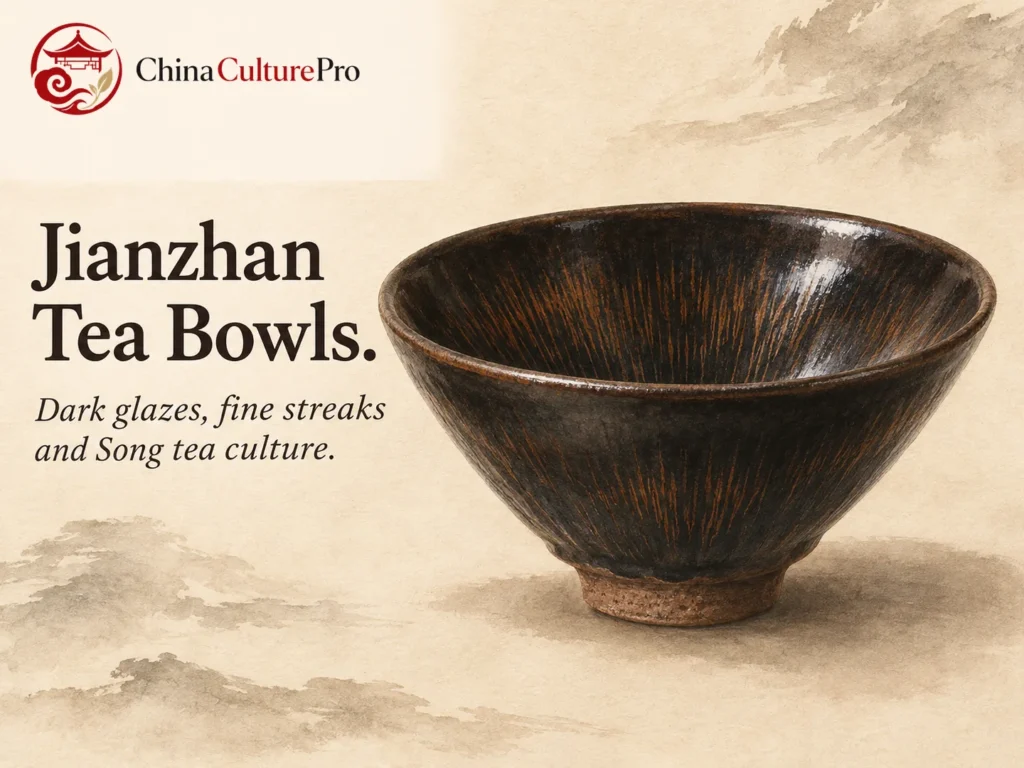
Jianzhan(建盏,jiànzhǎn)are tea bowls associated with the Jian kiln tradition of Fujian, especially the dark-bodied, dark-glazed bowls admired during the Song dynasty.[1]
- The material: A fired clay body carries a separate glaze coating.
- The surface: Streaks, spots and changing dark tones give individual bowls their appearance.
- The context: Historic tea preparation, collecting and modern craft all shape their story.
A metallic-looking surface does not make a bowl a metal vessel. Equally, a dramatic glaze pattern does not by itself establish a Song date or a particular place of manufacture.
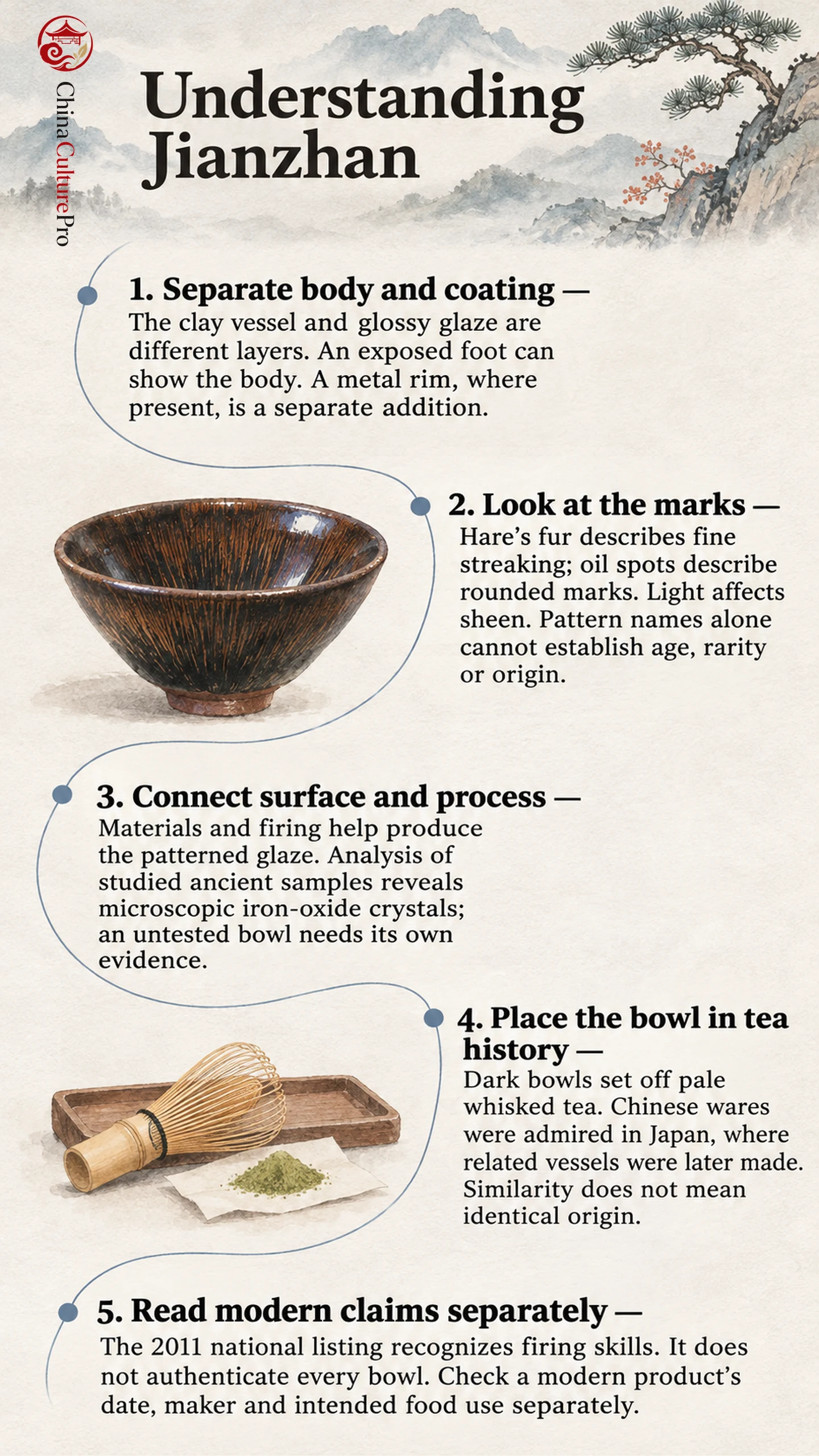
Against a dark glazed interior, fine brown streaks catch the light and seem to run toward the center of the bowl. Another surface breaks into small silvery spots. These are different effects within a ceramic tradition: jianzhan brings together Chinese porcelain history, kiln technology and the changing ways people prepare tea.
Clay Body, Foot and Dark Glaze
The bowl has a clay body and a glaze, each with its own visible qualities. The Smithsonian’s record for bowl F1952.9 describes coarse reddish-brown stoneware fired almost black, beneath a thick iron-rich black glaze.[1] The exposed lower body and foot can therefore look different from the glossy interior.
That distinction matters when reading photographs. A pale reflection on a glazed surface is not necessarily a light-colored clay body. The rim, wall and foot offer different views of the same object; the interior alone cannot show all its construction.
Some historic bowls also have metal bands at the lip. The Smithsonian explains that flowing iron-rich glaze could leave a rough rim, which owners covered with a metal band.[1] The added rim treatment is separate from the body and glaze, and is not present on every bowl.
Hare’s Fur, Oil Spots and Visual Variation
“Hare’s fur” describes fine streaking that recalls animal hair. A Metropolitan Museum teabowl has iridescent gray-brown streaks; its name describes an appearance, not animal material mixed into the bowl.[2]
Oil spots present a different visual pattern. The Smithsonian’s bowl F1909.369 has small round or oval silvery and coppery marks on a dark ground.[3] The spots are part of the fired glaze effect, not drops of cooking oil left in the vessel.
Look at the shape and distribution of the marks before relying on a vivid name. Long streaks and rounded spots create different rhythms across a curved surface, while lighting can change the apparent sheen. A photograph taken under one light does not fully describe how a bowl appears from another angle.
These descriptive names help explain the surface. They are not certificates of age, rarity or quality, and a modern maker can use a historical glaze name for a contemporary piece.
What Happens to the Glaze in Firing
The patterned surface develops through materials and firing. It is more than a dark paint applied to an already finished bowl. Research by Catherine Dejoie and colleagues examined ancient hare’s-fur and oil-spot samples using analytical techniques and identified a particular iron-oxide crystal phase in both.[4]
The finding connects visible decoration with microscopic structure. Streaks and spots can form within the glaze as it fires. It also shows why laboratory analysis can answer questions that a photograph cannot.
The research concerns the samples studied. It cannot identify every bowl offered under the jianzhan name, establish the composition of an untested modern glaze or authenticate a vessel remotely.
For the viewer, separate the broad process from an exact recipe: clay preparation, forming, glazing and firing work together, while a finished surface records their interaction. The finished object brings these stages together in one surface.
Song Tea Culture and Transmission to Japan
The bowl’s form becomes clearer when placed beside historical tea preparation. Smithsonian educational material describes Song powdered tea whisked with water to produce pale froth, whose appearance stood out against a dark glaze.[3] The vessel was involved in preparing and presenting the tea, not simply holding leaves beside a separate teapot.
Seattle Art Museum also places Jian bowls within the tea culture of Chan Buddhist monks and describes Japanese monks carrying admired bowls back to Japan.[5] The bowls became part of tea practices that crossed geographic and religious settings.
The Met notes that related bowls were later produced in Japan, particularly at Seto.[2] A Chinese Song bowl and a later Japanese vessel may share visual qualities while differing in date and origin.
Terms such as tenmoku belong within that wider history of reception. They should not erase the distinction between a Chinese kiln tradition and later Japanese production. The Song dynasty setting explains one influential chapter, rather than the complete history of every dark tea bowl.
Historical Bowls, Revived Craft and Modern Use
The official Chinese heritage inventory records Jian kiln jianzhan firing techniques in the third national list, announced in 2011, as project Ⅷ-188. It also describes revival work beginning in Fujian in the 1970s.[6] The listed subject is a craft practice, not an assurance that every contemporary bowl is an antique or an individually certified product.
The guide to Chinese intangible cultural heritage helps distinguish recognition of knowledge and skills from claims about a particular object. A maker’s date, place and materials remain separate information.
Nor is every dark Chinese tea bowl Jian ware. The Met catalogues a Southern Song leaf-decorated bowl as Jizhou ware, with black and brown glaze and pigment.[7] The dark palette alone cannot determine the kiln family.
For a modern drinking vessel, confirm its intended use and follow the maker’s care guidance. FDA pottery guidance distinguishes decorative ceramics from food-use ware and warns that improperly made glazes can release lead into food or drink.[8] This is a general ceramic-use consideration, not a finding that the Jian tradition is inherently unsafe. Check the individual product’s food-use information separately from its appearance or heritage description.
FAQs About Jianzhan
Are jianzhan made from metal?
They are ceramic bowls. A metallic sheen belongs to the glaze effect; some examples separately have a metal rim band.
Are hare’s-fur marks painted on?
The characteristic effect develops in firing. A named modern product still needs its own description of materials and decoration.
Are jianzhan and tenmoku exactly the same?
Their histories overlap, but the terms do not make every Chinese and Japanese dark-glazed bowl identical in origin.
Does national heritage status certify every bowl?
No. The Chinese listing recognizes firing techniques, rather than authenticating every product sold under the name.
Источники
[1] Smithsonian National Museum of Asian Art. Jian Ware Tea Bowl with Metal Rim, F1952.9
[2] Metropolitan Museum of Art. Hare’s-Fur Teabowl and Its Reception in Japan
[3] Smithsonian National Museum of Asian Art. Bowl with Oil-Spot Glaze: Surface and Song Tea Preparation
[4] Catherine Dejoie and Colleagues. Learning from the Past: Rare Iron-Oxide Crystals in Ancient Jian Wares
[5] Seattle Art Museum. Tea Bowl with Hare’s-Fur Decoration and Chan Tea Culture
[6] China Intangible Cultural Heritage Network. Jian Kiln Jianzhan Firing Techniques: National Project Ⅷ-188
[7] Metropolitan Museum of Art. Tea Bowl with Leaf Decoration, Jizhou Ware
[8] US Food and Drug Administration. Questions and Answers on Lead-Glazed Traditional Pottery