
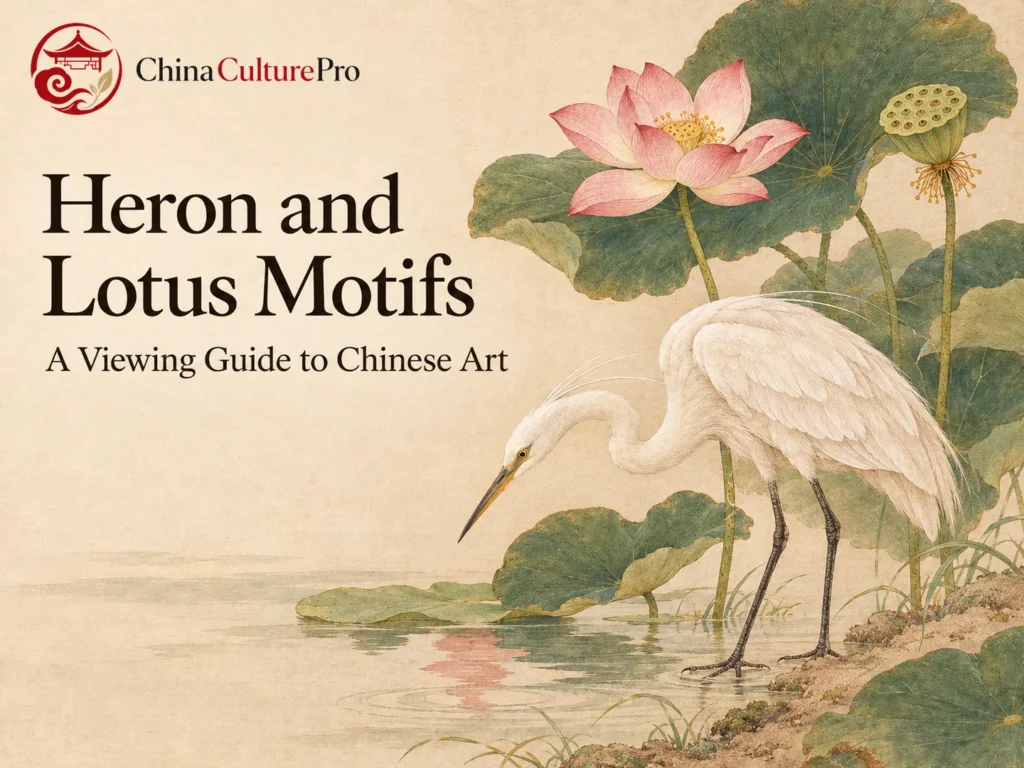

Quick Answer: What Is the Heron and Lotus Motif?
The heron and lotus motif (莲鹭纹, liánlùwén) pairs a long-legged waterbird with lotus leaves or flowers. It can be a lively pond scene, part of a painted poem or an auspicious wish. Some Chinese designs use the names of the egret and lotus to suggest success in examinations.[1][2][3][4]
- Bird. Look for a slender, pointed bill and a long neck.
- Plant. Find broad leaves on separate stems, layered flowers or a seedpod.
- Context. Read the inscription, surrounding plants and the object’s format before choosing an interpretation.[1][2][3]
Museum titles can call the same general kind of bird a heron or an egret.

Beside a tall lotus stem, a small white bird can anchor a pond scene. Its bill and legs identify the bird. The plant and any inscription give clues to the larger subject.
How to Recognize the Bird and Lotus
A heron stands or wades on long legs. The egret’s role in Chinese art also depends on the plants or objects around it. The neck can curve back toward the body. A lotus leaf is broad and round, and artists can show it as a disc on a stalk or as a folded surface. If the bloom is hard to identify, look for the pitted seedpod or for leaves rising separately from the same area of water.[1][5]
In Lotuses and Two Herons, the Smithsonian catalogues a silk painting with two long-legged birds and a dragonfly. The museum leaves the date broad and calls a Ming attribution possible. The dragonfly motif is another detail a viewer might use to read a pond picture.[5]
How Artists Build the Pond Scene
A Song tapestry in the National Palace Museum, Egrets Frolicking at a Pond with Hibiscus, shows three white egrets beside ornamental rocks. Lotus, hibiscus and daylilies grow near the birds. Shades of blue and white connect the water and feathers across the cloth. The weavers used changes in thread color to distinguish soft down from stiff feathers, making the scene look like a painting.[1]
Compare the textile with Ducks Sleeping on a Lotus Shoal. Both subjects can place birds among lotus. A duck rests low at the waterline, while the heron’s long legs and bill make a taller silhouette.
What a Poem or Catalogue Can Tell You
In Yan E’s eighteenth-century Heron and Lotus, gold and silver appear on indigo paper. The verse by Shen Tingzhao calls to mind a young gentleman and likens the bird’s feather plumes to tassels. The inscription also brings green leaves and red petals to mind, adding imagined colors to the metallic painting.[2]
A Qianlong porcelain vase in the Baur Foundation wraps three white herons, reeds and growing lotus around the body. Its verse draws comparisons with the integrity of an honorable person and the grace of a beauty’s dress. On other objects, the pairing can express a wish for examination success through Chinese wordplay. The lotus and egret career motif explains that reading and the related wish for an upright official career.[3][4]
FAQs About Heron and Lotus Motifs
Why do some catalogues say egret instead of heron?
An egret is a member of the heron family. Museum labels may use either word for the bird in a decorative scene. A species identification requires more visual detail than many artworks provide.[2][6]
Can a heron and lotus scene include other flowers?
Yes. The Song tapestry in Taipei shows hibiscus and daylily alongside lotus. The additional flowers are part of the pond setting and can contribute to the overall subject.[1]
Источники
[1] National Palace Museum. Egrets Frolicking at a Pond with Hibiscus, silk 000013
[2] Seattle Art Museum. Yan E, Heron and Lotus, object 2013.24.2
[3] Baur Foundation. Vase with Heron, Lotus and Poem, object CB.CC.1930.605
[4] Hong Kong Palace Museum. The Ways in Patterns: Egret and Lotus
[5] Smithsonian Institution, National Museum of Asian Art. Lotuses and Two Herons, accession F1916.561
[6] National Audubon Society. What Is the Difference Between Egrets and Herons?