


Quick Answer: What Are the Four Happiness Boys?
The Four Happiness Boys (四喜娃娃, sìxǐ wáwa) form a Chinese decorative design in which two children share parts of their bodies. Turn the object or picture and the same faces and limbs can suggest four children at play. The design expresses joy and good wishes.[1][2]
- Faces. Look for two heads, often on opposite sides.
- Bodies. Follow the limbs again after turning the image. A limb can belong to a different apparent figure from another angle.[1][3]
- Object. Ming brass and Qing white jade examples show how a compact carving or casting can carry the illusion.[1][3]
Count the poses you can read across the whole object.
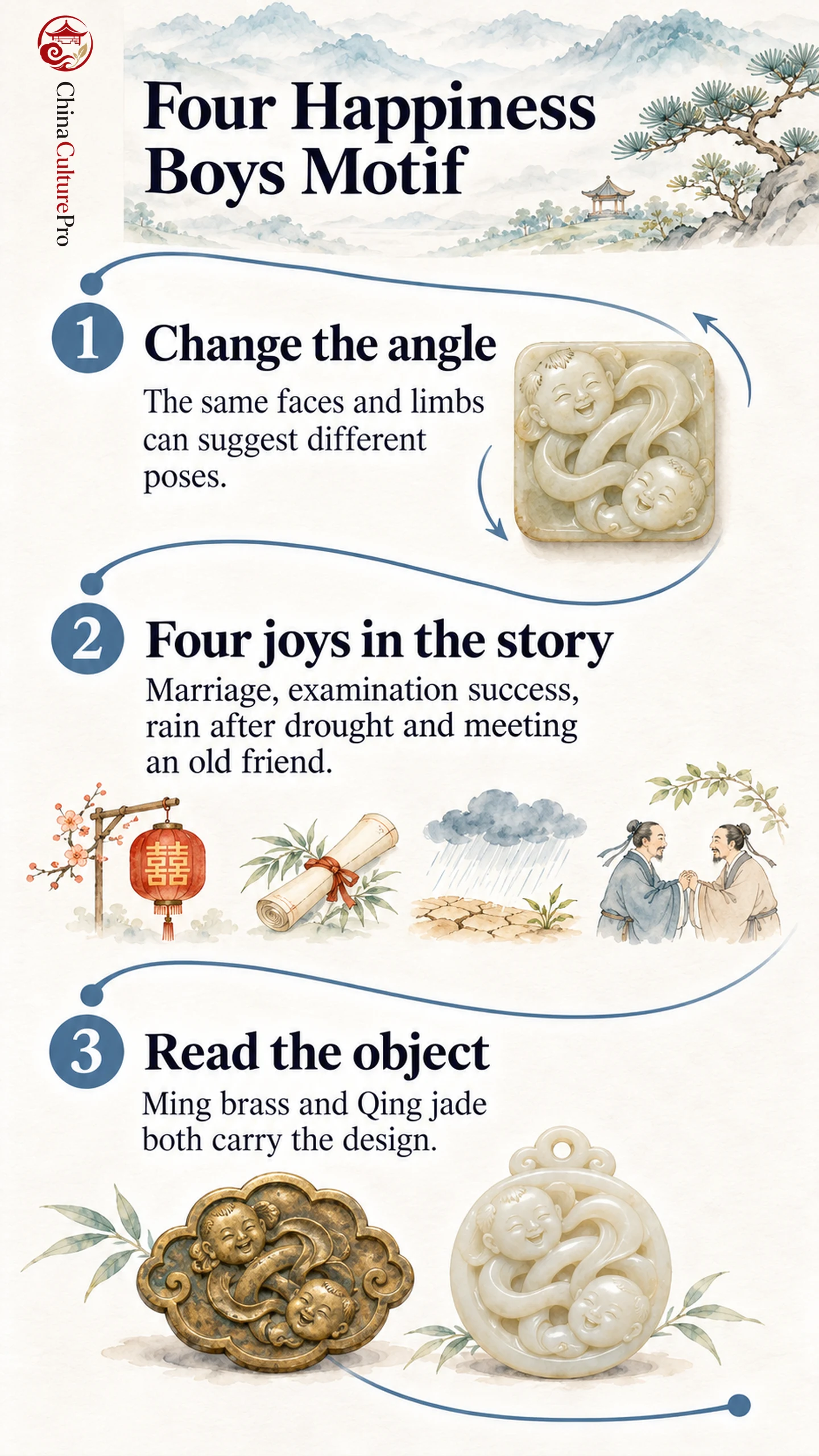
Two children seem to tumble across a small brass object in the Shandan County Museum. From another side, the same limbs suggest a different pair of poses. The compact outline gives the viewer no single top or bottom.
How Two Children Can Look Like Four
Start with one face. Follow the nearest arm and knee toward the middle, then turn the picture and trace a body again. The sculpture can alternate between facing children and figures that seem to turn away from one another. A Qing jade example presents two smiling heads close to the other figure’s knees. That arrangement lets parts of one pose help complete another.[1][3]
A conventional Hundred Boys scene distributes children across a garden or other setting. In the Four Happiness Boys motif, the figures share outlines. Four separate children in a painting can therefore belong to a different kind of scene.[2][5]
What the Four Happinesses Refer To
One traditional explanation names the wedding night, success in the imperial examinations, rain after a long drought and meeting an old friend far from home. The Shandan County Museum recounts these joys in a legend about the Ming scholar Jie Jin. The story explains the phrase “four happinesses” through four situations someone might hope to experience. On the brass object, the four apparent children take shape through shared limbs and carry no labels assigning an event to each one.[1]
The Double Happiness character expresses paired joy in wedding decoration through joined writing. The Four Happiness Boys invite a viewer to rotate a figure group. A marriage is one joy in the story, alongside achievements and unexpected good fortune in other parts of life.[1]
The Motif in Brass and Jade
The Shandan brass piece is about five centimeters high. The two children have bare feet and wear small bibs. Their attributes include a ruyi scepter and an ingot. A scepter and an ingot add familiar wishes for fulfillment and wealth to the play of bodies.[1]
A Qing white jade version shown at the Hong Kong Museum of Art in 2005 uses polished stone and an interlocked head-to-knee arrangement. A separate white jade figure recorded in a Harvard collection guide shows the children with flowers and a mushroom. That detail can be compared with lingzhi motifs on other carved objects, although the guide describes this one simply as a mushroom.[3][4]
FAQs About the Four Happiness Boys
Why are there only two heads?
Two heads are part of the visual trick. Shared limbs can be read as parts of different figures as you change the orientation, giving the impression of four children.[1][2][3]
Did Jie Jin invent the Four Happiness Boys motif?
A folk story credits him with drawing the design. The Ming brass example documents the motif’s use in the period. Its maker and the design’s invention remain uncertain.[1][5]
Источники
[1] Shandan County Museum. Ming Dynasty Brass Four Happiness Children
[2] Beijing Art Museum. Lecture on Auspicious Imagery in Chinese Art
[3] Sotheby’s. Qing White Jade Four Happiness Children, lot 99
[4] Harvard University. Wasson Ethnomycological Collection Guide, p. 133, item 32
[5] China Tibetology Research Center. Lu Yan and Zhang Huiqing on Auspicious Images