

Quick Answer: What Is a Daoist Temple?
Daoist, or Taoist, temples are religious establishments for honoring deities, cultivation, teaching and ritual services. Names often include gong (宫, gōng) or guan (观, guàn), although other names also occur. Their identity rests in religious traditions and communities as well as buildings.
- Spaces: courts, worship halls and supporting rooms serve different activities.
- Images: divine figures and revered teachers have distinct roles.
- Practice: officiants and local communities maintain services with regional differences.
This guide reads temples within Daoist religious life; it does not prescribe one layout or liturgy for all sites.[1]
Three seated figures in a hall may look like a familiar divine group, but their names can tell a different story. Understanding a Daoist temple means reading its rooms, images and community together, while noticing where a local arrangement differs from general descriptions.
Gong, Guan and Shared Architectural Forms
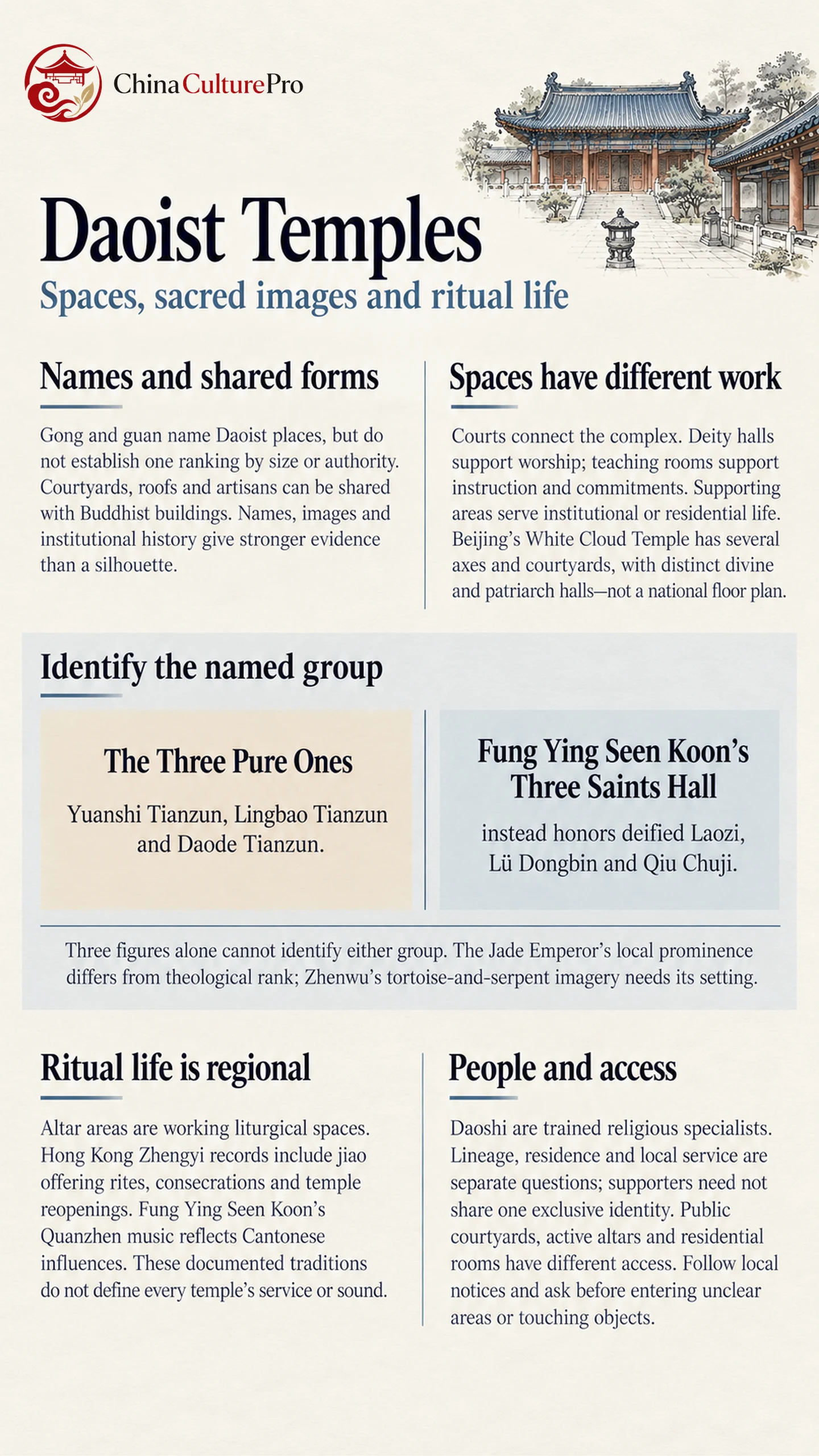
Gong and guan are useful naming clues, not a complete classification of a site’s size, authority or residents. The collective category of Daoist religious places also includes buildings described with other terms. Read the full name and the institution’s own account rather than treating one character as a universal ranking system.[1]
Courtyards, timber halls, decorated roofs and symmetrical arrangements are shared across parts of Chinese temple architecture. Daoist and Buddhist patrons have employed related building forms and artisans. A roof silhouette or incense burner therefore cannot establish a temple’s affiliation by itself; images, inscriptions, clergy and community history provide more specific evidence.[5]
Courtyards and the Work of Different Halls
| Part of the complex | Religious or institutional work | Важное ограничение |
|---|---|---|
| Entrance and courts | Mark arrival and connect different parts of the complex | The sequence and degree of public access vary |
| Deity halls | Provide settings for images, offerings and worship | The hall’s name and principal figure identify its particular focus |
| Teaching and discipline spaces | Support scriptures, religious instruction and transmitted commitments | Not every room with an image has the same function |
| Supporting areas | Accommodate institutional work and, where present, residential life | Their existence does not make them public visitor spaces |
Beijing’s White Cloud Temple (白云观, Báiyún Guàn) provides a documented example, with central and subsidiary axes and multiple courtyards. Its halls honor different divine figures and the master Qiu Chuji (丘处机, Qiū Chǔjī), while spaces for religious discipline and teaching have their own histories. This is one complex’s organization, not a national floor plan.[2][3]
Deities, Patriarchs and Named Sacred Groups
The Three Pure Ones (三清, Sānqīng) form a high-ranking group in common Daoist theological accounts. Their standard names are Yuanshi Tianzun (元始天尊, Yuánshǐ Tiānzūn), Lingbao Tianzun (灵宝天尊, Língbǎo Tiānzūn) and Daode Tianzun (道德天尊, Dàodé Tiānzūn). The last is associated with the divine form of Laozi (老子, Lǎozǐ); this religious identity is distinct from questions about Laozi as a historical thinker.[4]
The Jade Emperor (玉皇大帝, Yùhuáng Dàdì) has a celestial governing role. A temple prominently honoring the Нефритовый император need not claim that he outranks the Three Pure Ones in every theological scheme. Religious rank and a local temple’s principal devotional focus are different questions.[4]
Zhenwu (真武, Zhēnwǔ) is another important deity. Tortoise-and-serpent imagery can help identify some representations, but attributes must be considered with the name and setting. A general motif is not a guarantee of identification in every object or building.[5]
Fung Ying Seen Koon (蓬瀛仙馆, Péngyíng Xiānguǎn in Mandarin) in Hong Kong offers a useful counterexample to identification by number alone. Its Three Saints Hall (三圣殿, Sānshèng Diàn) honors the deified Laozi, Lü Dongbin (吕洞宾, Lǚ Dòngbīn) and Qiu Chuji. Its own publication names that group; it is not simply another label for the Three Pure Ones. The familiar English temple name follows Cantonese usage.[6][7]
Ritual Spaces and Regional Traditions
An altar area can be a working space for liturgy, not only a display before statues. Offerings, recitation and officiants’ movements belong to a particular service. Incense is one possible offering material, while the service’s purpose and transmission explain more than the presence of smoke.
Jiao (醮, jiào) are communal offering rites; Hong Kong’s heritage record places them among locally transmitted Daoist services. Hong Kong Zhengyi (正一, Zhèngyī) records include jiao festivals, consecrations and the reopening of temples after renovation. They also distinguish local ritual systems, including celebratory and funerary services in urban settings. These are regional examples, not a list of services every Daoist temple must provide.[8]
Liturgical sound is also locally transmitted. The documented Quanzhen (全真, Quánzhēn) music of Fung Ying Seen Koon has developed with influences from Cantonese singing traditions. Temple music is part of religious practice, while public festivals may involve broader community participation. Neither should be reduced to background entertainment for visitors.[9]
Clergy, Community and Respectful Access
A daoshi (道士, dàoshì) is a trained Daoist religious specialist; maintaining a building or making an offering does not by itself confer that role. Quanzhen and Zhengyi supply important lineage contexts, but residence, training and local service should be considered separately. The Quanzhen–Zhengyi comparison develops those distinctions.[10]
Temples also rely on supporters and institutional organization. A local community can engage Daoist specialists without every member adopting one exclusive religious identity. Relationships with local religious traditions help explain how a shrine and its officiants can be connected without being interchangeable categories.[10]
Read public signs, the full names of halls and the host institution’s explanations before joining an activity. Follow local temple etiquette for photography and entry, and ask before approaching an active altar or a restricted room. An open courtyard is not permission to touch ritual objects, use instruments or enter residential spaces.
FAQs About Daoist Temples
Are Daoist and Buddhist temples architecturally different?
They can share courtyard plans, roofs and building techniques. Names, sacred images, religious personnel and the community’s own account are more reliable than one architectural feature alone.
Is the Jade Emperor the highest Daoist deity?
In common Daoist theological accounts, the Three Pure Ones rank above him. His prominence in a particular temple or popular devotion is a different matter.
Is a Three Saints Hall always dedicated to the Three Pure Ones?
No. Sacred groups vary. Fung Ying Seen Koon’s Three Saints Hall honors a different trio, so the name and the identified figures matter more than the number of statues.
Does every Daoist temple have resident monastics?
No. Institutional forms and clergy residence differ. Some sites maintain residential communities, while others have different arrangements for religious services and local support.
Can visitors enter every hall or ritual area?
No. Public visiting, a ritual service and residential life have different boundaries. Follow the temple’s own notices and ask about areas whose access is unclear.
Источники
[1] Suzhou Ethnic and Religious Affairs Bureau. What Are Gongguan?
[2] Chinese Taoist Association, via Beijing Xicheng District Government. White Cloud Temple
[3] Fung Ying Seen Koon Daoist Culture Centre Database. White Cloud Temple (Baiyunguan), Beijing
[4] Taoist Federation (Singapore), practitioner explanation. Taoist Gods
[5] Birgitta Augustin, Metropolitan Museum of Art. Daoism and Daoist Art
[6] Fung Ying Seen Koon, own commemorative publication. Eightieth Anniversary Commemorative Publication
[7] Hong Kong Tourism Board. Fung Ying Seen Koon
[8] Hong Kong Intangible Cultural Heritage Office. Taoist Ritual Tradition of the Zhengyi School
[9] Hong Kong Intangible Cultural Heritage Office. Quanzhen Temples Taoist Ritual Music
[10] Stephen Jones, original field research. Yinyang: Household Daoists of North China and Their Rituals