

Quick Answer: How Did Christianity Develop in China?
Christianity in China developed through several encounters and locally rooted communities. It has a history much longer than the nineteenth-century Protestant missions often associated with it.
- **Early evidence:** A Tang monument records a seventh-century Church of the East mission.
- **Later contacts:** Catholic and Protestant histories followed different routes and institutional developments.
- **Chinese participation:** Converts, families, teachers, translators and church leaders helped shape these traditions.
Jidujiao (基督教, Jīdūjiào) can mean Christianity broadly but often denotes Protestantism in Chinese usage; Tianzhujiao (天主教, Tiānzhǔjiào) means Catholicism. Both belong within this guide to religion in China.[9]
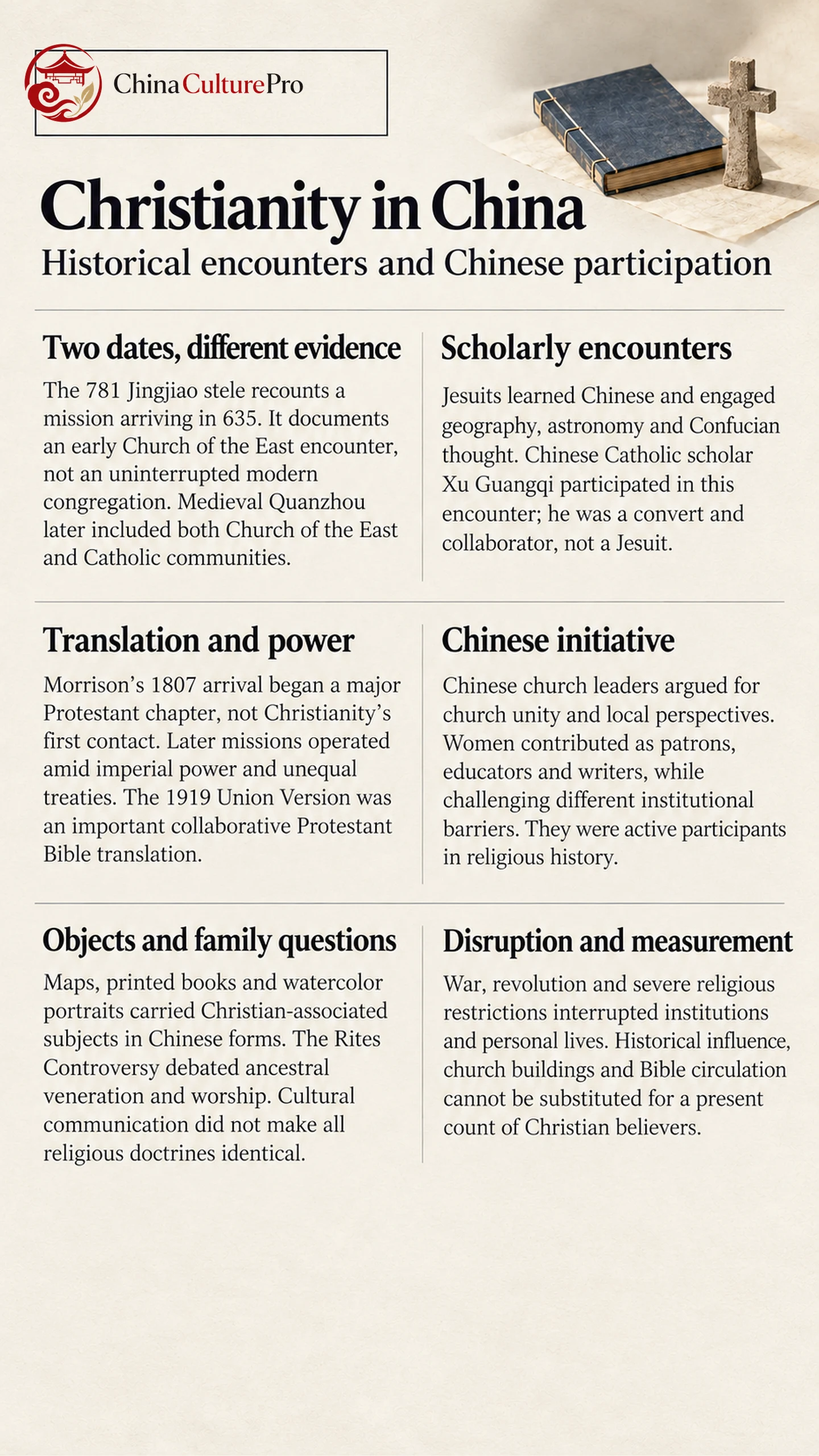
A stone inscription, a Chinese world map and a church publication preserve different kinds of Christian encounter. Reading them together reveals a history of translation, negotiation and local initiative, alongside conflict and disruption, rather than one continuous foreign mission.
Early Contacts: Jingjiao and Medieval Christian Communities
The Jingjiao (景教, Jǐngjiào), or “luminous teaching,” stele was erected in 781. Its Chinese and Syriac texts recount the arrival of Christian missionaries in 635 and subsequent developments under the Tang dynasty. Commonly called the “Nestorian stele,” it documents the Church of the East; that institutional name avoids reducing the community to a contested theological nickname.[1]
The dates answer different questions: 635 is the arrival recounted, while 781 is the monument’s date. The inscription does not demonstrate an unbroken congregation continuing to modern times. Later, research on medieval Quanzhou documents both Church of the East and Catholic communities in a port connected with maritime exchange. These were distinct Christian traditions, not a single uniform mission.[2]
Jesuit Encounters, Chinese Scholars and Cultural Exchange
Late-sixteenth- and seventeenth-century Jesuit activity brought a new Catholic encounter. Matteo Ricci and other Jesuits learned Chinese and engaged scholarly interests in geography and astronomy while pursuing religious conversion. Their dialogue with Confucian thought was a strategy of communication and an intellectual exchange, rather than the abandonment of Christian teaching.[3]
Xu Guangqi (徐光启, Xú Guāngqǐ), a scholar and Catholic convert associated with Ricci, represents Chinese participation in this encounter. He was not a Jesuit. The Ricci Institute’s portrait collection identifies him separately from its three European Jesuit subjects, a useful reminder that Chinese collaborators were historical actors with their own identities.[4]
Protestant Missions, Translation and Unequal Treaties
Robert Morrison’s arrival in 1807 marks a major beginning of nineteenth-century Protestant mission work, not Christianity’s first appearance in China. His translation and dictionary work made language central to the enterprise.[5]
Later nineteenth-century missions expanded amid foreign imperial power and unequal treaties. Their educational and publishing projects cannot be separated from that contested setting, even though individual Chinese believers’ reasons for conversion were their own.[7]
Bible translation became a sustained collaborative undertaking. The Union Version (和合本, Héhéběn), completed in 1919, was a major Protestant translation project involving several Bible societies. It should not be treated as the first Christian text translated into Chinese, or as the only Bible used by Chinese Christians.[6]
Chinese Christians as Teachers, Writers and Community Leaders
Chinese Christians argued about how churches should be organized and how faith related to society. Cheng Jingyi (诚静怡, Chéng Jìngyí), speaking at the 1910 Edinburgh missionary conference, pressed the importance of Chinese Christian perspectives and church unity beyond imported denominational divisions.[7]
Women also sustained religious networks. The seventeenth-century Catholic patron Candida Xu supported community religious life; in the Republican period, Protestant educator Ruth Cheng questioned barriers to women’s participation and ordination. These examples show different forms of initiative across time, without implying that Catholic and Protestant institutions gave women identical roles.[7]
Images, Books and Questions of Family Tradition
The 1602 Ricci world map combined European geographic models with Chinese collaborators, annotations and woodblock production. Its format belongs within Chinese printing history as well as missionary exchange. A map’s usefulness or circulation does not establish that every reader converted.[3]
The Ricci Institute’s four portraits, produced at a Shanghai Jesuit orphanage art school in 1914, used Chinese watercolor on paper to depict Christian-associated figures. Chinese materials and techniques could carry Christian subjects without making those subjects doctrinally Buddhist or Daoist.[4]
The Chinese Rites Controversy centered on whether ancestral rites were permissible civil veneration or incompatible worship. Disagreement among Catholic missionaries had papal and imperial consequences. Filial responsibility remained important to Chinese Christians, whose responses to family ritual differed across churches and periods.[7]
Twentieth-Century Disruption and the Limits of Simple Narratives
Twentieth-century history included war, revolution and severe restrictions. An archival study of the Protestant intellectual Cai Yongchun examines the personal and institutional trauma of the Cultural Revolution. Its detailed case cannot represent every believer, but it disrupts a story of smooth institutional continuity.[8]
Modern population claims also require care. Pew’s 2023 study distinguishes formal religious identification, belief and practice, which yield different measures. Historical influence, church buildings and Bible circulation are not interchangeable with a present count of Christians.[9]
FAQs About Christianity in China
Did Christianity first reach China in the nineteenth century?
No. The 781 Jingjiao stele recounts a mission arriving in 635. Nineteenth-century Protestant missions are one later chapter, rather than the beginning of the whole history.
Does Jidujiao include Catholicism?
In its broad meaning, yes. In everyday usage and some surveys, Jidujiao often refers specifically to Protestantism, with Catholicism named Tianzhujiao. Context determines how the term is being used.
Were Chinese Christians only foreign missionaries?
No. Chinese converts, clergy, patrons, teachers and writers shaped religious life. Treating them as passive recipients misses major parts of the historical record.
Does Chinese Christian art show that all doctrines merged?
No. Shared painting materials, book formats or Chinese vocabulary demonstrate cultural communication. They do not by themselves prove that different religions adopted identical doctrines.
Источники
[1] McGill University School of Religious Studies. Jingjiao Stele
[2] Samuel N. C. Lieu and colleagues, Macquarie University. Medieval Christian and Manichaean Remains from Quanzhou
[3] Asian Art Museum. China at the Center: Rare Ricci and Verbiest World Maps
[4] Ricci Institute, Boston College. Chinese Jesuit Portraits
[5] Ying Fuk-tsang, Journal of Ecclesiastical History. Evangelist at the Gate: Robert Morrison’s Views on Mission
[6] Hong Kong Bible Society. Milestones of Chinese Bible
[7] Alexander Chow and Stephanie Wong, University of St Andrews. Chinese Christian Theology
[8] Church History, Cambridge University Press. Surviving the Valley of the Shadow of Death: Cai Yongchun in the Cultural Revolution
[9] Pew Research Center. Christianity in China: Measuring Religion in China