

Quick Answer: What Is Chinese Folk Religion?
Chinese folk religion (民间信仰, mínjiān xìnyǎng) is an umbrella term for varied beliefs and practices centered on local deities, ancestors, spirits and the relationships between families and communities. Also called popular religion, it is not one centrally governed church with a single founder or creed.
- Household life: family remembrance and protective deities connect religion with everyday responsibilities.
- Community life: temples, festivals and associations organize shared religious occasions.
- Overlapping traditions: Buddhist and Daoist teachings and specialists can participate without absorbing every local practice.
The category helps describe Chinese religious life, but its breadth should not hide differences in locality, period or individual commitment.[1]
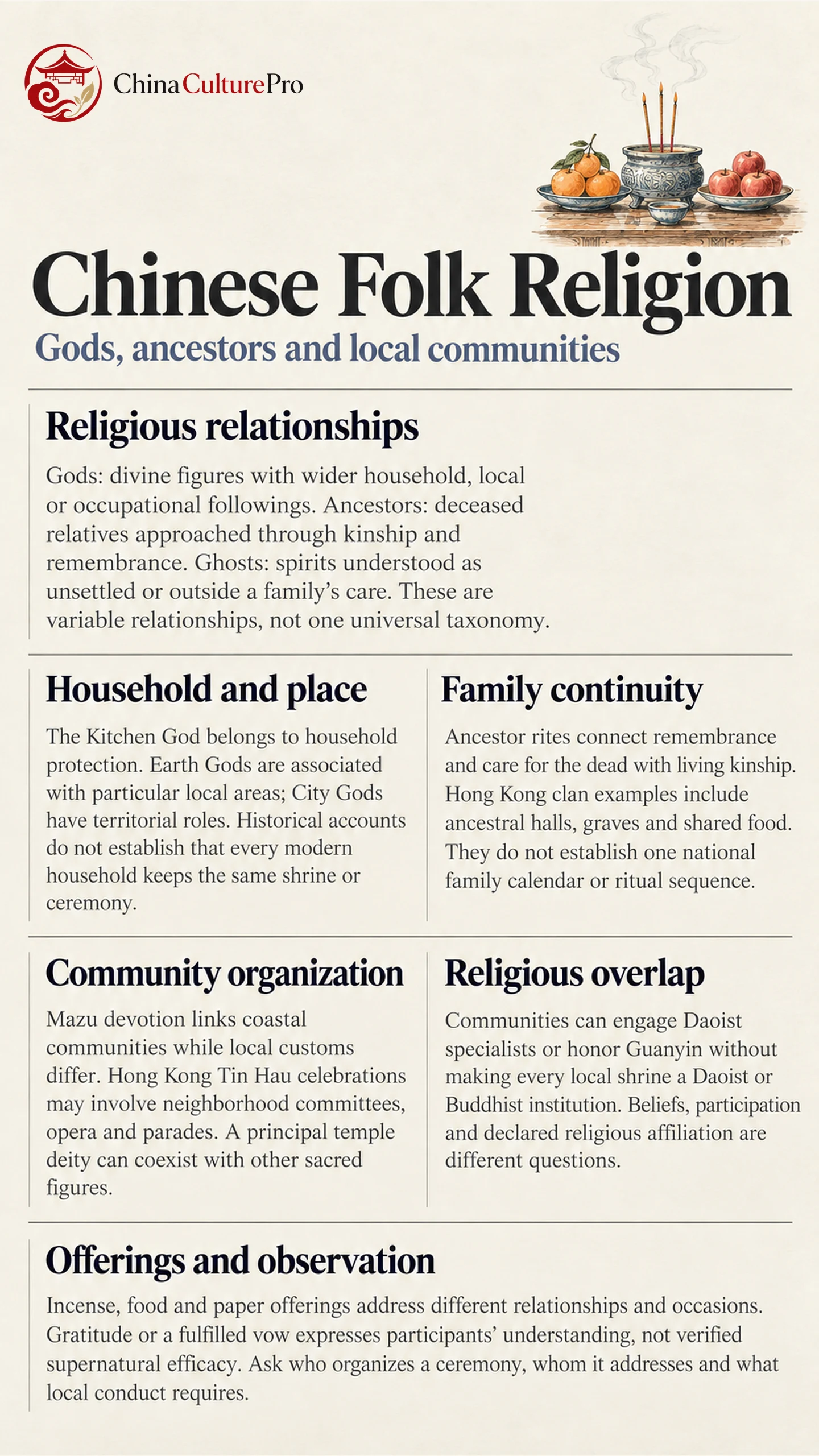
A family altar and a neighborhood temple may be connected through shared offerings, festival visits and obligations of care. Understanding these relationships explains more than assuming every shrine belongs to one denomination or that every participant holds exactly the same beliefs.
Gods, Ancestors and Ghosts: Different Relationships
| Категория | Religious relationship | Важное различие |
|---|---|---|
| Gods: shen (神, shén) | Recognized divine figures may protect a locality, household or activity | Their roles and following extend beyond one family |
| Ancestors: zuxian (祖先, zǔxiān) | Deceased relatives are approached through kinship, remembrance and obligations of care | They are connected to descendants and family histories |
| Ghosts: gui (鬼, guǐ) | Spirits may be understood as unsettled, unprovided for or outside a family’s care | Offerings can address beings beyond one’s own ancestors |
These categories express relationships, not a rigid classification accepted identically everywhere. A deceased person may be remembered differently by descendants and by unrelated neighbors. Stories about spirits should be described as religious understandings rather than verified accounts of how the unseen world operates.[2][4]
Household and Local Protective Deities
The Kitchen God (灶君, Zàojūn) belongs to traditions of household protection and family conduct. Historical New Year observances describe a divine report on the family’s actions. This explains the Kitchen God’s place in family customs without establishing that every modern household keeps the same shrine or ceremony.[3]
The Earth God (土地公, Tǔdìgōng) is associated with a particular local area. The City God (城隍, Chénghuáng) has a territorial role linked historically with the city and its administration. A local guardian and a widely worshipped deity are therefore different ways of organizing divine protection. The guide to City God worship develops this connection between place and religious authority.[3]
Images and stories may compare divine officials with human administration, but that metaphor should not become a complete description of every deity. The scale of worship also varies: a family’s protective figure, a village’s guardian and a deity with temples across regions need not have the same community of supporters.[2]
Ancestor Rites and Family Continuity
Ancestor veneration joins care for the dead with the continuity of the living family. Memorial observances can involve an ancestral tablet, food offerings, incense or visits to graves. Participants may emphasize filial responsibility, continued spiritual presence, remembrance or a combination of these meanings. Funeral traditions concern mourning and the transition after death; later memorial rites maintain a longer relationship.[4]
Hong Kong’s New Territories provide a concrete clan example. Documented observances bring members to ancestral halls or graves, while some communities share food after offerings. Such gatherings reaffirm kinship and transmit local ritual knowledge. They are specific traditions, not a requirement that every Chinese family possess an ancestral hall or use the same festival calendar.[5]
Temples, Festivals and Community Organization
Mazu (妈祖, Māzǔ) is associated especially with coastal religious communities. Worship includes temple ceremonies, performances and household observances, connecting devotion with maritime and community identity. Mazu’s religious following illustrates how one deity can link many local places while customs remain locally distinctive.[6]
Tin Hau is a Cantonese reading of her title Heavenly Empress (天后, Tiānhòu in Mandarin). In Hong Kong, neighborhood committees may organize opera performances and celebrations; some communities also hold land or water parades. Dates and scale differ. Temple festivals involve organizational work as well as worship, while ritual processions bring sacred images and community participation into public space.[7]
A temple’s principal deity does not exclude other figures. The Shau Kei Wan Tin Hau Temple’s own record lists several additional deities alongside its principal goddess. This is evidence about one temple’s religious setting, not a blueprint for all Chinese shrines.[8]
How Folk Religion Interacts with Buddhism and Daoism
Local communities may invite Daoist priests to conduct services, but the priest’s transmitted tradition and the shrine’s community identity answer different questions. Research on household ritual specialists shows why residence, lineage and local service should be considered separately. Daoist religion is neither identical with every folk custom nor detached from community religious life.[9]
Guanyin (观音, Guānyīn) is the bodhisattva of compassion in Chinese Buddhism.[10] Devotion also extends into local temple settings. The Shau Kei Wan example includes her under the Cantonese name Kwun Yum. Guanyin’s wider following demonstrates overlap without making every local shrine a Buddhist monastery.[8]
Research based on religious-belief questions also shows why a declared denomination is an incomplete guide to participation. An individual’s beliefs, occasional acts of worship and institutional commitments need not coincide. Specific practices and commitments therefore offer a more precise account of an individual’s religious life.[2]
Offerings, Reciprocity and Respectful Observation
Offerings can express gratitude, remembrance, petitions and continuing obligations. Incense, food and paper offerings have different forms and contexts; they are not one interchangeable ritual kit.[11] In vow traditions documented in Hong Kong, a worshipper returns to thank a deity after a prayer is understood to have been answered. This expresses participants’ religious understanding, not independent proof of a supernatural cause.[12]
When observing a ceremony, identify who organizes it, whom offerings address and which participants or specialists lead it. Follow local temple etiquette and ask before photographing or entering a restricted area. Sharing a community occasion does not imply that every attendee interprets it in the same way.[1]
FAQs About Chinese Folk Religion
Is Chinese folk religion the same as Daoism?
No. Daoist priests and teachings may be involved, but household rites and local deity traditions cannot all be assigned to Daoism. Institutional relationships need to be understood locally.
Does ancestor worship mean treating every ancestor as a god?
No. Family kinship is central to ancestor veneration. Some historical figures become widely venerated deities, but that is not the automatic status of every deceased relative.
Do all Chinese people follow folk religion?
No. People differ in belief, participation and religious identity. A shared festival or family custom does not establish one level of commitment for everyone.
Is there one sacred book for Chinese folk religion?
No single text governs every locality. Written ritual texts, genealogies, temple records, oral narratives and transmitted practices can all matter within particular communities.
Источники
[1] Stephen F. Teiser, Columbia University Asia for Educators. What Is Popular Religion?
[2] Chunni Zhang, Yunfeng Lu and He Sheng, original research. Exploring Chinese Folk Religion: Popularity, Diffuseness, and Diversities
[3] Columbia University Asia for Educators. The Kitchen God and Other Gods of the Earthly Domain
[4] Columbia University Asia for Educators. Settling the Dead: Funerals, Memorials, and Beliefs Concerning the Afterlife
[5] Hong Kong Intangible Cultural Heritage Office. Spring and Autumn Ancestral Worship of Clans
[6] UNESCO Multimedia Archives, nomination documentary record. The Mazu Belief and Customs
[7] Hong Kong Intangible Cultural Heritage Office (Управление нематериального культурного наследия Гонконга). Tin Hau Festival in Hong Kong
[8] Chinese Temples Committee, temple record. Tin Hau Temple, Shau Kei Wan
[9] Stephen Jones, original field research. Yinyang: Household Daoists of North China and Their Rituals
[10] Denise Patry Leidy, Metropolitan Museum of Art. Chinese Buddhist Sculpture
[11] Hong Kong Intangible Cultural Heritage Office. Paper Crafting Technique
[12] Rural Common, original local cultural account. A Map of Deities in Sha Tau Kok (Part I)