


Quick Answer: What Are Chinese Wedding Door Games?
Door games (堵门游戏, dǔmén yóuxì) are playful challenges used at some Chinese weddings before the groom meets or collects the bride. Friends may organize questions, songs or other tasks, followed by a welcome and the next family event.[1][3]
- Their purpose is a shared moment of celebration, not a genuine test of whether the couple may marry.
- The couple and participants should agree on activities, money, filming and a stopping time.
- Games can be brief, adapted or omitted when the couple prefers another welcome.
There is no national list of compulsory challenges. The ideas below are modern suggestions to choose from, not a fixed traditional script.
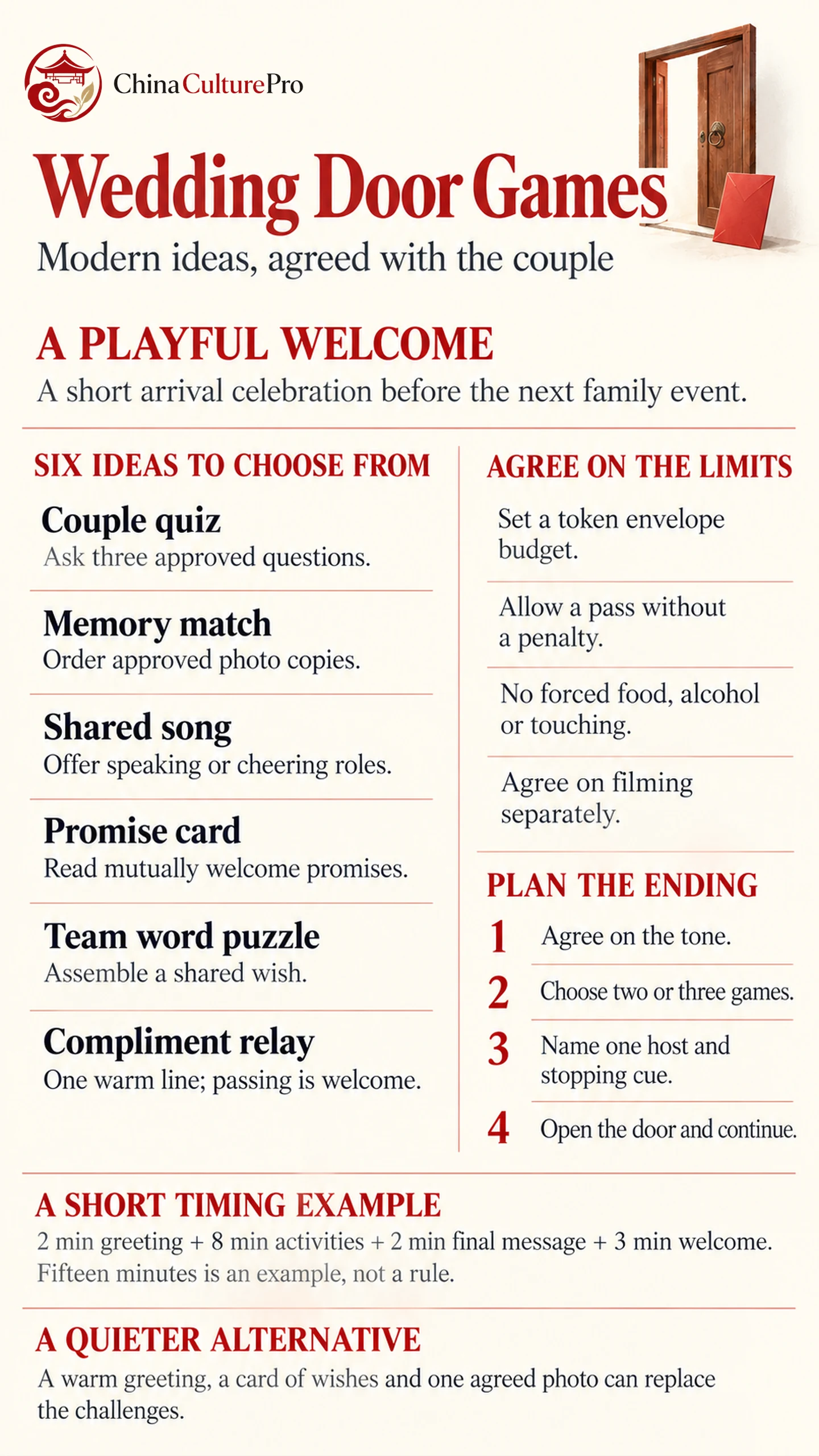
The most memorable gatecrash can be simple: friends ask a few affectionate questions, the groom’s group joins a short performance, and the door opens to cheers. It need not become a contest to invent the most embarrassing forfeit.
This guide places the games within Chinese wedding traditions, then offers practical activities and a plan for keeping the event enjoyable for the people actually taking part.
The Meaning and Place of the Gatecrash
In a familiar Singapore wedding sequence, the groom arrives at the bride’s home and is teased by her close friends and relatives before being welcomed in. Family tea follows in the account, making the playful arrival distinct from the more formal family exchange.[1] Your family’s order may differ, so confirm where the games fit before planning them.
Door games give the wedding party something to do together: one group poses a challenge and the other responds. Songs, questions about the couple, promises and red packets are among familiar modern forms.[3] Their value lies in the interaction, not in proving endurance or buying access to a person.
Do not assume a current photo-matching quiz or dance routine is an unchanged ancient rite. The activity can be newly designed for the couple. Keep it separate from the tea ceremony, where relatives may have a specific serving order and role.
Six Considerate Door Game Ideas
Choose activities that the couple welcomes and the participants can enjoy in their actual clothes and space. The following are adaptable suggestions; none needs a humiliating penalty to work.
| Идея | How to play | Keep it considerate |
|---|---|---|
| Couple quiz | Ask three approved questions about shared memories or everyday preferences | Avoid private disagreements, past relationships or questions intended to expose someone |
| Memory match | Put a few approved couple photographs in order or match them to short captions | Use copies and agree beforehand which images may be shown |
| Shared song | Let the group perform a short part of a song the couple likes | Offer speaking or cheering roles for people who do not want to sing |
| Promise card | Invite the groom or both partners to read a few sincere promises | Keep the words mutually welcome rather than imposing chores or gender stereotypes |
| Team word puzzle | Let friends assemble large word cards into a short congratulatory message | Use a language everyone understands and keep the task simple |
| Compliment relay | Invite willing friends to contribute one warm line about the couple | Allow a pass and avoid jokes at someone’s expense |
Pick two or three ideas rather than treating the table as a six-game requirement. A quiz followed by one song can be enough. If the room is small, favor spoken or seated activities over anything that depends on space, balance or physical contact.
Prepare answers and materials in advance. Ask a person who knows the couple to check the quiz, photograph choices and promise wording. The organizer should be able to explain each game in one sentence, including how it ends.
Agree on Money, Boundaries and Filming
A hongbao (红包, hóngbāo), a red envelope, may be part of playful bargaining at the door.[3] If you keep this element, agree on the token arrangement and total budget beforehand. It should not grow through surprise demands or become the price of declining a task.
Door-game packets are different from ordinary guest wedding gifts and the negotiated family gifts exchanged during betrothal. Keep their envelopes and intended recipients separate so helpers do not hand over the wrong packet.
Set the boundaries before the day: no unwanted touching, sexualized tasks, forced drinking, food punishments or public disclosure of private information. Some tasting challenges use sweet, sour, bitter and spicy flavors as metaphors for married life.[4] You can acknowledge that symbolism without making anyone eat or drink: replace the task with a spoken version or leave it out. A refusal ends that task without requiring an explanation.
This distinction also appears in contemporary local wedding guidance: a Chongqing rural-wedding guide encourages considerate games while rejecting coercive or humiliating pranks.[2] That is a local guidance example, not evidence that every Chinese community shares the same practice.
Agree on photographs and video separately from participation. A person may be happy to join a game but not want the clip posted publicly. Brief the photographer on the planned activities and who has declined filming; avoid surprise close-ups or recordings of cash amounts.
Plan a Short Gatecrash That Ends on Time
Start with the next event on the wedding timeline. Decide when the door must open so the couple, relatives and helpers can move on without rushing. Do not assume friends will recognize the stopping point while everyone is laughing.
- Choose the tone: The couple and organizers agree on the participants, activities, money arrangements and filming boundaries.
- Prepare a small set: Choose two or three activities, check the props and arrange a way to pass without a penalty.
- Appoint the host: Name one person to explain each activity, watch the time and stop any unwelcome addition.
- Finish with the welcome: End at the agreed cue, open the door and hand over to the next family event.
For a deliberately short version, you could reserve fifteen minutes: two for greeting and explaining, eight for the chosen activities, two for a final message and three for opening the door and moving inside. This is an original planning example, not a customary duration. Adjust it to the people and setting, and keep transfer or tea preparation time outside that block.
Check the room and access arrangements. Keep exits, shared corridors and the route for relatives clear. In an apartment or hotel, agree on the permitted space and noise level. The door is a symbol in the game; it should not be physically barricaded or forced.
Alternatives for Couples Who Prefer a Quiet Welcome
You can keep the sense of arrival without staging challenges. Friends might offer a short welcome, present a card of good wishes or join one planned photograph before the couple proceeds. Another option is a brief private meeting followed by the family ceremony.
Explain the choice to the organizers early: “We would like a warm welcome and one group photo, with no challenges or bargaining.” Clear instructions prevent a well-meaning friend from preparing a surprise activity. If guests ask about participation, the guest etiquette guide can help distinguish an invitation from an obligation.
When relatives disagree about what is expected, discuss the particular concern rather than arguing over which version is most traditional. The wedding taboos and family expectations guide offers context for that conversation.
FAQs About Chinese Wedding Door Games
Are door games compulsory at a Chinese wedding?
No. Some families enjoy them and others use a brief welcome or skip them. The couple can agree on the form of their own celebration.
How much money should be in the door-game envelopes?
There is no universal sum. Agree on a token budget and recipients beforehand, and keep this money separate from guest gifts and family betrothal arrangements.
Can someone refuse a challenge?
Yes. Provide an easy way to pass without payment, public pressure or a replacement punishment. Joining the wedding party does not mean agreeing to every proposed game.
Can mixed-gender friends take the usual wedding-party roles?
Yes, if that suits the couple and group. Assign the organizing, responding and hosting roles to willing friends rather than treating the traditional labels as compulsory casting rules.
Источники
[1] National Heritage Board / Ministry of Culture, Community and Youth, Singapore. Who’s Your Neighbour?
[2] Chongqing Municipal People’s Government. 减形式 降彩礼 重礼节 重庆发布《巴渝和美乡村婚事新办指南》
[3] ChineseNuance. What Are the Door Games at Chinese Weddings?
[4] WeddingEditor. Chinese Door Games Highlight Video