

Quick Answer: What Is a Suitable Chinese Wedding Gift?
For many Chinese weddings, a hongbao (红包, hóngbāo)—money in a red envelope—is a familiar guest gift. The wrapper carries good wishes, while the amount and method depend on the couple, community and relationship.[1][2]
- Check the couple’s stated preference before choosing cash, a transfer or an object.
- Distinguish an ordinary guest gift from an elder’s ceremonial gift or a family betrothal exchange.
- Choose an affordable amount and confirm how it should be delivered.
No single price list governs Chinese weddings worldwide. A thoughtful gift follows this couple’s circumstances rather than an assumed national tariff.
Several different exchanges can happen around a Chinese wedding, sometimes using similar red packets. A friend’s banquet gift, a grandmother’s jewellery and gifts exchanged before the wedding have different recipients and purposes.
This guide explains those distinctions within Chinese wedding traditions, then helps you prepare a gift without confusing a family ritual with a guest obligation.
First Identify Which Gift Exchange You Mean
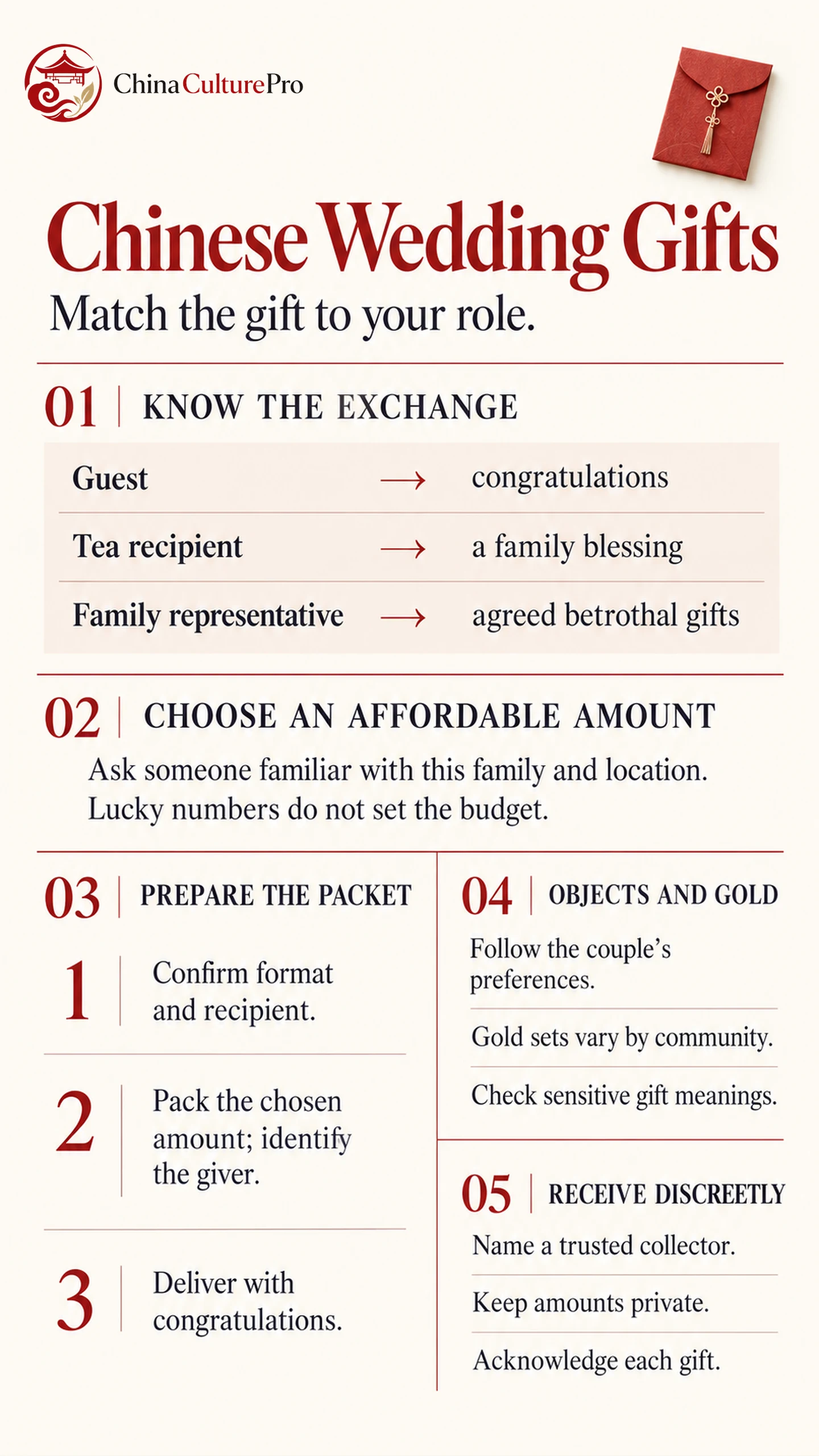
Start with your role. Tea recipients may give money or jewellery, while ordinary reception guests have a different gift context.[2] The wedding may include several arrangements or a plan agreed by the couple.
| Your role | Typical gift context | What to confirm |
|---|---|---|
| Invited friend, colleague or relative | A congratulatory guest gift, often a red envelope | Preferred format, local expectations and collection point |
| Elder receiving tea | A blessing offered during the family ceremony, sometimes money or jewellery | Whether you are in the serving order and what the family has planned |
| Parent or family representative | A negotiated exchange before the wedding | Items, recipients, return gifts and responsibilities agreed between families |
In some southern Chinese and diaspora settings, guo da li (过大礼, guò dà lǐ) names a formal betrothal gift presentation. Food, jewellery and money may be involved, with part of the gifts returned to express goodwill.[3] This is not a shopping list for every banquet guest. Read the betrothal and guo da li guide if you are helping organize that exchange.
Likewise, gifts connected with the tea ceremony belong to a particular family role. Do not infer from a photograph of a bride wearing gold that every guest must bring jewellery. Family transfers also need the distinctions explained in dowry and bride-price customs.
How Much Money Should a Guest Give?
Ask a trusted person who knows the family and location for a normal local range. Say whether you are attending alone, with a partner or as a family, and whether the gift is joint. A useful question is: “What would be a comfortable, customary gift for a friend attending this wedding?”
Set your own affordable limit before selecting a figure. Relationship and local custom can affect expectations, and some families keep records of gifts for future reciprocal occasions.[2] Those records describe a social practice; they do not turn your invitation into a bill. Do not assume an online hotel table-price chart establishes what you personally owe.
Number symbolism may influence the final figure. Even amounts and endings in eight are often favored, while four may be avoided because of its association with death; nine can be accepted for its association with longevity.[2] These preferences cannot establish an amount without knowing the currency and circumstances. There is no reason to borrow money to reach an auspicious number.
If a suggested range is uncomfortable, keep the conversation private. You can ask about a smaller gift or simply follow the couple’s no-gifts request if there is one. Avoid comparing your envelope with another guest’s at the reception.
Prepare and Present a Red Envelope
Use this sequence after deciding on the gift, rather than trying to pack it while waiting in a receiving line.
- Confirm the preferred format: Ask whether the couple prefers cash, a transfer or another gift, and who will receive it.
- Prepare the packet: Choose a clean envelope suitable for the wedding, add the chosen cash amount and identify the giver as requested.
- Deliver it with congratulations: Give the packet to the designated recipient, offer your good wishes and avoid discussing its value publicly.
Choose a plain celebratory packet if you cannot read the printed wording. Ask a fluent reader to check an unfamiliar inscription rather than selecting it only for its color. A simple card saying “Wishing you both a happy life together” is enough; Chinese calligraphy is optional.
Use both hands when practical as a respectful gesture. Follow the actual reception arrangements: a staffed collection desk, a named relative or a direct presentation may be used. Do not leave cash on an unattended table. If a joint gift is from several people, make the names clear so the couple can acknowledge it accurately.
When an Object or Gold Gift Makes Sense
A requested household item, registry gift or personal keepsake can be appropriate when it suits the couple’s preferences. Check before buying a large object, something difficult to transport or a gift that assumes the couple’s future home or family plans.
Traditional gift advice raises concerns about certain objects: clocks can evoke funeral language, pears can suggest separation, and knives or scissors can symbolize cutting a relationship.[4] These are cultural associations rather than predictions that an object causes harm. They also do not mean every family rejects a requested watch or kitchen tool. Ask about the specific gift instead of treating a broad taboo list as the couple’s personal beliefs.
Gold jewellery is especially connected with some family traditions, and forms vary between communities.[3] If you are giving it, check who the recipient is, when it will be presented, the preferred design and whether it should be worn during the ceremony. The wedding jewellery guide explains regional sets and meanings. An ordinary guest should not feel obliged to match an elder’s gift.
How Couples Can Receive Gifts Considerately
Clear instructions help guests avoid guesswork. State any registry, no-gifts preference or confirmed transfer method plainly. If cash will be collected, appoint a trusted person and arrange secure handling rather than asking the couple to carry packets while greeting guests.
Keep amounts discreet and record enough information to send thanks. A record helps identify a joint gift or resolve an unlabeled envelope; it should not become a public ranking of generosity. Handle questions about a missing name privately and without assuming deliberate omission.
If a relative wants to preserve a symbolic exchange, discuss its meaning, budget and practical details before the day. The wedding taboos guide can help frame sensitive family expectations. For clothing, arrival and participation beyond gifting, use the separate guest etiquette guide.
FAQs About Chinese Wedding Gifts
Do unmarried guests give wedding red envelopes?
Being unmarried does not automatically exempt a guest from wedding gifting. Confirm this wedding’s arrangements; rules associated with children receiving New Year money are a different context.
Is a gift required at both the tea ceremony and banquet?
Do not assume two gifts are required. Ask whether a ceremonial presentation and a reception gift are separate arrangements in this family, especially if you have been invited to receive tea.
Can I use a digital transfer instead of cash?
Yes, if the couple confirms that format and the correct recipient. Digital and paper gifting coexist, but preferences differ; do not send money to an unverified account or assume a payment link is official.
Can I give a gift from a registry?
Follow a registry or gift request supplied by the couple. Chinese heritage does not prevent a couple from choosing a different format for their own wedding.
Источники
[1] SG101. The Gifting of Red Packets in Singapore
[2] The Knot. History and Significance of the Red Envelope Wedding Tradition
[3] Singapore Federation of Chinese Clan Associations. Traditional Wedding Rituals
[4] China Daily / Chinaculture.org. The art of giving to Chinese