
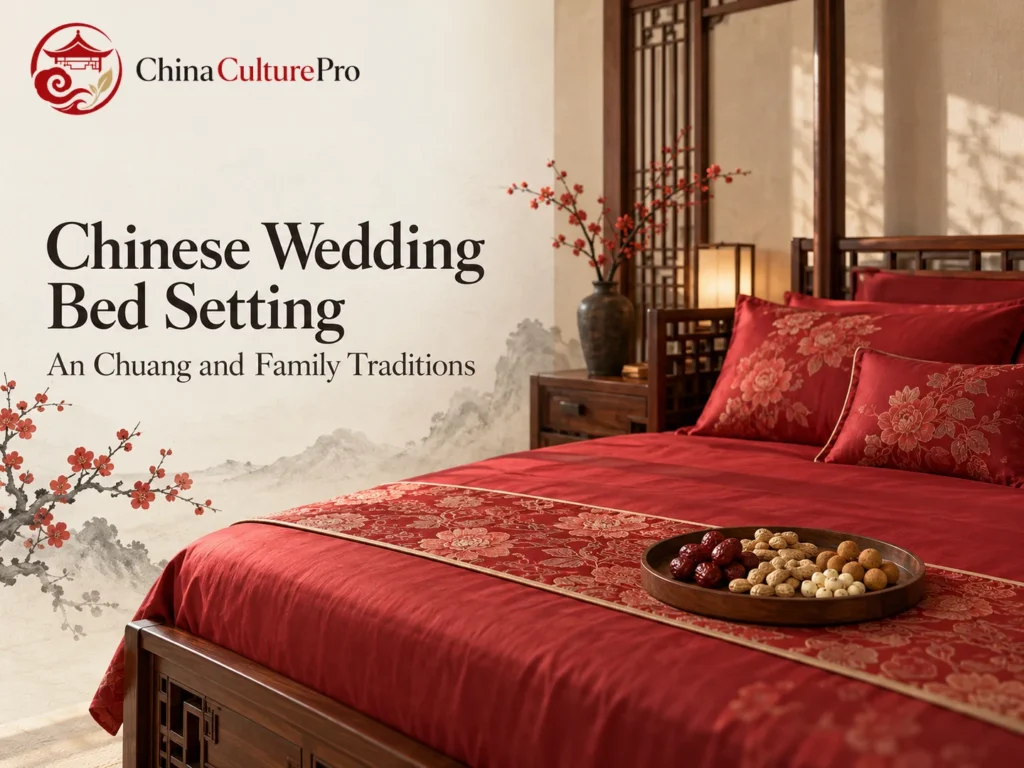

Quick Answer: What Is Chinese Wedding Bed Setting?
Chinese wedding bed setting, often called An Chuang (安床, ān chuáng), prepares the marital bed as a blessing for the couple’s new household. It commonly combines fresh bedding, symbolic foods and good wishes from relatives.
- Purpose: Wishes for marital harmony and, in many traditional versions, descendants.
- Participants: A parent, elder or other person the family considers fortunate may lead.
- Materials: Bedding and a small arrangement of auspicious foods are common; the exact set varies.
- Timing: Usually before the wedding, with the day and any period of non-use agreed by the family.
An Chuang is a family custom rather than a requirement for every Chinese wedding. Its objects express hopes; they do not determine fertility or the success of a marriage.

A carefully made bed and a small tray of fruit can carry a family’s hopes for a marriage. The confusing part is deciding which instructions belong to your relatives’ tradition and which come from a different region. Start with the household’s own version, then use the distinctions below to understand what each part is doing.
An Chuang, Bedding Preparation and Ya Chuang
An Chuang means settling or arranging the bed. In a wedding setting, it gives the couple’s sleeping space a ceremonial beginning. The work may involve making the bed, arranging chosen objects and saying blessings. A historical composite account also describes moving the bed slightly as the symbolic act of installation; that does not mean every family must buy or physically reposition a bed.[3]
Ya Chuang (压床, yā chuáng) names a related bed-occupying custom. In a documented Luoyang wedding custom, a boy from the groom’s close family sleeps on the new bed on the preceding night as a wish for a son. Rolling on the bed appears in other versions. These actions express hopes for descendants, rather than describing every part of preparing the room.[4] English accounts sometimes call both activities “bed setting,” which helps explain why two checklists can look different while referring to related observances.
The ceremonial preparation also differs from ordinary furniture delivery. Install and secure the bed before relatives arrive; nobody needs to lift a heavy frame for a symbolic gesture. The broader Chinese wedding traditions place this domestic ritual among several events that may happen before or during the marriage celebrations.
Who Sets the Wedding Bed, and When?
Traditionally, the helper represents a hoped-for good married life. Descriptions include a married woman, a married man or an older couple with descendants. These are different inherited models, not one universal eligibility test. A Singapore account notes the groom’s parents taking this role in more recent practice.[2]
For a contemporary ceremony, invite someone both partners welcome. If relatives disagree about who “qualifies,” ask which family version they are following before turning the choice into a judgment about someone’s marriage, bereavement or parenthood. The useful question is who can offer a meaningful blessing with the couple’s agreement.
Timing is similarly local. A Hong Kong account describes preparing the bed the day before the wedding because it is then left unused until the wedding day. A Singapore account describes choosing an auspicious day and also mentions a late-evening observance before the wedding.[1][2]
These examples do not create a compulsory hour. If your family consults an almanac, settle that choice before organizing access to the room. If the bed is already in daily use, establish the expected period of non-use first. Fit the ceremony into the wedding timeline rather than discovering the sleeping arrangements after the bedding is laid out.
Bedding, Symbolic Foods and Their Meanings
The materials work together as a blessing for the household. Some carry festive color associations; others evoke sweetness, continuity or descendants. The table gives common examples, not a shopping list every couple must complete.[1][2][3]
| Материал | Role in the ceremony | What to confirm at home |
|---|---|---|
| New bedding | Marks the prepared marital space; red is common in celebratory versions | Whether a particular color or embroidered design matters |
| Red dates | Appear among foods associated with auspicious wedding wishes | Whether they go on a tray or are arranged elsewhere |
| Peanuts | Included in some fruit-and-seed arrangements linked with descendants | Whether nuts are wanted and how they will be contained |
| Dried longan and lotus seeds | Common members of a symbolic arrangement wishing for family continuity | The household’s preferred combination and quantity |
| Sweets and red envelopes | Add wishes for sweetness and good fortune | Who provides them and whether the envelopes contain money |
Do not assume every object has one fixed translation. Sound associations depend on the word, dialect and combination being used. A relative may explain the arrangement through a familiar fertility blessing, while another family emphasizes a harmonious home. Ask for the phrase attached to the actual set rather than assigning a separate promise to every nut.
Embroidered dragon and phoenix motifs can connect bedding to marriage imagery. A Double Happiness symbol belongs to the wider wedding setting, but neither design is necessary to recognize the bed-setting custom. For the money gifts themselves, red-envelope etiquette is a separate question from decorating the bed.
A Practical Way to Arrange the Family Ceremony
Use this as an adaptable preparation sequence, not a claim that every region performs the ritual in this order.
- Agree the family version: Ask both families which customs they want to keep and where the ceremony will happen.
- Confirm the helper and timing: Invite a willing relative and agree when the bed can be prepared.
- Prepare bedding and a small tray: Gather clean bedding and the symbolic items the family has chosen.
- Make the bed and give the blessing: Let the agreed helper arrange the bedding and offer the family’s chosen words.
- Decide what happens afterwards: Agree when foods are removed and whether the bed remains unused until the wedding.
A short wish for growing old together is often easier to share than a script nobody present understands. The family can choose its own language; Chinese wedding wishes help distinguish affectionate general blessings from phrases specifically asking for children.
Keep the symbolic arrangement separate from the surface someone will sleep on. A tray makes removal simple and prevents loose food from being forgotten in the bedding. If a child participates, a brief supervised sit can preserve the family meaning without turning the moment into a jumping activity. Participation should be comfortable for the child and the couple.
Regional Differences and Modern Choices
Hong Kong and Singapore accounts already show why a single national checklist is misleading. The Hong Kong example emphasizes the bed at home and includes a boy and girl in its description of the children’s part. The Singapore example describes a boy rolling on the bed and gives a different account of who commonly performs the preparation.[1][2]
A mainland example adds another distinction: the Luoyang account separates preparing the bedding and scattering auspicious foods from the boy’s overnight stay. It therefore describes something more substantial than a quick photographic moment on the bed.[4]
Those differences reflect the examples being documented. They do not prove that all Hong Kong or Singapore families follow them, and they cannot stand for every mainland, Taiwanese or diaspora household. Use regional wedding customs to place a family version in a wider context.
The most workable modern choice is to identify the meaning the couple wants to retain. A couple may welcome a blessing for companionship while declining language about producing a son. A small gathering can keep the bedding and spoken wishes without reproducing every inherited restriction. Describe that choice honestly as the family’s adaptation.
Also keep neighboring ceremonies distinct. The hair-combing ceremony marks preparation for married life through a different action, while the wedding tea ceremony centers on respect and family relationships. Sharing a wedding schedule does not make their objects or rules interchangeable.
FAQs About Chinese Wedding Bed Setting
Is An Chuang compulsory for a Chinese wedding?
No. It is an inherited household custom that some families keep, adapt or omit. Ask the couple and their relatives what matters to them rather than assuming ethnicity determines the programme.
Can the couple use an existing bed?
A newly purchased bed appears in some historical descriptions, but an existing bed can be part of a modern adaptation. Confirm the family’s expectations before buying furniture specifically for the ceremony.
Must a boy roll on the wedding bed?
No universal rule requires that. Some documented versions involve a boy; another Hong Kong account includes a boy and girl. Families can also leave out the child’s part.
Can anyone sleep on the bed after An Chuang?
Some families leave the prepared bed unused until the wedding. Confirm the interval in advance, particularly if the couple already lives in the home and uses that bed daily.
Источники
[1] Family and Women Portal, Hong Kong. Dai Kam Jie (Bride’s Chaperone) Explains the Contemporary Take on Traditional Weddings: A Rich Blend of Heritage and Heartfelt Blessings
[2] Singapore Federation of Chinese Clan Associations. Culture – Rituals
[3] Chinese Historical and Cultural Project. Китайские свадебные традиции
[4] Henan cultural heritage portal. 洛阳婚嫁习俗