


Quick Answer: What Is a Chinese Native-Place Guild Hall?
A Chinese native-place guild hall (会馆, huìguǎn) was a base for people from the same region living or working away from home. A compound could give members space to meet, worship and stage performances. Some halls also accommodated people from the home region who came to the city for examinations.[1][2]
- Gathering halls and courts: These gave members a shared place to assemble.[1][2]
- Shrines: An association could honor its deities or people from its home region.[1][3]
- Stages: Some compounds included permanent theaters, with space for spectators nearby.[3][5]
Start with the community that built the hall. In some places the same group shared a home region and a line of trade.[1][2][4]
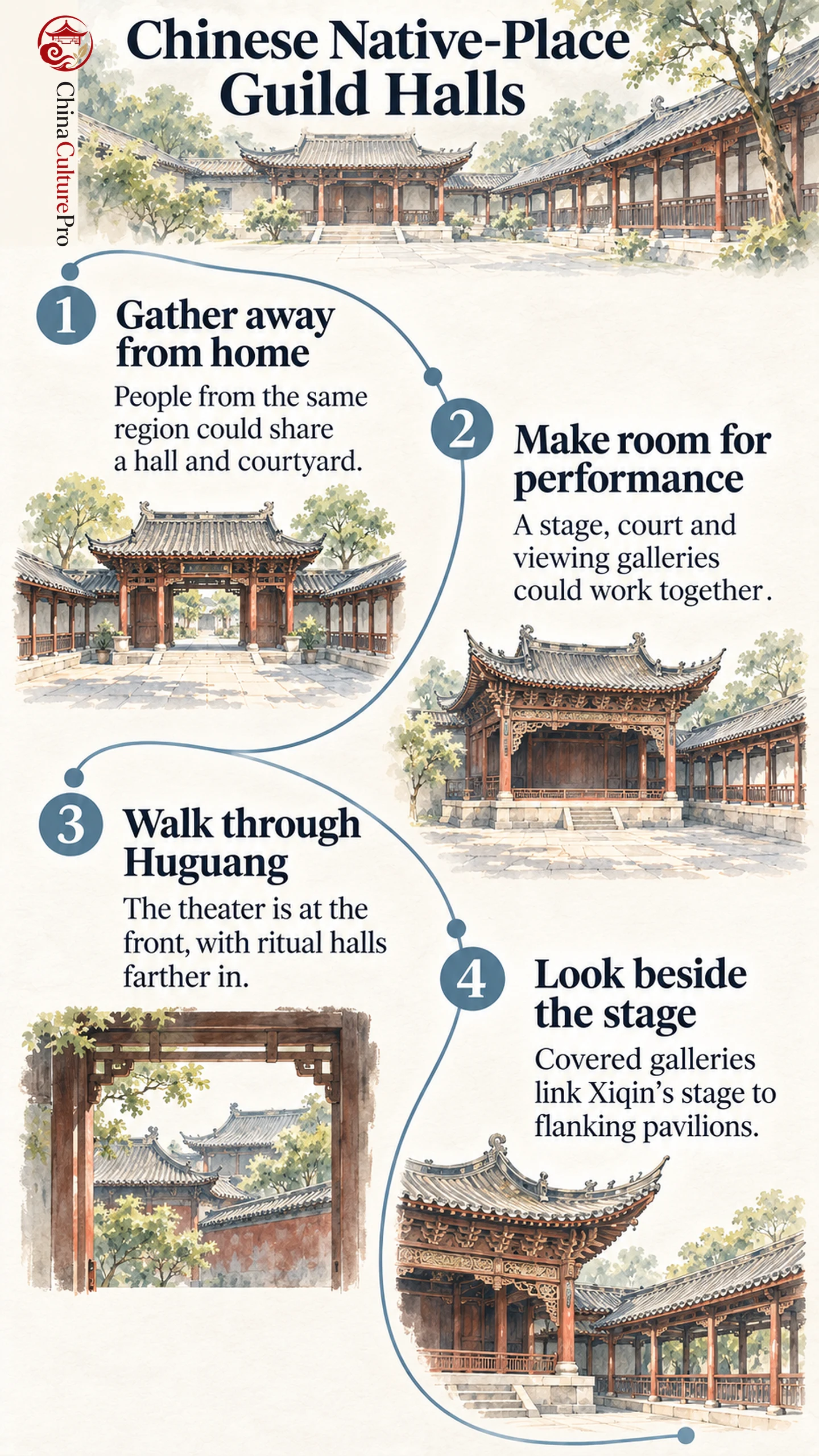
A theater, a shrine and an assembly space can all belong to the same compound. At Beijing’s Huguang Guild Hall and Zigong’s Xiqin Guildhall, their arrangement offers a way to read what the association did.[3][4][5]
How a Guild Hall Served Its Members
A group’s place of origin gave it a reason to assemble away from home. The hall created a setting for economic and social exchange and for forms of worship brought from the home region. Study of Sichuan guild halls shows how these practices became part of the religious landscape in the places migrants settled.[1][2]
The space around a stage is part of the architecture. A raised platform makes the performance visible. An open court gives spectators a direct view, and covered galleries can add sheltered places at the sides. In the Sichuan cases, the positions of stage, viewing space and shrine vary with the building.[3][5]
Huguang Guild Hall in Beijing
Huguang Guild Hall served people from what are now Hubei and Hunan. The Qing compound took shape in a construction campaign in 1807 and later expansions. Its theater occupies the front part of the complex.[3][6]
Farther inside, Wenchang Pavilion was dedicated to Wenchang, a deity associated with literary attainment. Xiangxian Hall honored worthies of the home region. From the front theater to these halls farther in, the arrangement puts performance and regional remembrance in different parts of the same compound.[3]
Xiqin Guildhall in Zigong
Salt merchants from western Shaanxi commissioned Xiqin Guildhall in Sichuan. Construction began in 1736 and finished in 1752. The same compound is associated with worship of Guandi and has housed the Zigong Salt Industry History Museum since 1959.[1][4]
The Xianji Tower stage stands just inside the gate. Covered galleries link it to the flanking Great Drum and Golden Bell pavilions. An 1829 inscription records spending on performances alongside ritual expenses, giving this example of Chinese architecture a record of what members paid for as well as where they gathered.[5]
FAQs About Chinese Native-Place Guild Halls
Was membership based on a trade or a place?
The native-place association formed around a shared place of origin. A trade could overlap with that identity, as it did among the Shaanxi salt merchants at Xiqin.[1][2][4]
Did every guild hall have a theater?
Theaters are documented at Huguang and Xiqin. Guild halls had different functions and layouts depending on the community that built them.[1][3][5]
What is Xiqin Guildhall used for today?
It houses the Zigong Salt Industry History Museum.[4]
Источники
[1] Elena Valussi. Guildhalls as Socio-Religious Spaces
[2] Christine Moll-Murata. Chinese Guilds from the Seventeenth to the Twentieth Centuries
[3] Visit Beijing. Huguang Guild Hall and Its Buildings
[4] Zigong UNESCO Global Geopark. Xiqin Guildhall
[5] Religions. Theatre Spaces in Qing-Dynasty Sichuan
[6] Beijing Municipal Government. Huguang Guild Hall