


Quick Answer: What Is a Shaanxi Cave Dwelling?
A yaodong (窑洞, yáodòng) is an arched dwelling common in parts of the Loess Plateau. In northern Shaanxi (陕西, Shǎnxī), some rooms are excavated into a bank of compact soil. Others are freestanding structures with built vaults that can stand above ground. The entrance can look similar in the two forms.[1][2]
- Cliff-cut room: The chamber extends into a slope or vertical face.[2][5]
- Built vault: In an independent yaodong, a constructed arch forms the room.[4][5]
- Courtyard: Several chambers can face an open court, as in the Jiang family compound in Mizhi (米脂, Mǐzhī).[3]
Northern Shaanxi is one part of the wider Chinese yaodong tradition. The examples below focus on dwellings in northern Shaanxi.
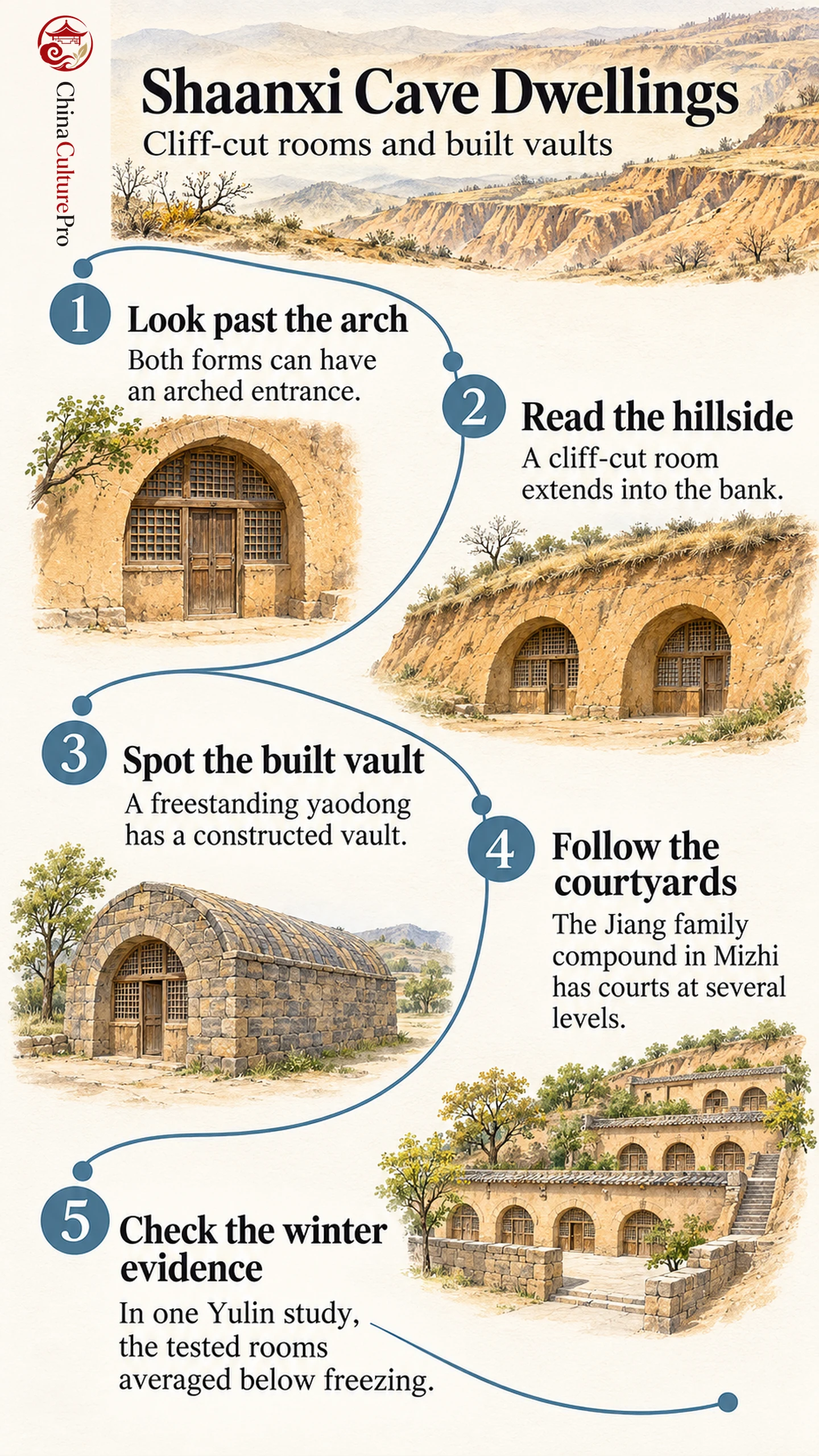
From the front, two dwellings can show much the same curve above the door. Where the side is visible, look at how the room continues behind the entrance. One room disappears into the bank, while another can have visible side walls and a roof above ground.
Cliff-Cut Rooms and Built Vaults
In northern Shaanxi, layers of loess, a fine wind-deposited soil, made it possible to form rooms inside deep banks. In the cliff-side layout, doors and windows are concentrated at the exposed end. Freestanding forms use masonry to make the vault, which can be covered with earth. The masonry around a door can be visible even where most of the chamber lies in earth.[1][2][5]
Mizhi Courtyards and the Yan’an Sites
In Mizhi, the late Qing Jiang family compound is laid out with upper, middle and lower courts. Rows of arched rooms and carved brick, wood and stone show how the dwelling type could be used within a large family property.[3]
At Yangjialing (杨家岭, Yángjiālǐng) in Yan’an (延安, Yán’ān), provincial archives record both earthen rooms and constructed stone chambers added after 1939, alongside other buildings. The dwellings served as living quarters within a larger compound that also held offices and a meeting hall.[4] These uses are part of the building history of Шэньси.
What the Earth and Masonry Do in Winter
Earth around a cliff-cut room and the mass of a built vault can slow indoor temperature changes. In a Yulin (榆林, Yúlín) field study, both tested yaodong types had higher average bedroom temperatures than the compared brick room during a winter test. Their average temperatures were still below freezing. The outdoor average was lower than all three bedroom averages.[5]
FAQs About Shaanxi Cave Dwellings
Are All Yaodong Underground?
Independent yaodong can stand above ground with built vaults. Cliff-cut rooms extend into a bank, and in some parts of the plateau rooms open onto a sunken court.[2][5]
Is Every Yaodong in Northern Shaanxi?
Yaodong forms occur elsewhere on the Loess Plateau, with different site layouts and materials.[2]
What Did the 2011 Heritage Listing Recognize?
The national list added northern Shaanxi yaodong building techniques from Yan’an’s Baota District to an existing entry on cave-dwelling construction.[1]
Источники
[1] China Intangible Cultural Heritage Network. Northern Shaanxi Yaodong Construction Techniques
[2] Qi Jiahua. The Form and Logic of Traditional Dwellings
[3] Shaanxi Public Culture Cloud. The Jiang Family Compound in Mizhi
[4] Shaanxi Provincial Archives. Yan’an Historic Sites Including Yangjialing
[5] Energy Reports. Comparative Analysis of the Indoor Thermal Performance of Yaodong Dwellings