


Quick Answer: What Are Chinese Loanwords in Vietnamese?
Chinese loanwords in Vietnamese reflect repeated contact through speech, scholarship and writing. They are integrated Vietnamese vocabulary, with Vietnamese pronunciation and meanings.
- History: Different layers entered through different periods and channels.
- Examples: Giáo dục means education; văn hóa means culture.
- Writing: Modern Vietnamese spelling can represent words of different origins.
- Reading: Keep Vietnamese tone marks and check the complete word.
This guide explains recognition and context, rather than a rule for translating every Chinese character.
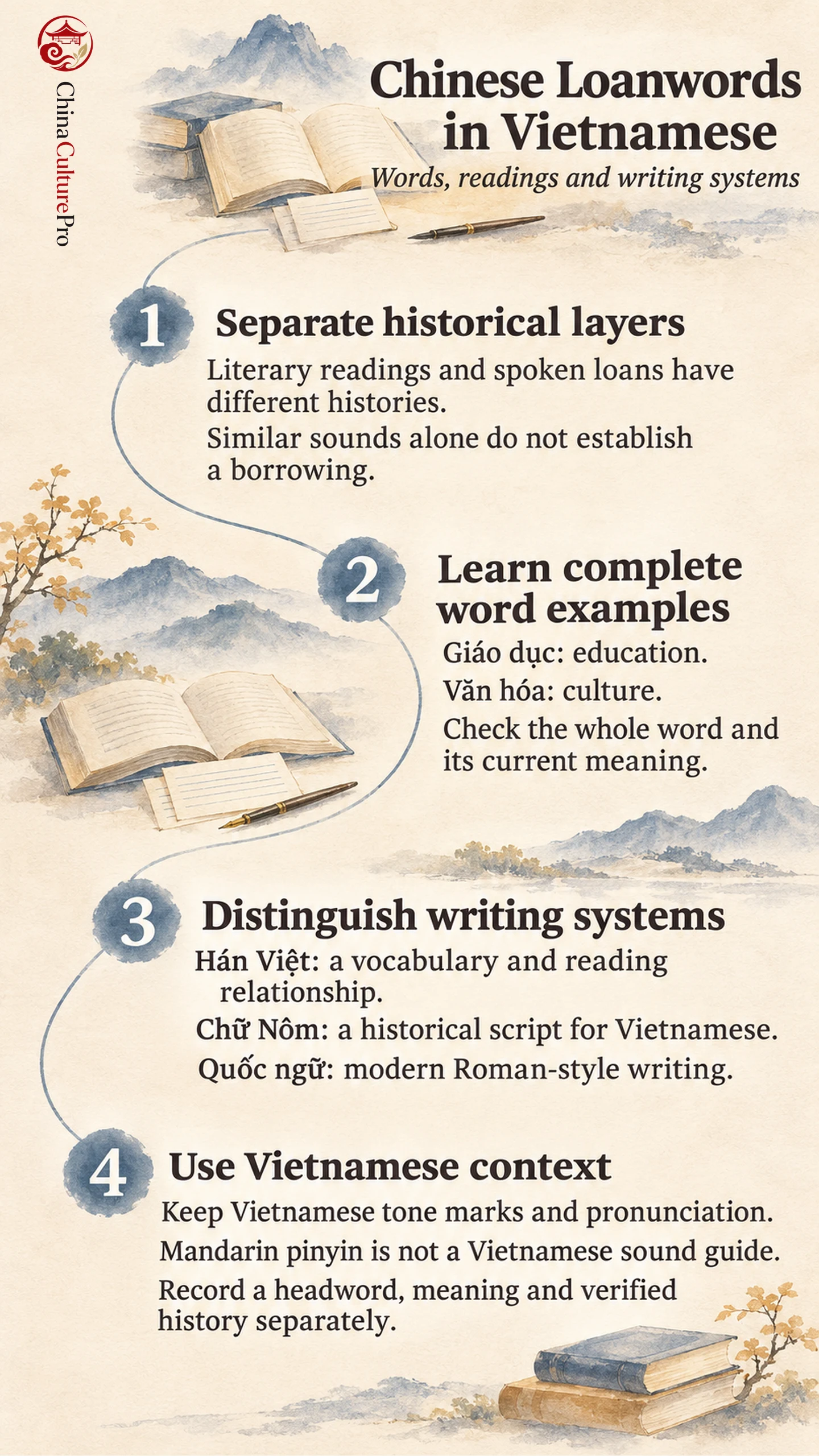
Chinese-derived vocabulary can make Vietnamese words look familiar to a Chinese-language learner. That familiarity is useful only when it remains a starting point. Historical source, present-day pronunciation and current meaning are three separate questions.
Understand the Different Layers of Borrowing
Sino-Vietnamese, called Hán Việt (漢越; Mandarin character identification: hàn yuè), is the conventional Vietnamese reading layer associated with Chinese characters. Its historical foundations are strongly connected with Middle Chinese and the literary tradition. Mandarin pinyin here identifies the characters; it does not give their Vietnamese pronunciation. [2]
Chinese-origin vocabulary is broader than that label alone. Older borrowings and later spoken loans need not match the standard literary readings. A word can therefore have a Chinese connection without looking like a predictable character-by-character textbook example. Historical linguists test patterned sound and meaning correspondences; a similar sound on its own proves little. [1]
The comparison belongs alongside Chinese loanwords in Korean и Chinese loanwords in Japanese, while each language retains its own history and reading systems.
Recognize Useful Vietnamese Word Examples
These examples identify useful Vietnamese forms; they do not authorize freely building new compounds. Preserve the accents when copying them. [2]
| Vietnamese | Практическое значение |
|---|---|
| học | study; learning |
| giáo dục | education |
| văn hóa | culture |
The shared historical layer does not require identical modern usage. A particularly useful comparison is thư viện, meaning library in Vietnamese: its character counterpart is 書院, which means academy in Chinese. Modern Mandarin normally uses 圖書館 for library. A familiar-looking historical connection can therefore lead to the wrong present-day translation. [3]
For reading, record a complete dictionary headword and one natural phrase. Do not create an unfamiliar expression just by combining remembered English glosses.
Keep Vocabulary Separate from Writing Systems
Hán Việt describes a vocabulary and reading relationship. Chữ Nôm is a historical character-based script used to represent Vietnamese speech. Quốc ngữ is the Roman-style writing system of modern Vietnamese. These labels answer different questions: a word’s ancestry, the representation of Vietnamese in a historical text, and modern spelling. [4]
Recognizing Chinese characters may help with an annotated historical text. It does not automatically let a modern Chinese reader understand every Nôm character or Vietnamese sentence. Conversely, a Vietnamese word written with Latin letters can still contain Chinese-derived elements. [4]
When comparing an old document with a modern transcription, identify which writing system you are looking at before drawing conclusions about the word’s origin.
Read Vietnamese Words in Their Own Context
Use Vietnamese pronunciation, including its written tone marks. Пиньинь путунхуа serves a different language and sound system. A shared historical source does not make modern Mandarin and Vietnamese pronunciations interchangeable. [2]
Meaning also continues to develop after borrowing. Vietnamese can form new words using Chinese-derived components, native Vietnamese components or combinations of the two. Structural and semantic changes mean that a compound’s internal history is not necessarily a reliable modern definition. [5]
A useful vocabulary note keeps three fields apart: the Vietnamese headword, its meaning in the sentence, and any verified historical character connection. Add an etymological claim only when a suitable dictionary or linguistic study supports it. Leave an uncertain route open rather than guessing a dynasty from the spelling.
FAQs About Chinese Loanwords in Vietnamese
Is Vietnamese a variety of Chinese?
No. Vietnamese belongs to the Austroasiatic language family. Extensive borrowing does not make it a Chinese variety. For the separate question of diversity within Chinese, the Chinese languages and dialects guide offers a separate introduction. [1]
Can Mandarin pronunciation replace a Hán Việt reading?
No. Hán Việt readings function within Vietnamese phonology. A Mandarin reading can identify a related character for comparison, but it is not the Vietnamese pronunciation. [2]
Does a Chinese-derived element guarantee the same meaning?
No. Whole words can change meaning, grammatical role or internal structure. Check contemporary Vietnamese usage instead of translating each component separately. [5]
Источники
[1] Mark J. Alves, World Loanword Database. Vietnamese vocabulary: description
[2] Xian Manxue, Digitizing Việt Nam. Revisiting Sino-Origin Vocabulary in Vietnamese
[3] Journal of Viet Nam Hoc. Volume 1, Number 1 (2020)
[4] Vietnamese Nôm Preservation Foundation. What is Nôm?
[5] V. A. Andreeva, Russian Journal of Vietnamese Studies. Sino-Vietnamese vocabulary in modern Vietnamese language