


Quick Answer: What Is Bayin?
Bayin (八音, bāyīn), or “Eight Sounds,” is a historical Chinese way to classify instruments by material. The Rites of Zhou (周礼, Zhōulǐ) lists metal, stone, earth, hide, silk, wood, gourd and bamboo.[1][2]
- Metal and stone: Cast bells and carved chime plates were separate categories.[2][3]
- Silk and hide: A silk string and a stretched drumhead both vibrate, but their materials place them in different groups.[2][3]
- Gourd and bamboo: A wind chamber and a flute tube can define different categories even though breath supplies the air in both.[2][3]
You can use bayin to read a historical instrument list even when a museum label uses a modern family name.[1][3]
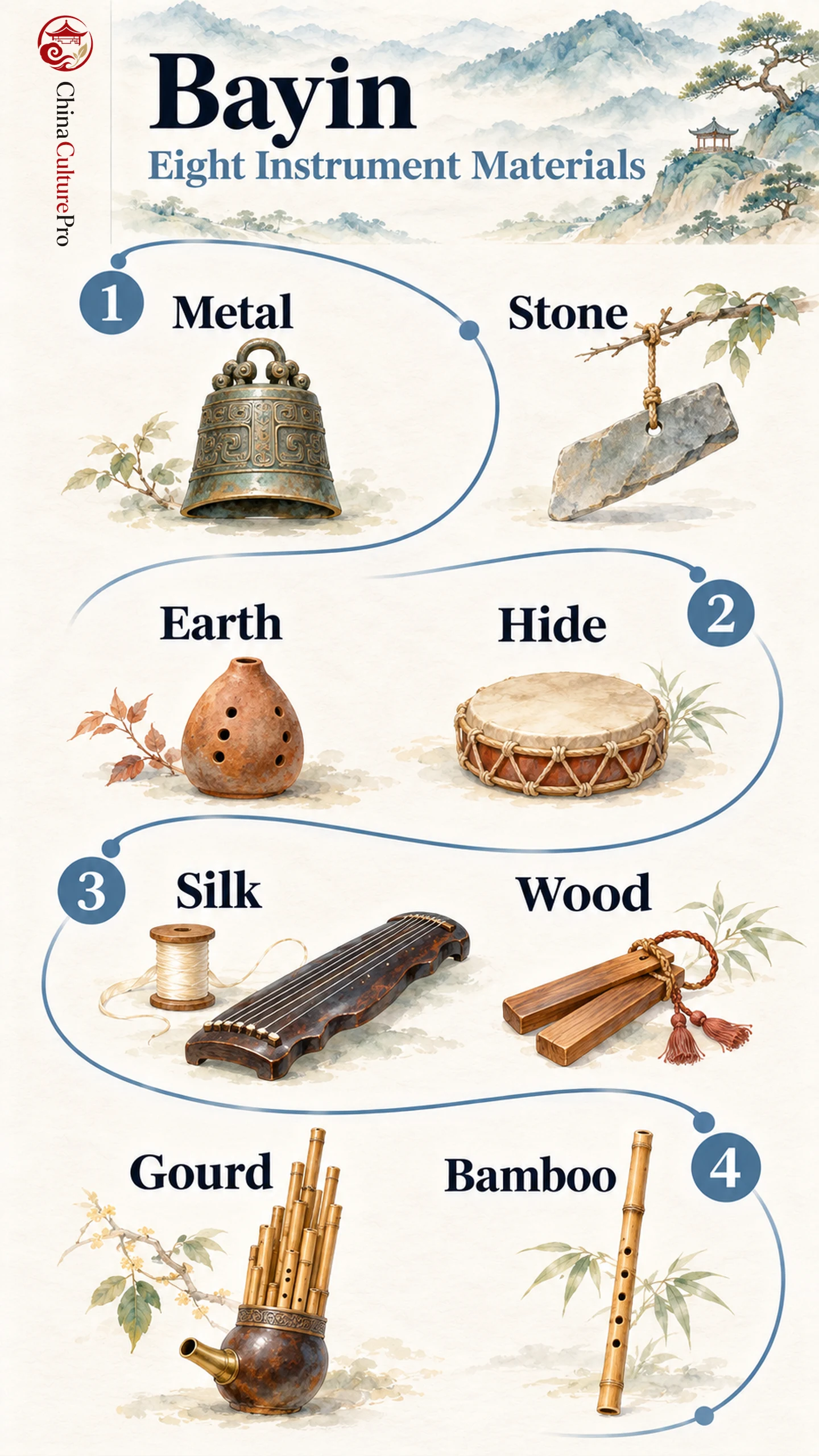
A wooden-bodied drum can count as hide, and a mouth organ with bamboo pipes can count as gourd. The category tells you which component a historical classification singles out.
The Eight Materials and Their Instruments
The rows follow the order in the Rites of Zhou. A traditional commentary provides examples for the eight terms. A modern instrument with the same name can use different materials.[1][2][3]
| Материал | Что обозначает | Пример |
|---|---|---|
| Metal (金, jīn) | A cast metal body vibrates when struck. | Bianzhong bells |
| Stone (石, shí) | A shaped stone plate vibrates when struck. | Bianqing chimes |
| Earth (土, tǔ) | A clay vessel holds the sounding air. | Xun vessel flute |
| Hide (革, gé) | A stretched animal skin vibrates when struck. | Bangu drum |
| Silk (丝, sī) | A silk string vibrates when plucked or bowed. | Qin zither with silk strings |
| Wood (木, mù) | A wooden body makes sound when struck or scraped. | Yu wooden tiger scraper |
| Gourd (匏, páo) | A gourd forms the wind chamber. | Sheng mouth organ with a gourd chamber |
| Bamboo (竹, zhú) | A bamboo tube contains the sounding air column. | Xiao flute |
Why One Instrument Can Contain Several Materials
A traditional gourd-chamber sheng combines a chamber, bamboo pipes and reeds. When a player directs air into the chamber, a reed vibrates to start a note. The gourd category takes its name from the chamber, which directs air to the reeds. Some later instruments use other materials for the chamber.[2][3][4]
The same distinction helps with silk. The qin’s wooden body helps radiate the sound. In the silk category, the named material is the string. A set of Chinese wooden clappers illustrates a different case. The wooden slats themselves meet to make the sound.[2][3][4]
How Bayin Relates to Modern Instrument Families
The passage in the Rites of Zhou places the Eight Sounds within the responsibilities of a court music official. It also discusses pitches and modes. The material categories give a vocabulary for the instruments used to sound music, alongside a vocabulary for the notes and their arrangement.[1][2]
A modern classification can put bronze bells, stone plates and wooden clappers together as idiophones. In all three, the body itself vibrates. Bayin puts them into separate materials. A clay xun and a bamboo xiao can both be classed as flutes because the air is directed at an edge. Compare the broader guide to Chinese musical instruments for wind, string and percussion groupings.[3][4]
FAQs About Bayin
Does bayin refer to eight notes?
In the Rites of Zhou passage it refers to eight instrument materials. The same passage discusses pitch standards separately.[1][2]
Does a traditional category change if the material changes?
The old label can still identify an instrument type. A qin with modern strings may still be discussed under silk when a writer is explaining the historical system.[3][4]
Источники
[1] Chinese Text Project. Rites of Zhou, Commentary on the Grand Music Master
[2] Chinese Text Project. Annotated Rites of Zhou, Volume 12
[3] The Metropolitan Museum of Art. Music and Art of China
[4] Monash University. Musical Instruments of China Exhibition Catalogue