


Quick Answer: What Is the Xun Ocarina?
The xun (埙, xūn) is a Chinese vessel flute, often made from fired clay. The player directs breath across the top opening and covers or uncovers smaller holes to change pitch.[1][3]
- Body: A hollow, closed vessel forms the main air chamber.[4]
- Holes: The blowing opening has a different job from the finger and thumb holes.[4]
- Use: A Qing court example survives, and modern concert programs also feature the xun.[4][5]
Look for the opening at the top first, then count the holes used to change the note.
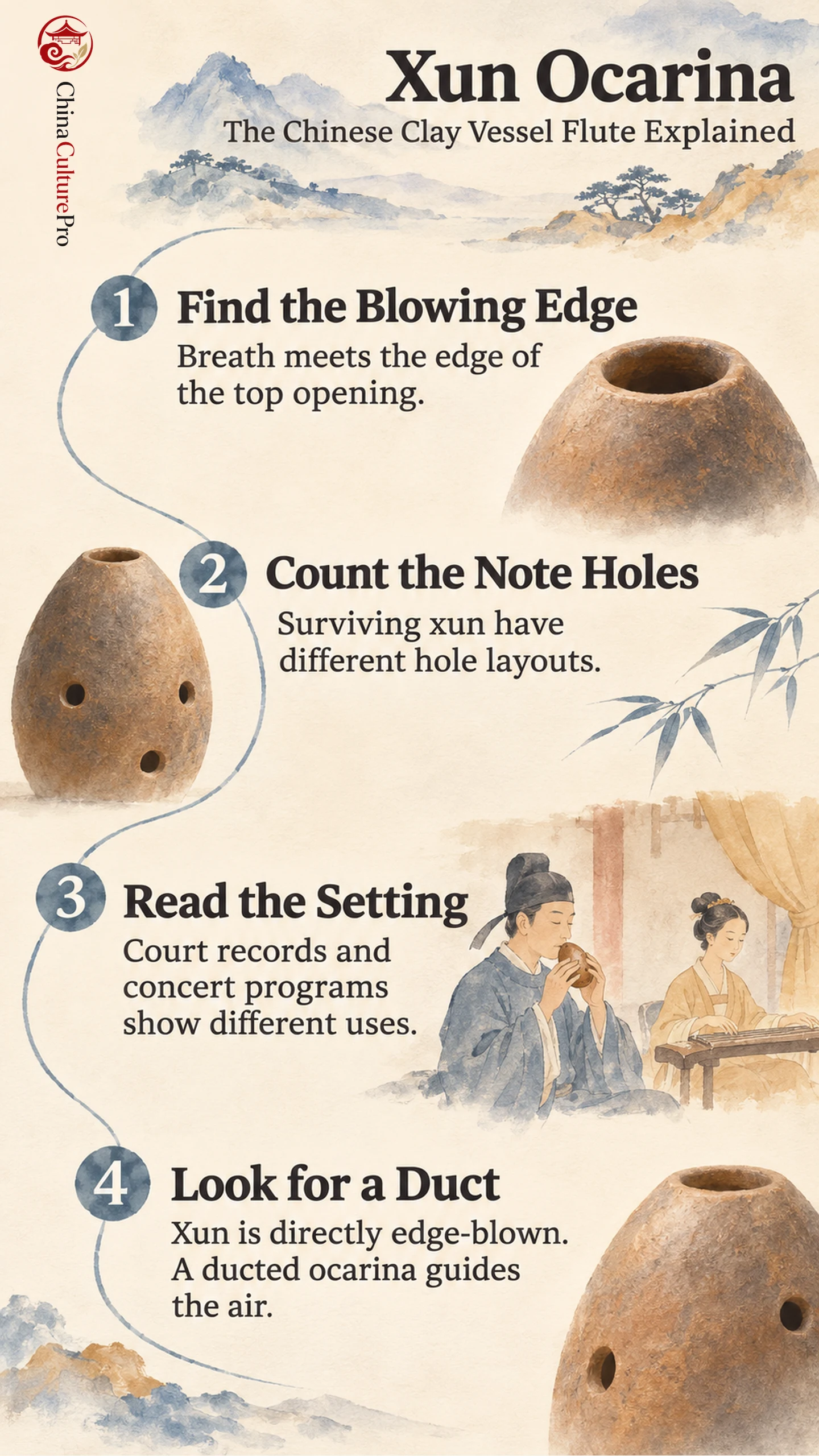
The xun can look like a small pot in a display. Its outline gives little away about the notes it can play. Find the blowing opening and the places the fingers cover to see how the instrument works.
How the Clay Chamber Makes a Note
The player holds the vessel in both hands and aims a narrow stream of air at the far edge of the top opening. The air jet meets the edge and excites the air in the cavity. Covering and uncovering note holes changes how the air inside the vessel responds.[1]
The chamber lies inside the rounded body. In a xiao flute, the sounding air column extends along a tube. In paixiao panpipes, moving to another pipe selects another sounding length. The small xun body contains the space used for its different notes.
Read the Holes on Museum Objects
The National Museum of China catalogs three black ceramic xun with flat bases. The largest stands 7.3 centimeters high. Each has a blowing opening above and five note holes on the body. Count the five note holes separately from the opening used to blow.[2]
The Met’s pottery xun, dated to the Han dynasty, measures 10.5 centimeters in length. Its catalog discusses differences in hole placement across forms. The Grinnell example has seven finger holes and two rear thumbholes, in addition to the top opening.[1][3]
From Court Ritual to the Concert Hall
The Palace Museum records a red and gold Qing clay xun made for Zhonghe Shaoyue (中和韶乐, Zhōnghé Sháoyuè), a court ceremonial ensemble. Its six note holes sit four in front and two behind. In bayin (八音, bāyīn), the traditional scheme of classifying instruments by material, xun represents earth or clay.[4]
A Hong Kong Chinese Orchestra program lists Wu Chih-ting playing xun as well as several other winds in a concert for families. The program presents the xun to a concert audience as part of a demonstration of different winds. Explore Chinese musical instruments for the wider wind family.[5]
How Xun Differs From a Ducted Ocarina
Both instruments enclose air in a small vessel. The Grinnell xun’s player aims the breath directly across the top rim. An Italian ocarina in the same collection uses a built-in duct to guide air to a sounding edge. Check for a duct when a label uses the broad English word ocarina.[1][6]
FAQs About the Xun
How many holes does a xun have?
Counts vary. A Qing court example has six note holes, plus its blowing opening. The three black ceramic xun in the National Museum have five note holes each.[2][4]
Does a xun use a reed?
The note comes from air directed against the edge of the blowing opening. The hollow clay body acts as the resonating chamber.[1]
What does a xun sound like?
Its tone can sound airy, especially at the start of a note. Listen to how the breath noise gives way to a clearer pitch in a held note.[7]
Источники
[1] Grinnell College Musical Instrument Collection. Xun
[2] National Museum of China. Pottery Xun
[3] The Metropolitan Museum of Art. Pottery Xun, 2005.14
[4] The Palace Museum, Beijing. Red-Lacquer Xun for Zhonghe Shaoyue
[5] Hong Kong Chinese Orchestra. A Musical Treasure Hunt III
[6] Grinnell College Musical Instrument Collection. Ocarina
[7] Middle Tennessee State University, Center for Chinese Music and Culture. Instrument Gallery: Xun