


Quick Answer: What Is the Yueqin?
The yueqin (月琴, yuèqín) is a plucked Chinese lute whose usually round body resembles a full moon. Its compact fretted neck helps distinguish it from other round-bodied lutes.[1][5]
- Look: Raised frets may extend from the neck onto the wooden face.[2]
- Sound: A pick or fingernail makes a bright, clearly defined attack.[1][6]
- Stage: Beijing opera groups the yueqin with two bowed strings in its traditional melodic ensemble.[3]
Identify the neck and the body together before using string count as a clue.
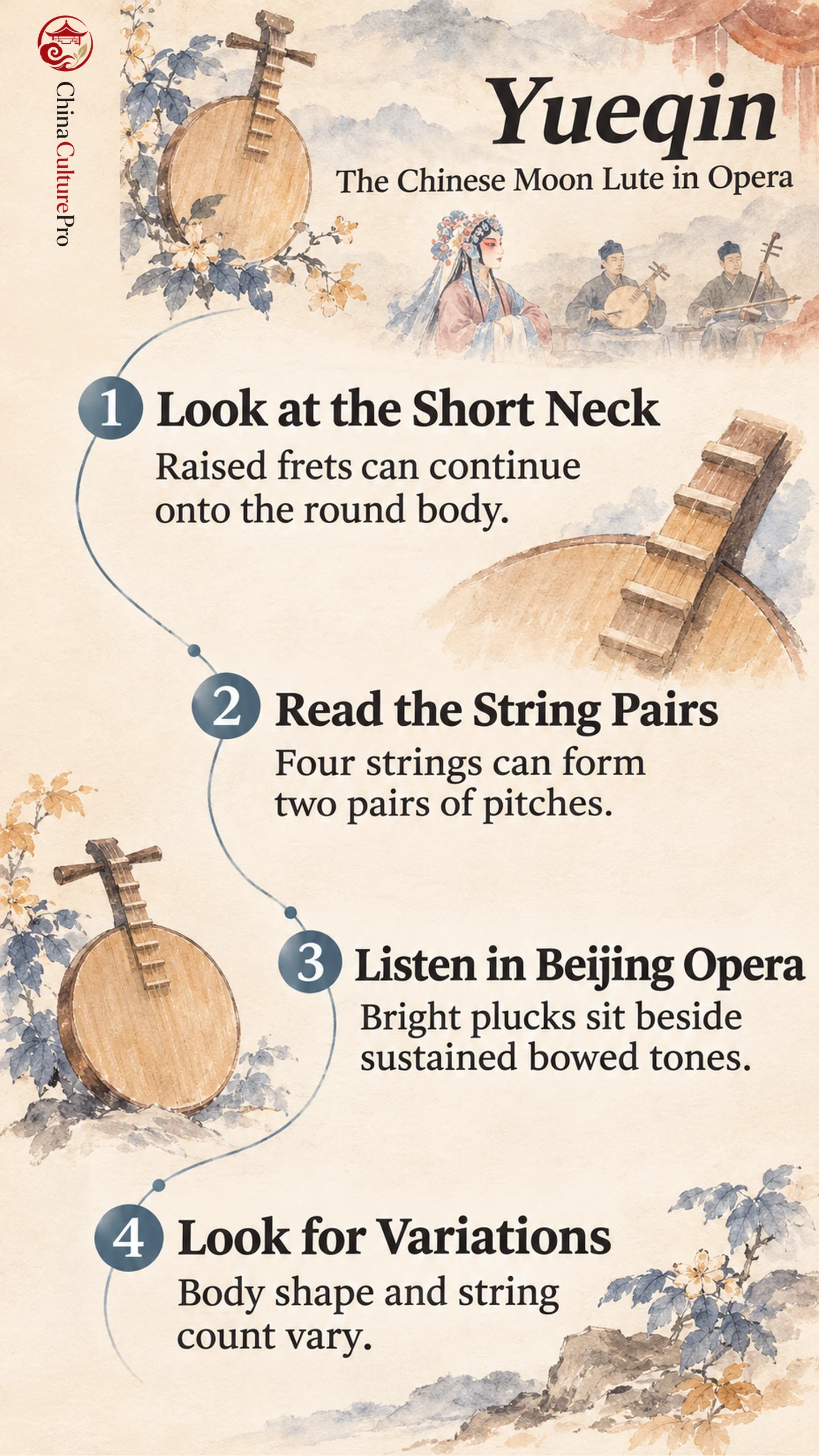
A round lute in an opera photograph might be a yueqin. The name points to the body shape. The length of the neck and the placement of the frets are better clues when several Chinese lutes share a round outline.
Recognizing the Short-Necked Moon Lute
A yueqin in the Powerhouse Collection, made around 1880 in Guangzhou, has a round wooden body about 35 centimeters across. Eight frets sit on the face of the instrument and two on its neck. That placement leaves a substantial part of the fretted playing area on the body itself.[2]
The ruan also has a round body, typically with a longer fretted neck. A qinqin often has a slender neck and a shaped body. In a partial photograph, follow the strings toward the tuning pegs and check how much neck lies beyond the body.
What Four Strings Can Mean
A nineteenth-century yueqin at the Met has four strings tuned as two pairs. The strings in a pair share the same pitch and are played together. The two pairs are a fifth apart. This means the four strings give the player two open pitches on that example.[1]
The right hand can make a single clear pluck or alternate strokes for a tremolo. Listen to the difference between a short note with a sharply defined start and repeated strokes that keep a tone present. In a tremolo, many small attacks merge into an almost continuous note.[1][6]
Hearing It in Beijing Opera
In Jingju (京剧, jīngjù), or Beijing opera, the yueqin joins the jinghu (京胡, jīnghú) and jingerhu (京二胡, jīng’èrhú), both bowed instruments. Together they are traditionally described as three principal instruments of the melodic accompaniment. In a sung phrase, listen for the yueqin’s brief plucked attacks beside the continuous tones of the bows.[3][5]
Yueqin also accompanies Chu opera in the Palace Museum exhibition account. The broader guide to Китайская опера places these stage traditions in context.[5]
How Yueqin Forms Vary
The Hartenberger collection discusses a two-string opera form alongside its own four-string specimen. The Chinese Music Archive records octagonal bodies and a redesigned model with a wider neck and 24 chromatically spaced frets. A body shape, peg count or fret count is useful when read alongside the collection label.[3][4]
The same archive describes the xianzi (弦子, xiánzi) played for dance by Yi communities in southwestern China. Compare the body, strings and setting when identifying one of these Chinese musical instruments.[3]
FAQs About the Yueqin
Why is the yueqin called a moon lute?
Yue means moon. The instrument takes its name from the round shape of many yueqin bodies.[1]
Is the yueqin the same as a ruan?
They are related plucked lutes. A yueqin generally has a shorter neck, with raised frets often extending onto the body.[2]
Does every yueqin have four strings?
Museums document four-string examples, often with two pairs. Some opera versions use two single strings.[1][4]
Источники
[1] The Metropolitan Museum of Art. Yueqin, 89.4.53
[2] Powerhouse Collection. Lute or Yueqin by Jin Shang, 7943
[3] Chinese Music Archive. Yueqin in the Plucked Instrument Collection
[4] Hartenberger World Musical Instrument Collection. China Yueqin, Moon Lute
[5] ChinaCulture.org. Chinese Opera Artifacts from the Palace Museum Exhibited in Macao
[6] BioResources, North Carolina State University. Yueqin: A Classic Chinese Plucked Guitar