


Quick Answer: What Is an Imperial Garden Rockery?
An imperial garden rockery (假山, jiǎshān) is a constructed hill or mountain scene in a royal garden. In Beijing’s Forbidden City, Duixiu Hill (堆秀山, Duīxiù Shān) carries a pavilion above the Imperial Garden. In the Qianlong Garden (乾隆花园, Qiánlóng Huāyuán), several rockeries shape smaller courts.[1][3]
- Stone: Arranged rocks suggest cliffs, ravines and mountain slopes.
- Path: An ascent or winding passage lets people enter the scene.
- Pavilion: An elevated structure offers a view and gives the hill a visible summit.
The two gardens show how palace rockeries range from one prominent landmark to a series of scenes.
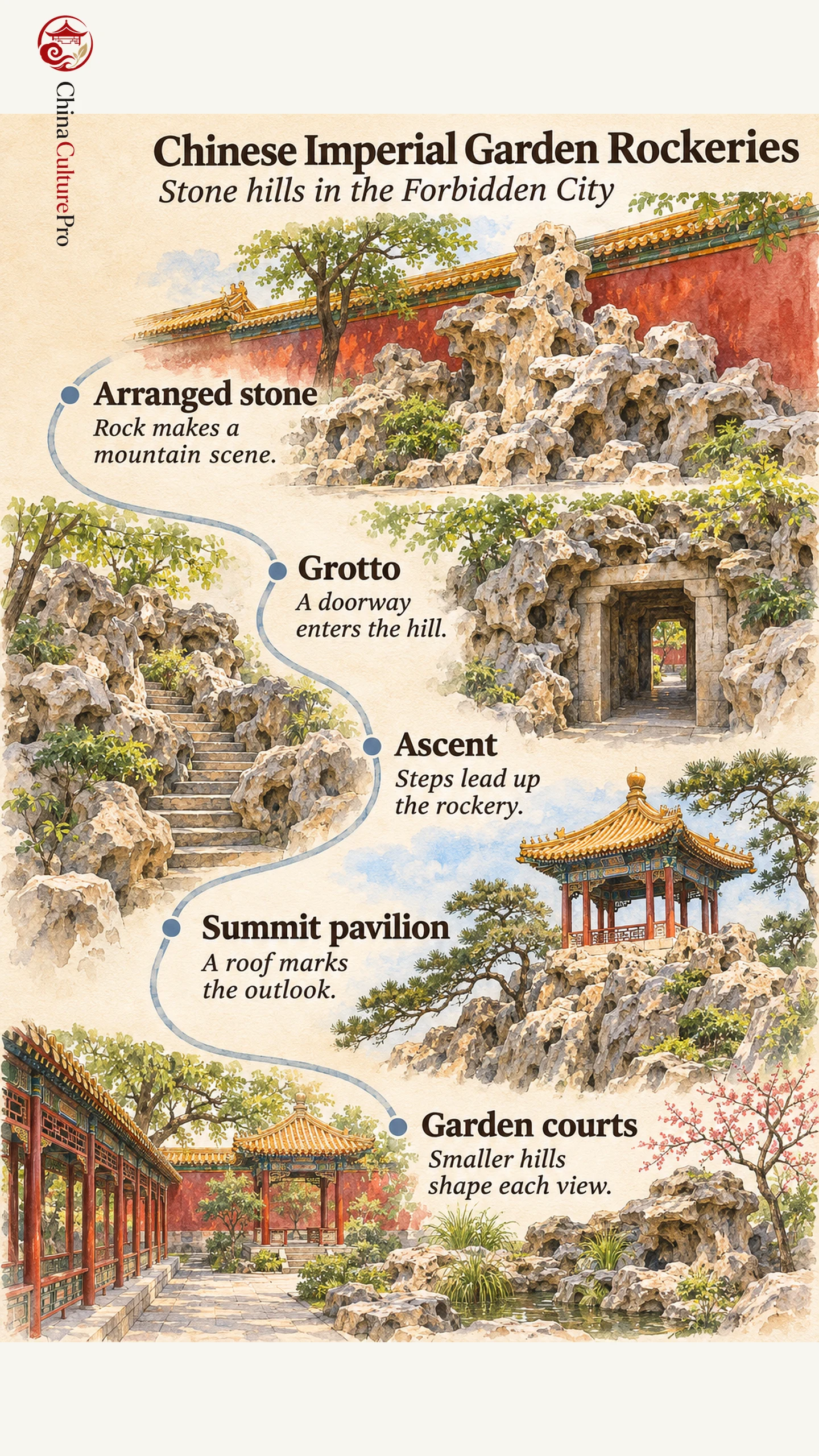
Seen against a Forbidden City wall, a mound of irregular stone can look like a mountain in miniature. A roof above the stone marks a destination and shows the scale of the formation below it.
Duixiu Hill and the Imperial View Pavilion
Duixiu Hill was built in 1583, in the Ming dynasty, at the site of an earlier hall in the northeastern part of the Imperial Garden. The Palace Museum records that the formation rises about ten meters beside the palace wall. Steps on its eastern and western sides ascend to the Imperial View Pavilion (御景亭, Yùjǐng Tíng).[1] The structure is visible above the stone before either route comes into view.
The front combines a rocky face with deliberate architectural features. A grotto entrance leads to a domed interior with a carved coiling dragon overhead. Stone dragon fountains flank the entrance.[1] The fountains add a different example of garden water design from the open ponds common in Suzhou.
A Qing hanging scroll in the museum’s collection depicts the hill and its pavilion alongside old cypresses. In its account of the painting, the museum identifies the hill as a place where the imperial household climbed during the Double Ninth Festival.[2] The scroll documents a Qing depiction of the hill. The festival use comes from the museum’s account.
The Qianlong Garden: Rockeries Across Four Courts
The Qianlong Garden, part of the Palace of Tranquil Longevity complex, was laid out from 1772 to 1776 for the Qianlong emperor’s intended retirement. The Palace Museum describes a long, narrow site divided into four successive courts. In the first, winding paths pass among rocks south of the principal building. A smaller side court has its own rockery with a pavilion.[3]
In the third court, a taller rockery supports Songxiu Pavilion (耸秀亭, Sǒngxiù Tíng). The museum describes steep stone faces and deep recesses below it and views into and beyond the garden from the pavilion. Its built-in rail seating gives an example of seating at a garden viewpoint.[4]
The succession of courts matters. A rockery can fill a small enclosure, mark a turn beside a hall or lift a viewer above surrounding roofs. Each position gives the stone a different role in the whole garden.
Reading the Stone, Pavilion and View Together
First look from below. The building silhouette shows where the designed summit lies, while steps and openings suggest how the rockery might be entered. From above, the roof becomes shelter for a view across the garden. At Duixiu Hill and Songxiu Pavilion, the same building therefore serves as a focus from below and a viewpoint from above.[1][4]
Routes through the stones have a parallel in Suzhou’s garden rockery paths. In the Forbidden City, a rockery’s relationship to the enclosing court and the palace buildings is part of its design.
FAQs About Chinese Imperial Garden Rockeries
Is Duixiu Hill a natural hill?
No. It is an artificial rockery created during the Wanli reign in the Imperial Garden. The Palace Museum documents the former hall site and the paths to the summit pavilion.[1]
Are imperial rockeries always large?
Size varies. The Qianlong Garden includes both smaller court rockeries and a formation high enough to carry Songxiu Pavilion.[3][4]
Why place a pavilion on a rockery?
A pavilion gives the ascent a destination and a sheltered place to look out. From below, it gives the formation a distinct summit.
Источники
[1] The Palace Museum. Duixiu Hill
[2] The Palace Museum. Ancient Cypresses in the Imperial Garden
[3] The Palace Museum. Qianlong Garden
[4] The Palace Museum. Songxiu Pavilion