


Quick Answer: How Do Chinese Letter Honorifics Work?
Chinese letter honorifics (敬称, jìngchēng) express respect through the way a writer addresses someone and refers to that person’s affairs. Their position matters as much as their dictionary meaning.
- Recipient: Use the person’s correct title and an appropriate greeting.
- Traditional phrases: Some expressions follow the recipient’s title; others introduce the message.
- Writer: A respectful signature closing belongs with the sender’s name.
- Register: A modern email can use a simpler opening than a traditional formal letter.
These examples explain particular conventions; they are not one compulsory formula for every Chinese-speaking community.
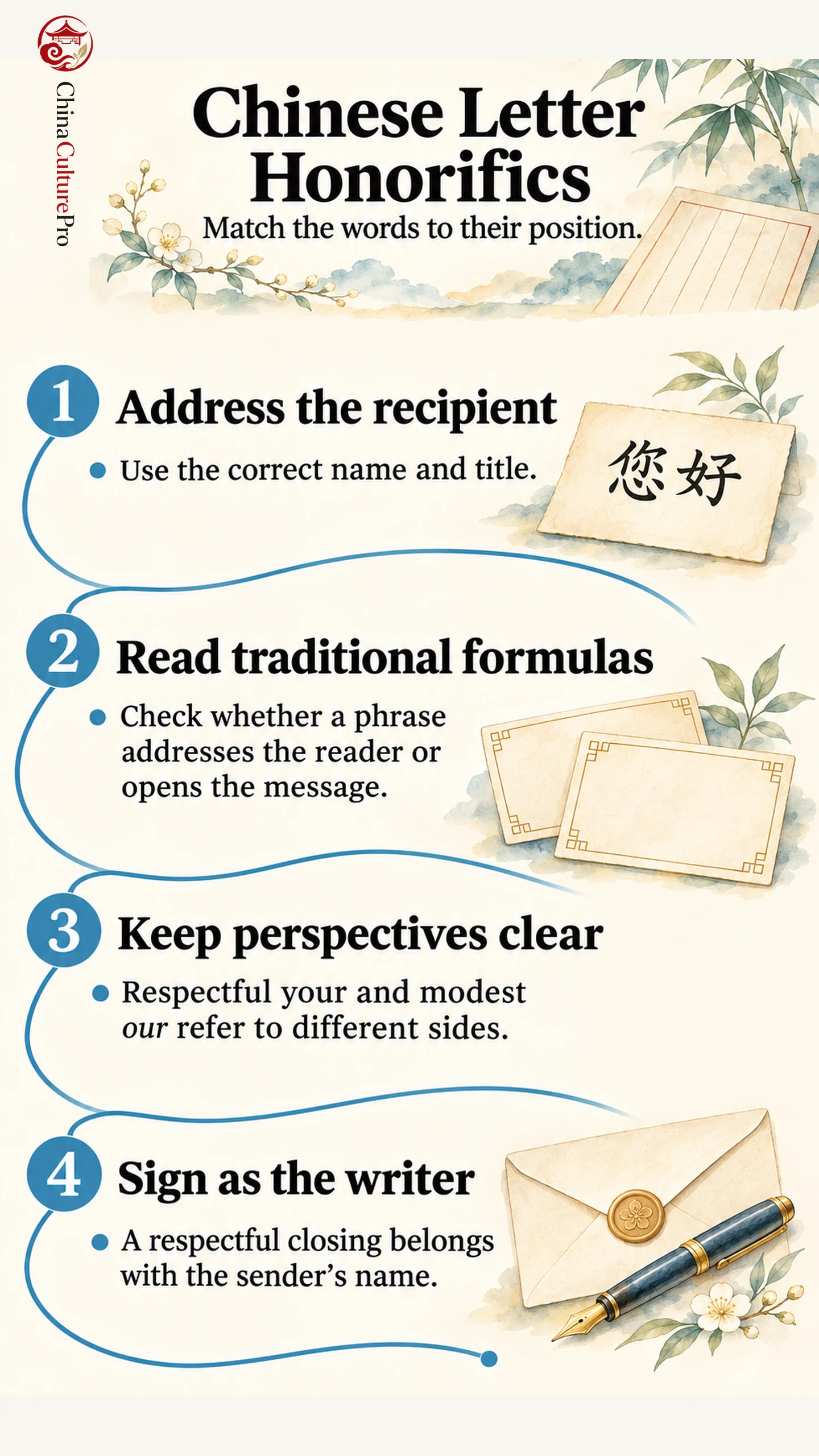
When reading a letter, locate the recipient’s name and the writer’s signature first. They provide anchors for expressions that are difficult to interpret in isolation.
Identify the Recipient and the Register
For a teacher, 老师/老師 (lǎoshī), a surname plus title can form 林老師您好 (Lín lǎoshī nín hǎo): “Hello, Teacher Lin.”[6]
A title followed by a greeting gives a straightforward opening for a modern email.[7]
Keep the person’s surname and given name distinct when adapting an example. A title identifies the relationship; it should not assign a profession you have not confirmed. See Chinese greetings and introductions for the wider speaking context.
Traditional Phrases and Their Positions
Traditional tichengyu (提称语, tíchēngyǔ) can politely invite the addressee to read.[1][2] The opening formula in the third row does a different job.
| Выражение | Meaning and position |
|---|---|
| Taijian (台鉴/臺鑒, táijiàn) | A respectful request for the recipient to read, associated with the addressee.[1] |
| Junjian (钧鉴/鈞鑒, jūnjiàn) | A deferential request addressed to a senior or respected superior, following that person’s designation.[2] |
| Jingqizhe (敬启者/敬啟者, jìngqǐzhě) | An opening formula meaning roughly “I respectfully state the following,” introducing the writer’s message.[3] |
For example, 王部長鈞鑒 addresses Minister Wang; 敬啟者 introduces the writer’s message.[2][3]
Respectful Your and Modest Our
The direction of reference also matters. Respectful gui (贵/貴, guì) can precede the recipient’s organization: 貴校 (guìxiào), “your school.” Modest bi (敝, bì) refers to something associated with the writer: 敝校 (bìxiào), “our school.” These are respectful and self-modest perspectives, respectively, rather than interchangeable decorations.[4][5]
Keep those perspectives consistent when both organizations appear in one message.
A Short Modern Message to a Teacher
The closing jingshang (敬上, jìngshàng) accompanies the writer’s name.[6]
Here is an original practice message from an imagined student, Chen An, using traditional characters. It illustrates a simple contemporary register rather than a classical layout.
林老師您好: — Hello, Teacher Lin.
我是陳安,想請問下次讀書會的時間。 — I am Chen An. May I ask when the next reading group will meet?
謝謝您。 — Thank you.
陳安 敬上 — Respectfully, Chen An.
If the message needs a written date, use a consistent Chinese date format alongside the signature.
How to Check Your Letter
- Identify the recipient and verify the title. Choose a form suited to the actual relationship.
- Select the register. Use a straightforward title and greeting for a modern message, or check the intended traditional formula’s function before using it.
- Read the opening and signature separately. Confirm who each expression refers to, state the purpose clearly and sign with your own name.
FAQs About Chinese Honorifics in Letters
Is taijian the same as junjian?
Both can invite respectful reading, but junjian specifically addresses a senior or superior. Similar general meanings do not make their social uses identical.[1][2]
Must a modern email use traditional letter formulas?
No. A title and greeting can provide a respectful opening. Choose wording that fits the recipient and medium instead of collecting elaborate expressions.[7]
Does jingshang address the recipient?
In the signature pattern shown here, it accompanies the sender’s name. Read it as the writer’s respectful closing, not as another title for Teacher Lin.[6]
Источники
[1] Ministry of Education. Revised Mandarin Chinese Dictionary: 臺鑒
[2] Ministry of Education. Revised Mandarin Chinese Dictionary: 鈞鑒
[3] TCSS Chinese teaching resources. Letter vocabulary: 敬啟者、敬覆者、敬稟者
[4] TCSS Chinese teaching resources. Letter vocabulary: 貴
[5] Ministry of Education. Concise Mandarin Chinese Dictionary: 敝
[6] E起玩吧 classroom teaching site. Email lesson with a message to a teacher
[7] Digital Literacy Education Resources, maintained by National Yang Ming Chiao Tung University. Writing a polite professional email