


Quick Answer: What Are Chinese Fables?
Chinese fables, commonly discussed as yuyan (寓言, yùyán), use illustrative narratives to communicate ideas indirectly. Many familiar tales come from philosophical or political discussions.[1]
- Read the story: Notice the action, question or reversal that gives it force.
- Check the source: A modern title may summarize a passage from a much longer classical work.
- Separate meanings: The original argument, a later idiom and a classroom moral can emphasize different things.
Here, “fable” includes human-centered parables as well as animal tales. Each original summary below is followed by its source context.[1]
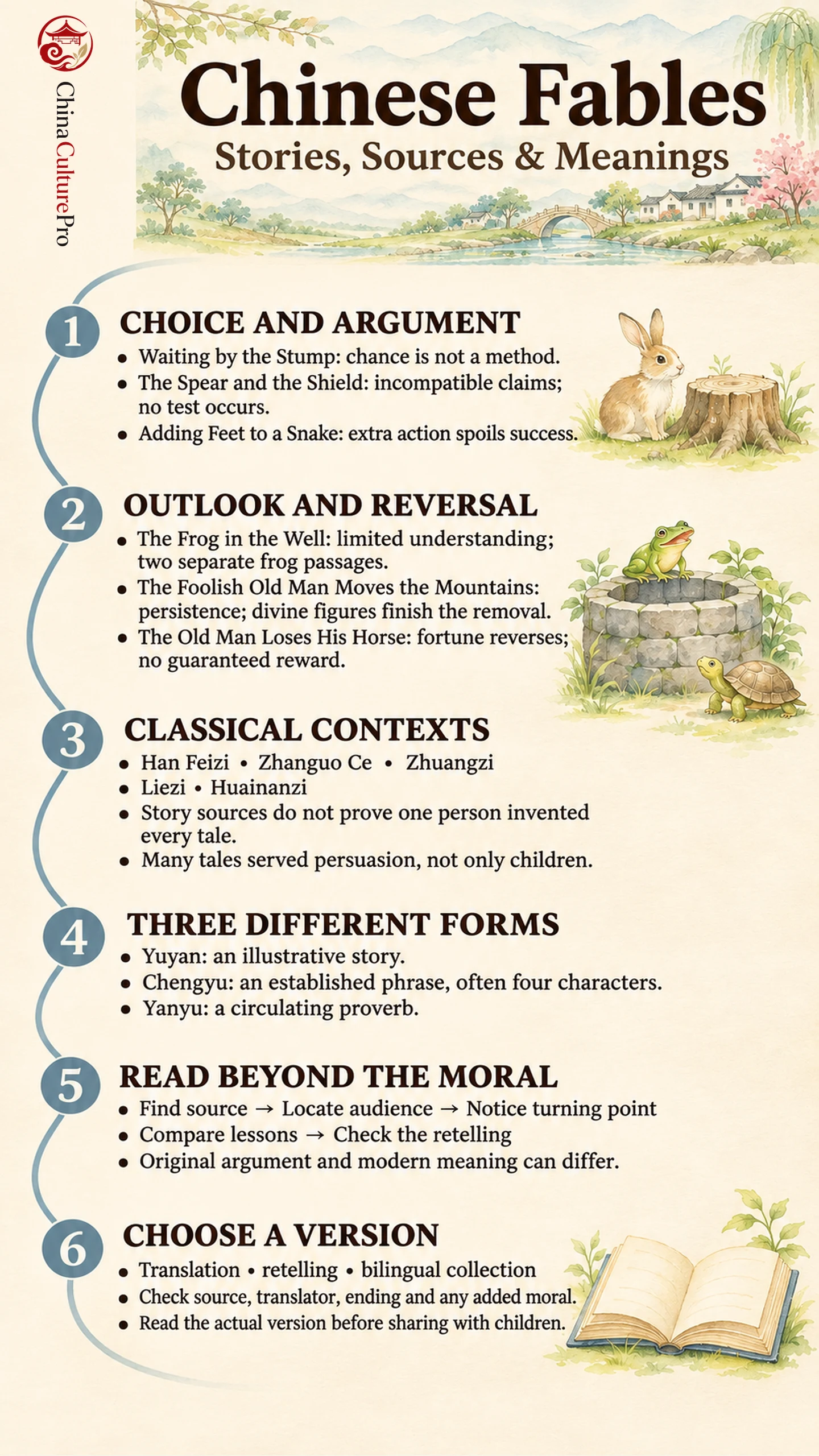
A farmer waits beside a stump. A seller praises both his spear and his shield. An old man treats a missing horse as a reason to suspend judgment. These small narrative situations make ideas memorable, but a one-line moral can conceal what the storyteller was trying to persuade an audience to accept.
This guide begins with six stories from Chinese literature. Read them for their plots first, then compare their familiar meanings with the arguments surrounding them in the cited texts.
Six Classical Chinese Fables
The English titles below identify familiar stories; they are not necessarily original chapter headings. The source references let you find the surrounding passage rather than treating the title as a complete citation.
Waiting by the Stump
Waiting by the Stump (守株待兔, shǒu zhū dài tù) appears in chapter 49 of the Han Feizi (韩非子, Hán Fēizǐ). A farmer happens to obtain a rabbit after it runs into a stump and breaks its neck. He puts aside his farming tool and waits beside the stump, hoping for another rabbit. It does not come, and he becomes an object of ridicule.[2]
The familiar lesson concerns expecting effortless gains or clinging to an unworkable habit. The original passage makes a more specific political comparison: governing present people solely through the methods of ancient rulers is like waiting for that accidental rabbit. The mistake is treating a past result as a repeatable method without considering changed circumstances. Legalism in ancient China provides background to these debates about political methods.[2][11]
The Spear and the Shield
The Spear and the Shield is associated with the expression 自相矛盾, zì xiāng máo dùn. In chapter 36 of the Han Feizi, a seller says that nothing can pierce his shield, then claims that his spear can pierce anything. A listener asks what would happen if that spear struck that shield. The seller cannot answer. The story does not report an actual test or say which object would win.[3]
Its force lies in the incompatibility of two unrestricted claims. In the surrounding argument, the example challenges praises of ancient sage-rulers that cannot both stand as presented. “Do not contradict yourself” is a useful modern summary, but the passage is also a tool for testing an argument, not simply a warning against dishonesty.[3]
Adding Feet to a Snake
Adding Feet to a Snake (画蛇添足, huà shé tiān zú) comes from the Qi II (齐策二, Qí Cè Èr) section of the Zhanguo Ce (战国策, Zhànguó Cè), often translated as Strategies of the Warring States. Several retainers agree that whoever first finishes drawing a snake will win a serving of wine. The quickest artist starts adding feet. Before he finishes, another completes a snake and takes the drink: a snake does not need feet.[4]
The familiar meaning is to spoil something by adding an unnecessary extra. In its setting, a persuader uses the story to advise a successful commander against extending his campaign and putting his position at risk. The drawing contest is a small-scale analogy for knowing when further action will undermine an achievement.[4]
The Frog in the Well
The Frog in the Well (井底之蛙, jǐng dǐ zhī wā) is linked to chapter 17 of the Zhuangzi (庄子, Zhuāngzǐ). A frog delights in the freedom and water of its well and invites a sea turtle to visit. The turtle cannot fit comfortably inside. Its account of the vast sea leaves the frog astonished.[5]
The familiar expression criticizes a limited outlook. In the chapter, the tale participates in a philosophical exchange about the limits of a person’s understanding. It is useful to distinguish this developed frog-and-turtle story from the chapter’s earlier statement that a well frog cannot be told about the sea. They are related passages, not one continuous conversation; the familiar idiom should not be treated as a verbatim quotation of the chapter’s opening. Our Zhuangzi guide explores the text’s wider use of stories.[5]
The Foolish Old Man Moves the Mountains
The Foolish Old Man Moves the Mountains (愚公移山, Yú Gōng Yí Shān) appears in chapter 5 of the Liezi (列子, Lièzǐ). An elderly man resolves to remove the mountains obstructing his household’s route. A critic mocks the scale of the task. The old man answers that his descendants can continue the work, while the mountains will not keep growing.[6]
Perseverance is a familiar reading, but the ending matters: the heavenly ruler is moved by the man’s sincerity and commands two divine figures to carry the mountains away. The original story does not end with the family completing the removal through shoveling alone. Keeping that ending allows readers to discuss persistence, time and extraordinary assistance without silently rewriting the tale.[6]
The Old Man Loses His Horse
The Old Man Loses His Horse (塞翁失马, sài wēng shī mǎ) is traced to the Huainanzi (淮南子, Huáinánzǐ). A household loses a horse, which later returns with other horses. The apparent gain leads to another reversal when the son breaks his leg while riding. Later, that injury keeps him from fighting in a war in which many local men die.[7]
The expression is often used when an apparent loss brings an unexpected benefit. The sequence also encourages caution about judging fortune too early: gain and loss can change meaning as events unfold. It does not establish a rule that every misfortune must produce a compensating reward. That final claim would turn a story about reversals into a guarantee it cannot support.[7]
Where These Fables Come From
Classical storytelling was often an instrument of argument. In the Warring States period (战国时期, Zhànguó Shíqī), writers and persuaders used small narratives to make larger claims accessible or to unsettle an audience’s assumptions. Reading a tale inside that exchange can reveal why its particular details were chosen.[1]
A book title also does not securely identify the person who invented every story within it. The Liezi, for example, is a collection with disputed dating and authorship, containing materials from different periods. “Found in this work” is often a more careful statement than “created by this named philosopher on this date.”[10]
Fables, Chengyu and Proverbs
A story, a fixed expression and a short saying can refer to related ideas while remaining different forms. Chengyu (成语, chéngyǔ) often condense an allusion into a compact expression. Proverbs, or yanyu (谚语, yànyǔ), circulate as sayings about experience and practical understanding.[8][9]
| Форма | Working definition | На что обратить внимание |
|---|---|---|
| Yuyan | An illustrative narrative that communicates an idea indirectly through a story. | An action, comparison or reversal within a particular telling. |
| Chengyu | An established expression, often four characters long, that may carry an allusion or layered meaning. | A conventional expression used in a new sentence or situation. |
| Yanyu | A circulating proverb that expresses an observation or practical lesson in a short saying. | A compact statement rather than a complete narrative. |
The four characters of the stump expression can invoke the farmer’s story without retelling it. That does not mean every established four-character expression has a fable behind it, or that every proverb is a story title. The distinctions in Chinese idioms versus proverbs help when moving between narrative reading and everyday language use.[8][11]
Chinese literary allusions explain another part of this process: a brief reference can bring a larger remembered scene into a new text. To interpret the reference well, knowing the plot is a beginning; knowing how it is being used is the next step.
How to Read Beyond the Moral
Use this sequence when a familiar story seems to carry only one obvious lesson.
- Find the source: Record the work and chapter or section, rather than relying only on a story title.
- Locate the audience: Ask who tells the story and whom the speaker is trying to persuade.
- Notice the turning point: Identify the action, question or reversal that changes the situation.
- Compare the lessons: Separate the passage’s argument from a familiar modern moral or idiom meaning.
- Check the retelling: Notice whether dialogue, the ending or the surrounding argument has been changed.
You can then state an interpretation precisely: “In this passage, the story challenges a particular policy” or “In present-day use, the expression criticizes a habit.” Those are different claims. Neither requires pretending that the tale contains a complete rule for every situation.
Choosing a Translation or Retelling
Choose an edition by what you want to do with it. A close translation with chapter references is useful for studying argument and wording. A modern retelling may be easier to share aloud, while a bilingual collection can help you connect an English story title with the Chinese phrase that invokes it.
For Chinese children’s stories, check the actual version before sharing it: these plots can include death, injury and war. A retelling may shorten those details, add dialogue or supply an explicit lesson. These choices can make the version suitable for a particular reader, but should not be confused with the wording or ending of the source passage.
When comparing versions, check whether the source and translator are named, whether the moral is separated from the translated text, and whether the ending has been preserved. Our guide to Chinese books and translations provides broader edition-selection advice. For expressions used independently of a tale, the Chinese proverbs guide follows the different task of checking wording and context.
FAQs About Chinese Fables
Are Chinese fables only stories for children?
No. Many familiar tales come from philosophical or political texts addressed to adult questions. Children’s retellings are one later reading setting, with their own choices of vocabulary, plot detail and lesson.[1]
Do all Chinese fables feature talking animals?
No. Human figures such as a farmer, merchant or commander are common. The broad yuyan tradition includes illustrative narratives that English readers might call parables as well as animal fables.[1]
Does every chengyu come from a fable?
No. Established expressions have varied literary and everyday origins. Some invoke a particular story, while others do not. Check the expression’s source rather than inventing a tale from its four characters.[8]
Can one fable have more than one interpretation?
Yes. A later idiom or retelling can emphasize a different lesson from the passage’s original argument. Explain the evidence and context for your reading; multiple interpretations do not make every added detail or claimed moral equally well supported.
Источники
[1] Marcin Jacoby, Acta Universitatis Carolinae Philologica. Parable as a Tool of Philosophical Persuasion: Yuyan in the Zhuangzi
[2] Han Feizi, Wikisource Chinese text. Chapter 49: Wu Du
[3] Han Feizi, Wikisource Chinese text. Chapter 36: Nan Yi
[4] Zhanguo Ce, Wikisource Chinese text. Qi II: Zhaoyang Attacks Wei
[5] Zhuangzi, Wikisource Chinese text. Chapter 17: Autumn Floods
[6] Liezi, Wikisource Chinese text. Chapter 5: Tang Wen, Chongxu Zhide Zhenjing edition
[7] Ministry of Education, Dictionary of Chinese Idioms. Sai Weng Shi Ma: The Old Man Loses His Horse
[8] Ministry of Education, Revised Mandarin Chinese Dictionary. Vocabulary classification
[9] Ministry of Education, Revised Mandarin Chinese Dictionary. Yanyu: Proverb
[10] Steve Coutinho, Internet Encyclopedia of Philosophy. Liezi
[11] Ministry of Education, Revised Mandarin Chinese Dictionary. Editorial treatment of chengyu entries