

Quick Answer: Who Was Zhuangzi?
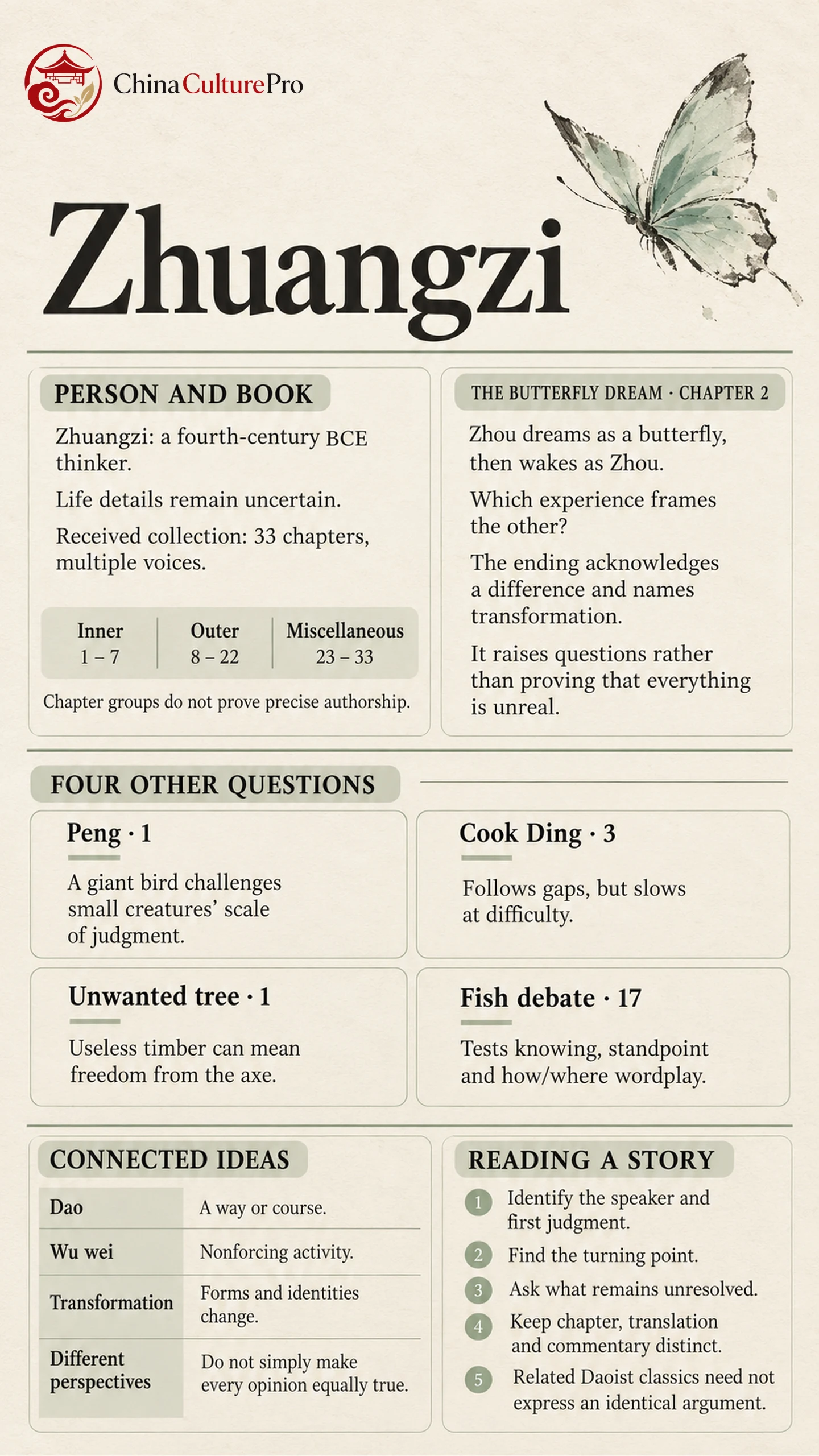
Zhuangzi (庄子, Zhuāngzǐ), or Master Zhuang, often written Chuang-tzu in older English, was a Chinese thinker associated with the fourth century BCE. The name also identifies a major Daoist classic containing writings from more than one voice. The received book has thirty-three chapters.[1][2]
- Person: Details of his life are difficult to confirm independently of later accounts and the text.
- Book: Stories, dialogues, humor and surprising comparisons carry its philosophical questions.
- Famous scene: A dream involving a butterfly challenges confidence about identity and waking.
- Interpretation: Questions about perspective and change do not reduce to a simple claim that nothing is real.
A scene featuring Zhuangzi can be a literary device; it is not automatically a dated episode from the historical thinker’s life.
A butterfly, a skilled cook and a tree unwanted by carpenters can each unsettle a confident judgment. The Zhuangzi makes such encounters do philosophical work: a story changes the position from which a reader sees an ordinary question.
The Thinker and the Thirty-Three-Chapter Book
The thinker is also known as Zhuang Zhou (庄周, Zhuāng Zhōu). He belongs to the intellectual world of the Warring States period, when different teachers debated conduct, language and political order. A precise life story is difficult to reconstruct, and conventional birth and death dates should not be treated as securely documented.[1]
The received collection owes much to the editing and commentary associated with Guo Xiang (郭象, Guō Xiàng), who died in 312 CE. Its three familiar divisions help locate passages but do not establish a single author for every section.[1][2]
| Division | Scope and attribution |
|---|---|
| Inner Chapters (内篇, nèipiān) | Chapters 1–7, traditionally linked most closely with the thinker, though precise authorship is disputed. |
| Outer Chapters (外篇, wàipiān) | Chapters 8–22, with material reflecting multiple philosophical voices. |
| Miscellaneous Chapters (杂篇, zápiān) | Chapters 23–33, another varied grouping in the received collection. |
The distinction matters whenever a summary says “Zhuangzi believed.” Sometimes that refers to the historical figure, sometimes to an argument in one chapter, and sometimes to an interpreter’s reconstruction. The broader history of Chinese philosophy provides context for these different claims without turning a varied collection into one uniform treatise.
The Butterfly Dream: Identity, Waking and Transformation
The butterfly dream (庄周梦蝶, Zhuāng Zhōu mèng dié) appears at the end of chapter 2. Zhuang Zhou dreams of being a butterfly, without awareness of himself as Zhou. He wakes as Zhou, then wonders whether Zhou dreamed the butterfly or a butterfly is dreaming Zhou. The passage also acknowledges a distinction between them and closes with the expression transformation of things (物化, wùhuà).[3][4]
The unsettling movement is between perspectives. Within the dream, being a butterfly is not experienced as a mistaken attempt to be a human. Waking changes the frame from which the experience is judged. The reader is invited to consider how confidence depends on the position one currently occupies.
That invitation does not constitute a demonstration that the world is unreal. Nor does the text simply erase every distinction between butterfly and person: its ending explicitly keeps a difference in view. Interpretations emphasize identity, knowledge, changes of perspective or transformation in different ways. Preserving the ending keeps those questions open rather than replacing the story with an unsupported metaphysical verdict.[1][2]
It is also a literary scene, not evidence that scholars can verify a particular dream on a particular night. Familiar retellings may add a setting or mood, but those additions should not become details of the classical account.
Four Other Stories and the Questions They Open
The Peng (鹏, Péng) in chapter 1 is an immense bird that develops from a giant fish. Smaller creatures judge its extraordinary journey from the scale of their own movements. The contrast raises questions about the limits of a familiar viewpoint: what is practical or imaginable for one creature need not exhaust the possibilities of another. The story’s exaggeration makes scale part of the philosophical problem.[3]
Cook Ding (庖丁, Páo Dīng), in chapter 3, describes cutting an ox by following openings rather than hacking indiscriminately. His perception has changed through experience. At a difficult place, however, he becomes cautious and slows his movement. The listener hears a lesson about caring for life. The episode is more demanding than an assurance that mastery makes every situation easy.[5]
The unwanted tree in chapter 1 challenges a judgment of uselessness. Because its shape fails a carpenter’s standards for timber, it can escape the axe and offer room for rest. What is worthless to an extractor may be valuable from the standpoint of the living tree or someone resting near it. This scene is distinct from another tree story in chapter 4, where a carpenter encounters a tree in a dream.[3][6]
The fish debate in chapter 17 involves Huizi (惠子, Huìzǐ), Zhuangzi’s conversational counterpart. When Zhuangzi describes the fish as enjoying themselves, Huizi challenges how a non-fish could know. Zhuangzi challenges Huizi’s knowledge of his knowledge, and the exchange turns partly on a question word that can involve “how” or “where.” Zhuangzi’s closing response returns to the location of the exchange, leaving readers to examine what the challenge assumes about knowing.[4]
Together, the stories ask different questions about scale, skill, usefulness and knowledge. Their shared power comes from shifting what a reader initially takes for granted, while their differences resist a single moral pasted onto every tale.
Recurring Philosophical Questions
Three concepts connect these readings with wider Daoist discussions. They orient interpretation without making every story an explicit statement of the same doctrine.[1][2]
- Dao (道, dào): a way or course, explored through questions of conduct, language and the natural world.
- wu wei (无为, wúwéi): nonforcing activity, a related Daoist ideal whose use should be checked against the particular passage.
- transformation of things: change through which forms and identities become something else.
The Dao is approached through varied voices and situations. A character may challenge another person’s words, but the story can also turn the challenge back on the questioner. Reading this as “every opinion is equally true” would miss the activity of criticizing, learning and changing one’s judgment that the text itself performs.[2]
Similarly, wu wei helps readers investigate nonforcing conduct, but the phrase is not the explicit label in every celebrated skill story. Ding’s caution matters because responsiveness can include close attention and a deliberate change of pace. A general impression of ease is not enough to explain the scene.
Scholars disagree about the best overall interpretation, including how to understand skepticism, naturalness and freedom. A useful first reading keeps those disagreements visible while attending to what each passage actually does.
How to Read a Zhuangzi Story
Start with the scene and its turning point. Who offers the first judgment? What does a reply, a change of scale or a surprising image make newly visible? Then ask what remains unresolved. In the fish exchange, the meanings of knowing and the question word matter; in the tree scene, the standard of usefulness changes.
Keep the chapter number with any quotation and compare a translation with explanatory notes. Robert Eno’s teaching translation covers the Inner Chapters and includes interpretive commentary; it should not be mistaken for a complete translation of all thirty-three chapters.[3]
The Tao Te Ching (道德经, Dàodéjīng), traditionally associated with Laozi (老子, Lǎozǐ), is a related classic within Даосизм. The relationship invites comparison, not an assumption that the books have one author, one literary style or an identical argument. Read the Zhuangzi’s humor and imagined voices as part of its reasoning, while distinguishing the text from any one commentator’s reconstruction.
FAQs About Zhuangzi
Did Zhuangzi write the whole book?
The received collection contains multiple voices. The first seven chapters are traditionally linked most closely with the thinker, but precise authorship remains disputed. Its thirty-three-chapter form reflects later transmission and editing.[1][2]
Does the butterfly dream prove reality is an illusion?
No. The story raises questions about identity, perspective and transformation. Its ending also acknowledges a difference between Zhou and the butterfly; it is not a proof that everything is unreal.[3][4]
Does Zhuangzi teach that every opinion is equally true?
That is too simple. The text challenges fixed standpoints, but it also criticizes judgments and explores learning. Scholars disagree about how far its skepticism or relativism should be taken.[1][2]
How is the Zhuangzi related to the Tao Te Ching?
Both are formative Daoist classics, with overlapping vocabulary and concerns. Their literary forms and internal voices differ, so they should be compared rather than treated as interchangeable statements of one system.[2]
Источники
[1] Stanford Encyclopedia of Philosophy. Zhuangzi
[2] Steve Coutinho. Zhuangzi
[3] Robert Eno. Zhuangzi: The Inner Chapters
[4] Philip J. Ivanhoe and Bryan W. Van Norden, editors. Zhuangzi Selections from Readings in Classical Chinese Philosophy
[5] Columbia University, Asia for Educators. Zhuangzi, Chapter 3: The Secret of Caring for Life
[6] Yale Forum on Religion and Ecology. Sacred Texts: Zhuangzi Selections