


Quick Answer: What Are the Three Teachings?
The Three Teachings (三教, sānjiào) are Confucianism (儒家, Rújiā), Daoism (道教, Dàojiào) and Buddhism (佛教, Fójiào). The grouping helps explain major traditions in Chinese intellectual and religious history, including their differences and interaction.[1]
- Distinct traditions: They have different histories, texts, institutions and accounts of cultivation.
- Overlapping practice: Participation in a ritual need not imply exclusive membership in one tradition.
- Exchange and debate: Borrowing, criticism and competition could occur alongside cooperation.
- A limited framework: Local religious life and other traditions are not fully contained by a three-part map.
The phrase does not mean that everyone in China follows all three, or that the traditions became one uniform religion.[1][2]
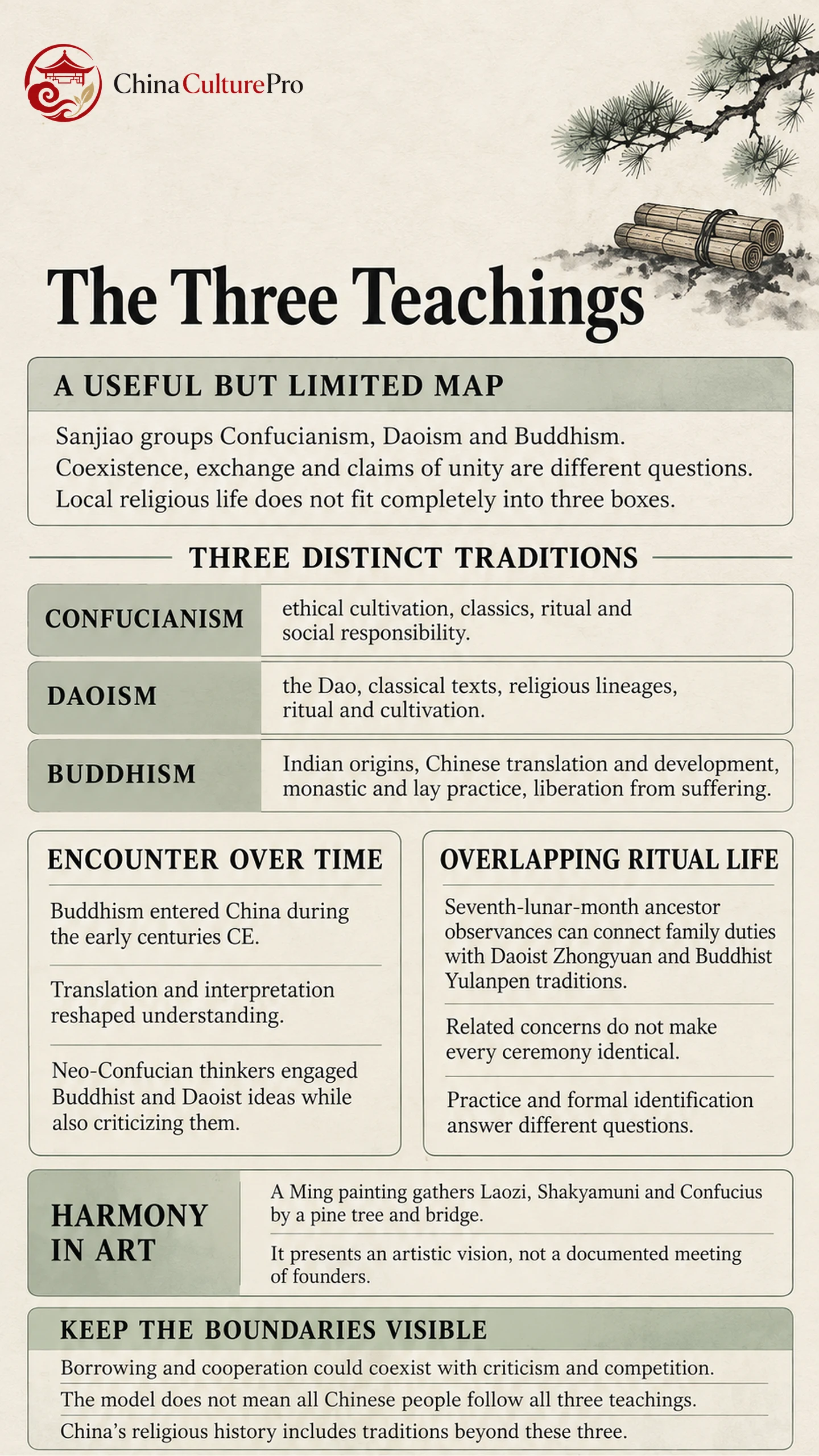
A Chinese ritual or painting may draw on more than one tradition without announcing a change of religion. The Three Teachings provide a starting point for understanding that overlap, as long as the framework does not erase differences or local practice.
What the Sanjiao Framework Does—and Leaves Out
The category places three influential bodies of teaching in relation to one another. Some historical accounts stress their distinct but complementary roles; others argue for an underlying unity. Those are different claims, rather than two descriptions that automatically mean the same thing.[1]
For a reader, this distinction changes the question. “How did these traditions coexist?” asks about relationships between them. “Were they ultimately one?” asks about an interpretation of their teachings. Evidence that people participated across boundaries does not, by itself, answer the second question.
The model also foregrounds traditions maintained through texts and influential representatives. Village gods, household rites and local specialists may fit it imperfectly. Treating the three headings as a complete inventory can make those forms of life difficult to see.[1]
A guide to Chinese philosophy provides another map of the intellectual landscape, including schools outside this particular religious grouping.
Three Traditions With Different Histories and Aims
The following definitions identify broad areas of concern. They do not assign each tradition exclusive ownership of ethics, ritual or reflection.[1][3][4]
| Традиция | Broad description |
|---|---|
| Confucianism | Traditions of ethical cultivation, classical learning, ritual and social-political responsibility. |
| Daoism | Diverse traditions of the Dao (道, dào), including classical thought, religious lineages, ritual and cultivation. |
| Buddhism | Traditions originating in India and developing in China through translation, monastic and lay practice, and teachings on liberation from suffering. |
Confucianism includes arguments about good conduct and government, but also practices surrounding ancestors, ceremonies and moral education. Calling it “only philosophy” can conceal part of its social and ritual history.[1][2]
The Dao, often translated as the Way, has a central role in Daoist traditions. Their history includes religious lineages, liturgy, deities and cultivation, as well as classical texts. A clean division between an original philosophy and a separate later religion is often misleading.[3]
Buddhist communities encompass monks, nuns and laypeople, while Chinese Buddhist history includes diverse scriptural interpretations and forms of devotion. Meditation is important, but does not exhaust the tradition.[4]
The comparison is therefore not “Confucian ethics, Daoist nature and Buddhist death.” Each tradition reaches across more than one sphere of life.
How Encounter Changed the Traditions
Buddhism entered China during the first centuries of the common era through contacts involving India and Central Asia. Translators and teachers had to convey unfamiliar ideas using languages and concepts their audiences could understand. Chinese Buddhism developed through that continuing work of interpretation, not merely the replacement of an imported vocabulary with Chinese names.[4]
Daoist lineages also developed institutions, ritual repertoires and accounts of cultivation over time. Their engagement with other traditions should be considered within particular historical settings rather than explained by one timeless doctrine.[3]
During the Song and Ming periods, Neo-Confucian thinkers elaborated accounts of mind, nature and moral development while engaging Buddhist and Daoist ideas. Engagement could include criticism: using a concept did not require accepting every teaching associated with another community.[5]
This history complicates the familiar comparison between Confucianism and Taoism. Differences remain meaningful, but they developed through conversation and contest as well as through inheritance.
Shared Ritual Life Without a Single Membership
Late-imperial religious life often linked family, community and a larger cosmic order. A person committed to Confucian learning could participate in Buddhist, Daoist or local ritual activities without treating each occasion as an exclusive change of allegiance.[6]
Ancestor-related observances in the seventh lunar month offer a specific example. Filial piety (孝, xiào) helps connect family obligations with the Daoist Zhongyuan (中元, Zhōngyuán) and Buddhist Yulanpen (盂兰盆, Yúlánpén) traditions. Both can involve concern for the dead, while their explanations, ritual specialists and procedures remain different.[2]
Месяц духов is a useful wider cultural setting for those observances. It should not be assumed that every household performs one identical ceremony or understands its actions through all three traditions.
Contemporary research also distinguishes formal religious identification from beliefs and practices. Someone’s self-description, participation in incense offerings and commitment to a religious community answer different questions. Counting one does not necessarily count the others.[2]
This is why “Which religion does this gesture belong to?” can be less useful than asking who performs it, for whom and with what explanation.
A Ming Painting Makes Harmony Visible
One Ming-dynasty painting brings the relationship into a single image. It portrays Laozi (老子, Lǎozǐ), Shakyamuni (释迦牟尼, Shìjiāmóuní), the historical Buddha, and Confucius (孔子, Kǒngzǐ) in a gathering by a pine tree and bridge. The image offers an artistic vision of encounter among the Three Teachings.[7]
The painting expresses a vision of harmony; it does not document a meeting of the represented founders. Reading an image as a statement about harmony is different from treating it as a documentary scene.
The individual traditions still matter to interpreting the figures. The guides to Laozi и Confucius explain those associations, while Buddhist auspicious symbols provide another entry into the visual vocabulary surrounding Buddhist practice.
Ask what an artwork joins together and what differences it preserves. A shared composition can propose cooperation without demonstrating agreement on every question of ethics, ritual or liberation.
Coexistence, Competition and the Limits of the Model
Harmony was one possible ideal, not a guarantee that every encounter was harmonious. Thinkers could criticize other teachings, communities could defend their authority, and state support could favor some institutions over others. The history of exchange therefore includes boundaries and disagreement.[1][5]
The reverse simplification is also unhelpful: a polemical text does not establish that ordinary people always kept their practices separate. Intellectual criticism and participation across traditions can belong to the same broader historical world.
For a temple, ritual or text, begin with its own setting. Look for named deities, officiants, scriptures, patrons and local explanations before assigning a single identity from appearance alone. These are interpretive questions, not a checklist that produces a certain classification.
The threefold map is useful precisely when its limits remain visible. It cannot encompass all Chinese religious history, all local practice or every individual’s understanding of belief and belonging.[1][2]
FAQs About the Three Teachings
Are the Three Teachings one religion?
The phrase groups three historically connected traditions. Some people argued for their underlying unity, but that position should not be treated as a universal account of their doctrines or institutions.
Can someone participate in more than one tradition?
Yes. Overlapping practice is historically important. The meaning of participation depends on the person, occasion and community; it does not prove that everyone holds the same combination of beliefs.
Is Confucianism only a philosophy?
Its ethical and political arguments are central, but ritual, ancestor-related practice and institutions also matter. Whether it is classified as a religion depends partly on how the category is being used.
Do the Three Teachings include all religion in China?
No. Local religious traditions do not fit neatly within the model, and China also has other religious histories, including Islam and Christianity. The grouping is a framework, not an exhaustive census.
Источники
[1] Stephen F. Teiser, adapted by Asia for Educators. Sanjiao: The Three Teachings
[2] Pew Research Center. Confucianism, Taoism and Chinese folk religions
[3] Fabrizio Pregadio. Religious Daoism
[4] Stephen F. Teiser, adapted by Asia for Educators. Buddhism: The “Imported” Tradition
[5] Justin Tiwald. Song-Ming Confucianism
[6] Asia for Educators. Understanding “Religion” in Context
[7] National Museum of Asian Art. Shakyamuni, Laozi, and Confucius