


Quick Answer: Who Was Jin Yong?
Jin Yong (金庸, Jīn Yōng) was the pen name of Louis Cha (查良镛, Zhā Liángyōng; 1924–2018), a novelist and journalist closely associated with Hong Kong. He became a defining writer of wuxia (武侠, wǔxiá), martial-arts fiction in which fighting ability meets questions of courage, loyalty, love and responsibility.[3][15]
- His fiction: A body of 15 works, including shorter fiction, rather than 15 uniformly full-length novels.
- A familiar route: Three linked Condor novels follow different generations; the first novel alone occupies four volumes in a major English translation.
- His wider influence: Stories and characters circulate through television, film, radio, stage and games.
Read the edition’s contents before buying a “volume one”: it may begin one translated novel rather than an entire interconnected series.[3][4][12]
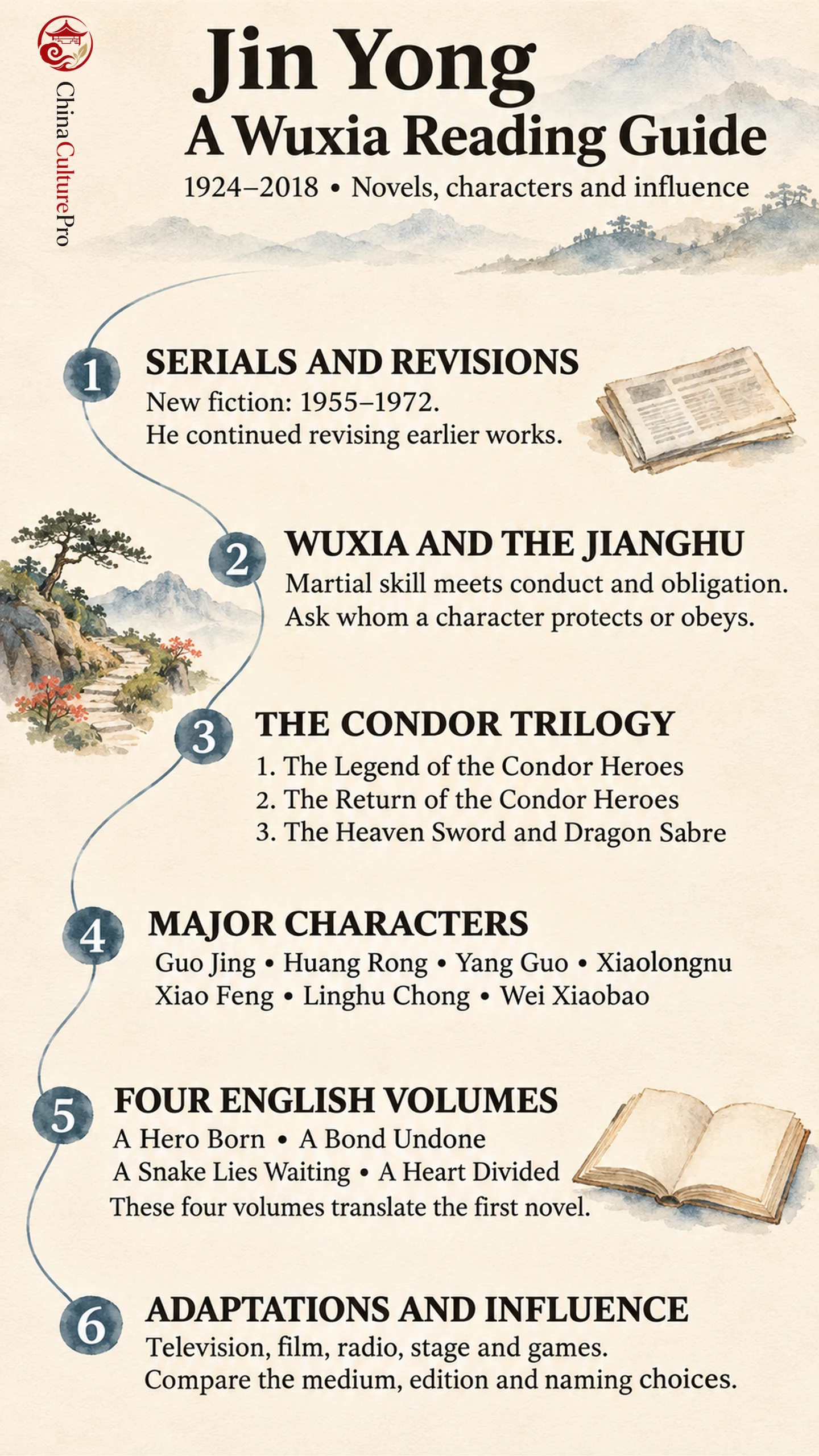
A spectacular fight in Jin Yong can raise a question that superior technique cannot settle: whom should a person protect, obey or refuse? The books combine adventure with competing obligations. Their newspaper origins, revisions and translations also help explain why familiar stories can appear in different forms.
From Newspaper Serials to Revised Novels
Cha was born in Haining (海宁, Hǎiníng), Zhejiang (浙江, Zhèjiāng), in 1924 and moved to Hong Kong in 1948. His working life included journalism, translation and screenwriting. Zhejiang’s regional cultural history и Hong Kong’s urban culture provide different parts of that background.[1]
In 1955, the New Evening Post (新晚报, Xīn Wǎnbào) began serializing The Book and the Sword (书剑恩仇录, Shū Jiàn Ēn Chóu Lù) under his Jin Yong pen name. He co-founded Ming Pao (明报, Míng Bào) in 1959. Serial fiction and newspaper work were closely connected, rather than separate stages of his career.[1][2]
New installments had to hold a returning readership’s attention. Stories subsequently moved into book editions, with material compiled and rearranged. Most of his fiction appeared as newspaper serials, although there were magazine exceptions.[2]
He completed his last new novel in 1972, then continued revising his earlier works. Another major revision round took place between 2000 and 2006. Thus an original serial, a revised Chinese edition, a translation and a television adaptation need not preserve every detail identically. Identify the version before treating a difference as an error.[1][2]
Wuxia, Xia and the Jianghu
Three concepts help explain the fictional world. These definitions concern the reading task; they are not a single code followed by every character.
| Понятие | Значение в этом руководстве |
|---|---|
| Wuxia | Martial-arts fiction concerned with heroic conduct and personal obligations. |
| Xia (侠, xiá) | An ideal of acting bravely for others, beyond merely possessing fighting skill. |
| Jianghu (江湖, jiānghú) | An imagined social realm of fighters, schools, alliances and rivalries beyond ordinary authority. |
The martial world gives characters institutions of their own: teachers, schools, reputations and debts. A school’s respected name and a person’s actual conduct can raise different questions. Follow which obligation a character invokes, and whether that claim protects someone or preserves power.[3][11][14]
Fictional abilities can be extravagant. Read them as narrative devices, while using the history of Chinese martial arts for the separate subject of real practices. The broader wuxia guide и comparison with immortal-cultivation fantasy explain the surrounding genre landscape.
Major Novels and the Condor Reading Order
The Condor Trilogy (射雕三部曲, Shèdiāo Sānbùqǔ) comprises three Chinese novels. For the linked sequence, read them in this order:[4]
- The Legend of the Condor Heroes (射雕英雄传, Shèdiāo Yīngxióng Zhuàn).
- The Return of the Condor Heroes (神雕侠侣, Shéndiāo Xiá Lǚ).
- The Heaven Sword and Dragon Sabre (倚天屠龙记, Yǐ Tiān Tú Lóng Jì).
The first novel’s English publishing title is Legends of the Condor Heroes. Its opening world belongs to the Song dynasty (宋朝, Sòng Cháo), and the sequence moves across generations. Starting with the first novel makes inherited relationships easier to follow; it does not mean all three share one protagonist throughout.[3][4][7] The Song dynasty overview supplies historical background without turning invented adventures into documentary evidence.
Three other major works offer different interests. Demi-Gods and Semi-Devils (天龙八部, Tiānlóng Bā Bù) opens questions about identity and belonging. The Smiling, Proud Wanderer (笑傲江湖, Xiào Ào Jiānghú) invites attention to the martial world’s claims of moral authority. The Deer and the Cauldron (鹿鼎记, Lù Dǐng Jì) offers comic antiheroism in an early Qing dynasty (清朝, Qīng Cháo) setting.[9][10]
Choose among these separate novels by interest: belonging, the martial community’s authority, or comic antiheroism. Readers interested in the last novel’s historical setting can use the Qing dynasty guide. Keep a historical timeline beside the fiction when rulers, territories or conflicts become hard to place.
Characters and Competing Ideas of Heroism
Begin with a few central figures and a question about each. The questions below are reading prompts, not personality rankings or complete plot summaries.
| Персонаж | Associated work | What to watch for |
|---|---|---|
| Guo Jing (郭靖, Guō Jìng) | The Legend of the Condor Heroes | How care for another person becomes a practical responsibility. |
| Huang Rong (黄蓉, Huáng Róng), called Lotus Huang in the English editions discussed here | The Legend of the Condor Heroes | How knowledge and quick interpretation matter alongside physical strength. |
| Yang Guo (杨过, Yáng Guò) and Xiaolongnu (小龙女, Xiǎolóngnǚ), also rendered Penance Yang and the Dragon Maiden | The Return of the Condor Heroes | What happens when personal attachment conflicts with a teacher–student prohibition. |
| Xiao Feng (萧峰, Xiāo Fēng) | Demi-Gods and Semi-Devils | Whether ancestry can determine a person’s moral worth. |
| Linghu Chong (令狐冲, Lìnghú Chōng) | The Smiling, Proud Wanderer | How individual judgment relates to the martial community’s competing claims. |
| Wei Xiaobao (韦小宝, Wéi Xiǎobǎo), called Trinket in John Minford’s English translation | The Deer and the Cauldron | How a comic antihero unsettles expectations of heroic success. |
The book-to-character relationships and translated aliases help readers orient themselves across editions.[6][7][8][9][10][13]
One accessible example comes from A Heart Divided. An injured Huang Rong directs Guo Jing through a confusing landscape while he carries and protects her. The scene distributes agency: her understanding of the route matters, while his efforts make movement possible. “Who is stronger?” misses much of what the pair accomplish together.[6]
Xiao Feng presents another problem. The revelation of his origins changes how others judge him, making belonging and prejudice part of the story’s ethical conflict. Ask whether a character’s verdict about a group is also the narrative’s verdict; those positions need not coincide.[9]
Reading Jin Yong in English
The four-volume English Legends of the Condor Heroes translates the first novel in the trilogy. Read its volumes in the following sequence, with the credited translators shown here:[4][5]
| Volume | English title | Translator credits |
|---|---|---|
| 1 | A Hero Born | Anna Holmwood |
| 2 | A Bond Undone | Gigi Chang |
| 3 | A Snake Lies Waiting | Anna Holmwood and Gigi Chang |
| 4 | A Heart Divided | Gigi Chang and Shelly Bryant |
Finishing A Heart Divided completes that first novel, not the full three-novel sequence. A Past Unearthed begins the English Return of the Condor Heroes, translated by Gigi Chang.[5][7]
As of November 6, 2026, the publisher’s catalogue also lists A Love Illicit as Return of the Condor Heroes Volume 2, translated by Gigi Chang. Publication and availability details differ by market and format, so check the particular edition before ordering. The catalogue entry identifies one volume; it does not establish completion of the full trilogy in English.[13]
Keep a character list for the edition in hand. Lotus Huang and Huang Rong, or Penance Yang and Yang Guo, should not be counted as separate people. The Chinese transliteration guide helps with spelling differences; a translated name can also involve an interpretive choice beyond romanization.[7][14]
For another reading route, John Minford’s English The Deer and the Cauldron presents the comic adventures of Trinket. Check the stated scope and editing of your edition instead of assuming every English volume reproduces an entire Chinese novel.[10] The Chinese classic books guide offers more questions for comparing editions and translations.
Adaptations and Cultural Influence
Jin Yong’s fiction has generated television series, films, radio dramas, stage work and games. The influence extends beyond recognizing a plot: character names, performances and theme songs can become points of shared reference. Those references can reach a reader through a performance before the printed novel.[12]
Archival objects make this circulation concrete. The Jin Yong Gallery’s collection includes a 1976 record of television theme songs and a special issue connected with a 1983 television adaptation. A 2024 authorized sculpture exhibition interpreted characters through poses and visual composition. These are different ways of remaking literary figures, not illustrations that fix their appearance forever.[8][12]
If you start with a screen version, compare one scene with the prose: what does the adaptation show directly, omit or give to a different character? The Chinese cinema overview и martial arts film history help place that medium in context.
For sustained literary study, John Christopher Hamm’s Paper Swordsmen examines the novels’ narrative artistry and political and cultural contexts. It offers a route from familiar entertainment toward close reading within Chinese literature, without requiring a reader to give up the pleasure of an adventure.[11]
FAQs About Jin Yong
Is Jin Yong the same person as Louis Cha?
Yes. Jin Yong is the pen name under which Louis Cha published his martial-arts fiction. English catalogues may use either name.
Should I read the Condor Trilogy in order?
For the linked sequence, begin with The Legend of the Condor Heroes, continue with The Return of the Condor Heroes, then read The Heaven Sword and Dragon Sabre. Other major Jin Yong novels are separate reading choices.
Do four English Condor volumes contain the whole trilogy?
No. The sequence from A Hero Born to A Heart Divided translates the first Chinese novel. Return of the Condor Heroes begins a different novel, with its own English volume numbering.
Did Jin Yong stop all writing in 1972?
No. He completed his last new novel that year, but continued revising his fiction. The later revision history matters when comparing versions.
Источники
[1] Hong Kong Heritage Museum. Jin Yong Gallery: exhibition pamphlet
[2] Hong Kong Memory. Jin Yong’s World of Martial Arts
[3] Macmillan. A Hero Born: introduction and edition information
[4] City University of Hong Kong research repository. The constraints of translating martial arts fiction
[5] Macmillan. Legends of the Condor Heroes: series
[6] Macmillan. A Heart Divided: excerpt and edition information
[7] Hachette UK, MacLehose Press. A Past Unearthed
[8] Hong Kong Heritage Museum. A Path to Glory: Sculpted by Ren Zhe
[9] Chan On-fung, Nanjing University Centre for Chinese New Literature. Exotic writing and historical reflection in Jin Yong’s wuxia novels
[10] John Minford, Australian National University. The Deer and the Cauldron: a martial arts novel
[11] John Christopher Hamm, University of Hawai‘i Press. Paper Swordsmen: Jin Yong and the Modern Chinese Martial Arts Novel
[12] Hong Kong Heritage Museum. Jin Yong Gallery
[13] Hachette Aotearoa New Zealand, MacLehose Press. A Love Illicit: Return of the Condor Heroes Volume 2
[14] University of Warwick research repository. Mok: doctoral study of the English reception of Jin Yong
[15] Hong Kong Liaison Office, Xinhua. The writer Jin Yong has died