
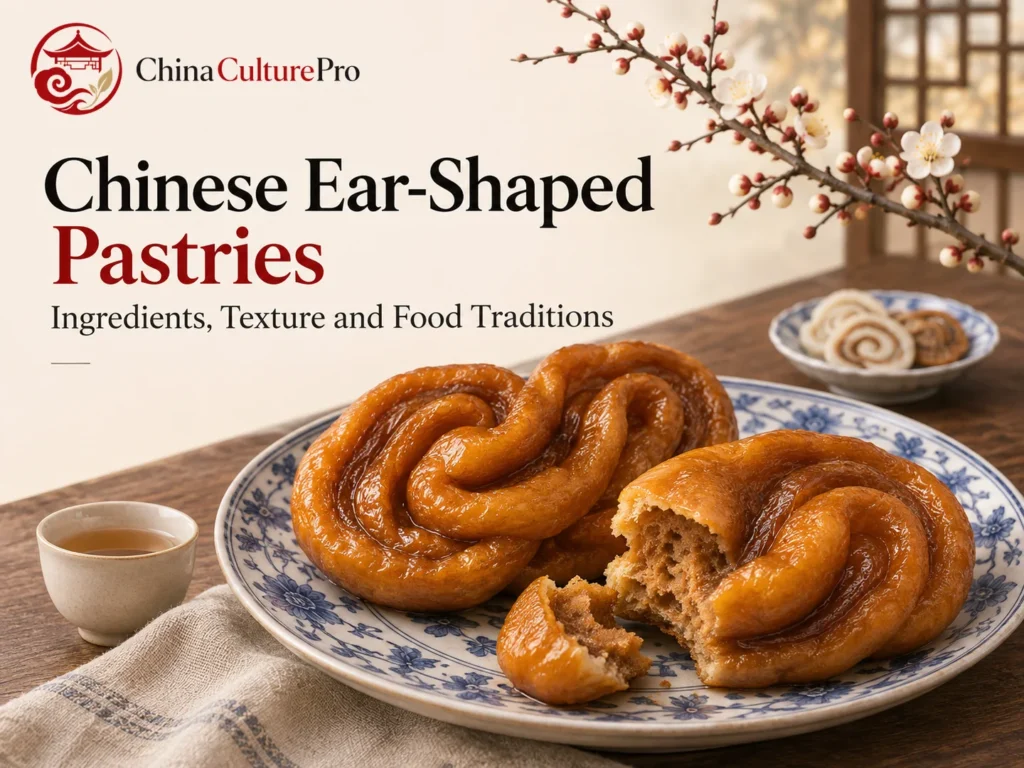

Quick Answer: What Are Chinese Ear-Shaped Pastries?
Chinese ear-shaped pastries include Beijing sugar ears, tang er duo (糖耳朵, tángěrduo), also called mi mahua (蜜麻花, mìmáhuā). This fried wheat-dough sweet has ear-like folds and a syrup-soaked finish. The English description can also be confused with small, dry cat-ear crisps, which are a different snack.[1][2][3]
- Main example: Sugar ears are glossy, sweet and soft after their syrup dip.
- Base: Flour and sugar are shaped into dough before frying.
- Distinction: A small spiral crisp is not the same preparation as Beijing sugar ears.
Use the complete Chinese name and actual texture to identify the food; an ear shape alone is insufficient.[1][5]
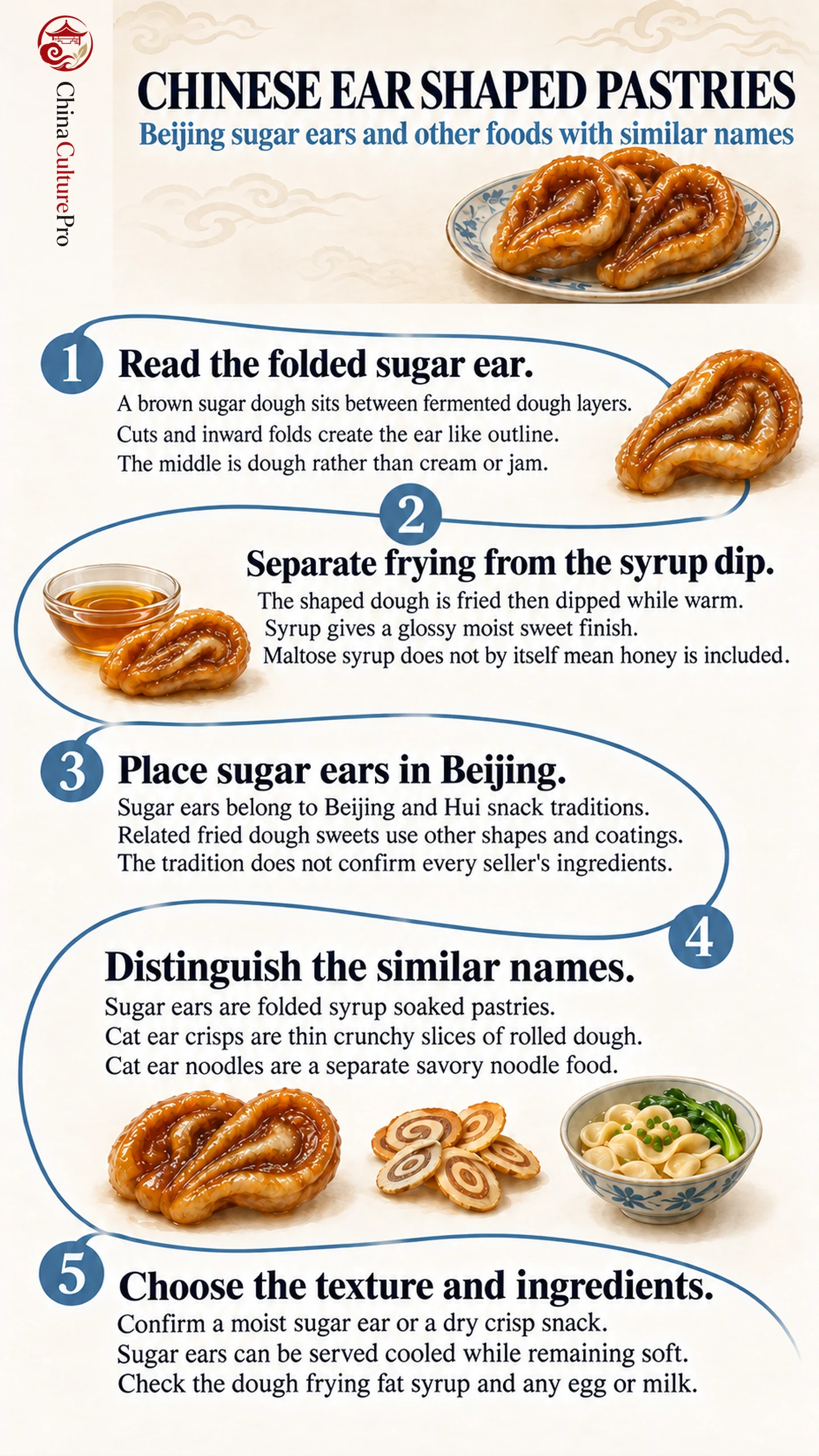
An ear-like fold can lead to very different snacks. Beijing sugar ears have a glossy, syrup-rich finish, while small cat-ear crisps give a dry crunch. Separating the dough shape from its coating explains the contrast within Chinese sweets and snacks.
Sugar Ears: Dough Layers and the Ear Shape
A documented sugar-ear preparation places a brown-sugar dough between two layers of fermented dough. The middle is another dough layer, not a spoonful of cream or jam. The combined sheet is cut, slit and folded through itself to create the ear-like form.[2][4]
The thinner edge turns inward through the slit, while the thicker edge folds toward the center. This creates two unequal, curled sides.[4]
Frying, Syrup and a Moist Sweet Bite
The shaped dough is fried until golden, then dipped in syrup while still warm. The syrup moistens the pastry and leaves a glossy surface. The finished sugar ear can be sweet, soft and slightly sticky rather than uniformly dry and crisp.[1][3][4]
Maltose syrup is a documented dipping ingredient. “Honeyed” is therefore an imperfect shortcut for reading the ingredients. Some descriptions list honey as well, while an original home version uses maltose. For the ingredient itself, see Chinese maltose sweets.[2][4]
Beijing Snack Traditions and Related Sweets
Sugar ears belong to Beijing snack culture and are associated with its Hui Muslim food traditions. That cultural association identifies a tradition, rather than confirming the ingredients or preparation of every current seller’s pastry.[1]
Related sweets include Chinese honey cakes, another fried dough preparation finished in syrup. The broader family of Chinese fried dough twists includes other shapes and coatings.[3]
Sugar Ears, Cat-Ear Crisps and Cat-Ear Noodles
Cat ears, mao er duo (猫耳朵, māoěrduo), can name a crisp snack or a shaped noodle. In one crisp-snack preparation, pale and brown-sugar doughs are rolled together, sliced thinly and fried. That recipe includes milk and egg.[5]
| Продукт | Recognizing feature |
|---|---|
| Beijing sugar ears | Folded fried dough with a glossy syrup-soaked finish. |
| Cat-ear crisps | Small, thin slices of rolled dough with a dry crunch. |
| Cat-ear noodles | Small shaped dough pieces served as a savory noodle dish. |
The noodle meaning belongs to Chinese noodle traditions. In a Taiyuan example, small dough pieces are pressed into curved shapes and served with toppings. A shared nickname does not make them sweet pastries.[6]
How to Choose and Serve Ear-Shaped Pastries
First decide which texture you want: a larger syrup-soaked sugar ear or a small crisp snack. Sugar ears can be served cooled while remaining moist.[1]
For vegetarian or vegan requirements, ask about the dough, frying fat and syrup separately. Honey, milk or egg can matter depending on the preparation. On a snack packet, read the ingredient list rather than inferring it from the spiral pattern.[2][5]
FAQs About Chinese Ear-Shaped Pastries
Are sugar ears the same as cat-ear crisps?
No. Sugar ears are syrup-soaked folded pastries; cat-ear crisps are thin, crunchy slices.
Are sugar ears always crisp?
No. Syrup-dipped sugar ears are commonly soft and moist.
Does honeyed pastry always contain honey?
No. Maltose syrup is used in documented preparations; check whether honey is also included.
Are cat-ear noodles the same as cat-ear crisps?
No. The noodle dish and the dry fried snack use the same shape-inspired name for different foods.
Источники
[1] Beijing municipal English portal, China Daily food description. Sweet Ears
[2] Beijing Tourism, original food description. Tang Er Duo
[3] Guo Tie, original food reporting, The Beijing News. Beijing Sugar Ears: Ear-Shaped and Sweet
[4] 杨小勺, original home preparation. Beijing Snack Tang Er Duo
[5] Original author, Baidu Experience, first-person recipe. Small Snack Cat Ears
[6] Taiyuan culture and tourism online exhibition. Traditional Noodle Skills: Minjian and Cat Ears