

Quick Answer: How Did Chinese Culture Develop in Cambodia?
Chinese Cambodian communities developed through migrations from several parts of southern China, settlement in Cambodia, and everyday exchange with Khmer-speaking neighbors. Teochew became an important community language, alongside other Chinese varieties. Schools and associations helped organize cultural life.[1][2][3]
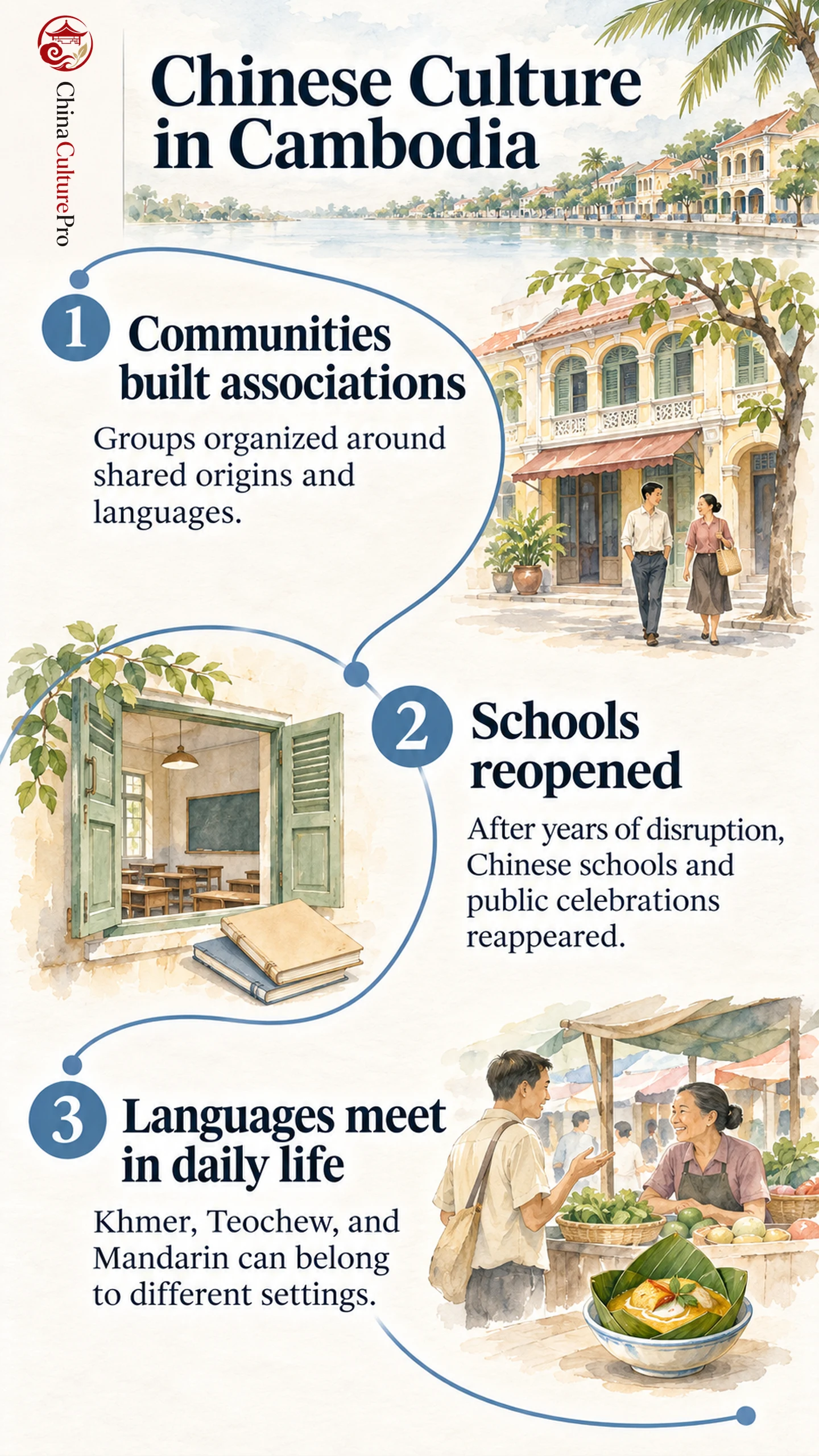
- Community institutions. Phnom Penh had associations linked to regional and language backgrounds.[1][2]
- Disruption and revival. The Khmer Rouge period devastated communities. Schools and public celebrations began to reappear in the following decades.[2][3]
- Language. A person might speak Khmer in public life, use a heritage variety at home, or study Mandarin at school.[1][2]
The combination differs by household, generation, and experience of migration.[1][2]
A Phnom Penh shop sign in Khmer and Chinese, a Mandarin lesson, and a conversation in Teochew can tell different parts of a family’s story. Each belongs to a particular setting.[1][2]
How Communities Organized in Phnom Penh
Researchers trace Teochew, Hokkien, Hakka, Cantonese, and Hainanese associations and schools in Cambodian history. In Phnom Penh, these institutions connected people with shared origins or speech. Their roles can be compared with those of other Chinese diaspora dialect associations.[1][3]
Michiel Verver describes shops in Phnom Penh where some families used Khmer and Chinese on their signs and kept shrines inside. His study shows how commerce and family practice could share the same premises.[2]
What Changed Under the Khmer Rouge and Afterward
The Khmer Rouge period of 1975–1979 devastated Chinese Cambodian families and institutions alongside the wider population. A study of Phnom Penh documents the reopening of Chinese schools and a return to public Lunar New Year celebrations in the early 1990s. Duanhua (端華, Duānhuá) School is one institution discussed in accounts of that recovery.[2][3]
The renewed schools joined a changing community that included established Cambodian Chinese families and newer migrants. Studying Mandarin at school could coexist with speaking Khmer or Teochew in other settings.[1][2][3]
How Khmer and Chinese Speech Meet
A study of Cambodian Teochew documents Khmer words used by speakers of Teochew, including terms for dishes such as amok. It also shows how speakers can adapt borrowed words to a different sound system. This is one example of how Chinese diaspora languages develop through local contact.[1]
Nearby communities have their own histories. The language and association patterns of Chinese communities in Vietnam developed in a different setting.
FAQs About Chinese Culture in Cambodia
Is Cambodian Teochew the same as Mandarin?
Cambodian Teochew is a local variety of Teochew. Mandarin is a separate variety used in some schools. Some people learn both, while Khmer also has a central place in daily life.[1][2]
Does Chinese Cambodian describe only recent arrivals?
It can describe families established in Cambodia across several generations. Recent Chinese migrants also contribute to contemporary Chinese cultural life, with histories that differ from those of older local families.[2][3]
Источники
[1] Robert McFarland, in Sinophone Southeast Asia. Cambodian Teochew and Khmer language contact
[2] Michiel Verver, Cross-Currents. Templates of Chineseness and trajectories of Cambodian Chinese
[3] Lingua Sinica. Cambodia country profile