


Quick Answer: What Did Chinese Comet Records Preserve?
Chinese records describe where a comet (彗星, huìxīng) appeared, how it looked or where it moved. Some give a date. The Mawangdui (马王堆, Mǎwángduī) silk preserves drawings of different comet forms alongside interpretations. A Chinese report from 240 BCE can be confidently associated with Halley’s Comet.[5][3][4]
- The silk shows different shapes of comet heads and tails.[1]
- A chronicle can identify a sighting by a reign year and positions in the sky.[3]
- Modern astronomers can compare such records with calculations of a comet’s orbit.[3][4]
A date and a position usually give a stronger basis for identification than a name such as broom star alone.
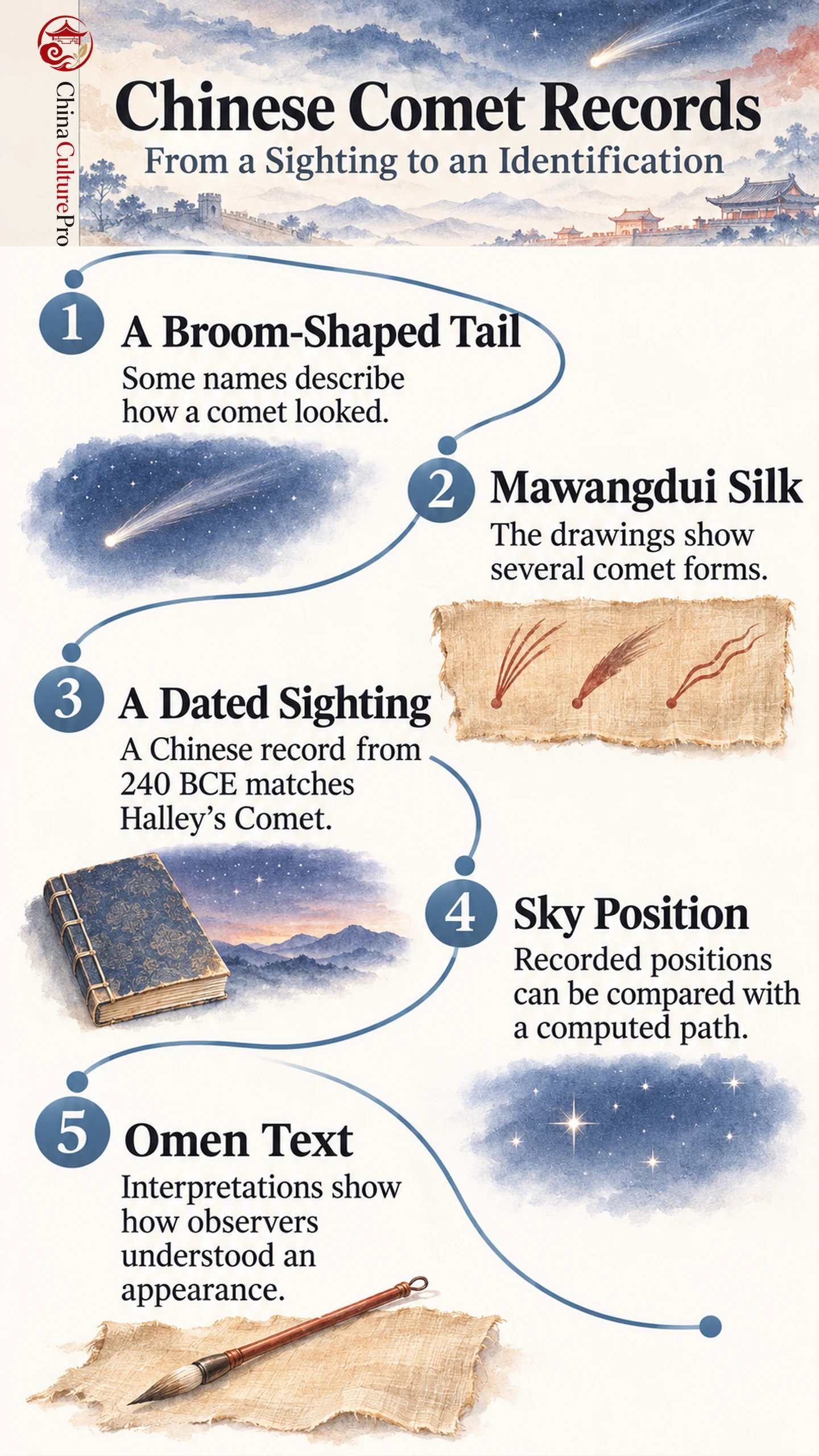
An observer who writes that a broom-shaped star appeared in the east preserves its appearance and a direction. A recorded date and a later position can help turn that description into evidence for a particular comet.
The Comet Drawings from Mawangdui
A silk manuscript recovered from Mawangdui tomb 3 in Changsha records several types of sky and weather phenomena. It includes drawings in which comet heads and tails take different shapes. Text alongside the pictures assigns meanings to the appearances. The manuscript is damaged, and scholars continue to study the readings of parts of it.[1][2]
A drawing can preserve how an observer or compiler distinguished one shape from another. It need not preserve a date or position for the appearance that inspired it.[5]
The Chinese Record from 240 BCE
In a passage concerning the seventh year of the ruler who would become the First Emperor, the Records of the Grand Historian describes a comet appearing first in the east. The reign date converts to 240 BCE. Astronomers comparing the account with the history of Halley’s Comet treat it as an early secure identification.[3][4]
The observers recorded an appearance. The identification as a returning comet came much later, when astronomers compared observations from different years and computed orbits.[3]
How Astronomers Compare Old Sightings
A researcher first has to read the date in its historical system. That can mean converting a reign year and lunar month. Next comes the reference area in the sky, which may draw on star groupings familiar to the writer. Duration, motion or changes in appearance give additional clues. Several details can be compared with a calculated path and with independent reports.[4]
The history of Chinese calendrical astronomy helps explain those dates. Accounts of celestial globes show another way to represent the sky, while eclipse records offer a comparison with phenomena whose times can be calculated in a different way.
What the Omen Text Adds
A compiler could include a description of a comet and an interpretation of what it foretold. The interpretation helps explain why the sighting mattered to that writer. The location, dates and appearance carry a different kind of evidence for the study of Chinese astronomy.[1] The distinction also helps in reading historical accounts and traditional stories.
FAQs About Chinese Comet Records
Did Chinese observers identify the comet as Halley’s in 240 BCE?
They recorded a comet appearance. Astronomers identified it as part of Halley’s sequence of returns much later.[3]
Does the Mawangdui silk give an orbit for each comet?
It preserves visual forms and accompanying interpretations. The drawings alone do not provide the time and position data needed for an orbit.[1][2]
Why do some records call a comet a broom star?
Several Chinese terms refer to the appearance of the tail. A tail could recall the shape of a broom.[1]
Источники
[1] National Taiwan University, Center for the Advancement of Science Education. Ancient comet observations and the characters for brooms and comets
[2] Fudan University, Center for Excavated Texts and Paleography. Notes on the Mawangdui astronomical manuscripts
[3] American Astronomical Society. This Month in Astronomical History: May
[4] F. Richard Stephenson and Kevin K. C. Yau. Far Eastern observations of Halley’s Comet
[5] Smithsonian and NASA educational archive. Ancient eclipses and the historical record